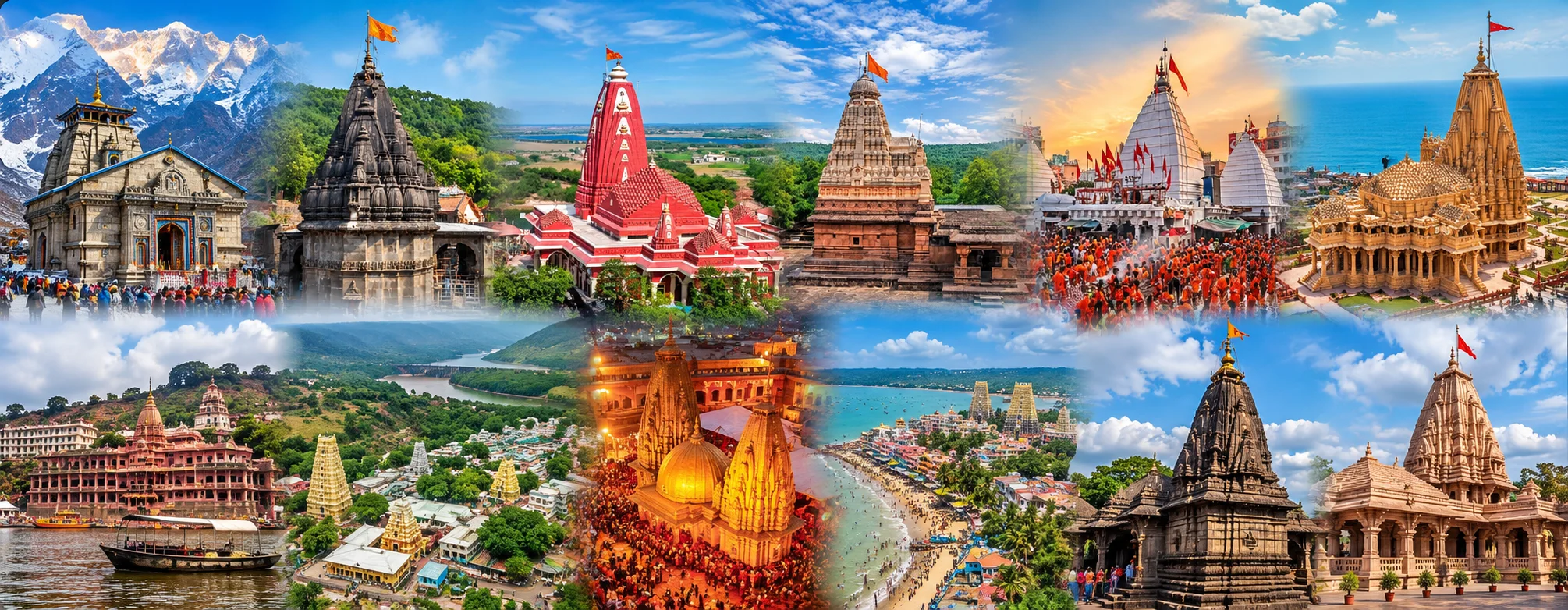

01 / INTRODUCTION
Dvādaśa Jyotirlingas
Twelve lights of Śiva
Śivāya Namaḥ
This simple movement—from darkness towards light, from the unseen towards the revealed—contains the essence of the Jyotirlinga tradition.
Among the innumerable sacred places of Bhārata, the twelve Jyotirlingas occupy a place of exceptional reverence. They are remembered as a site of manifestation, a kṣetra where Śiva disclosed His presence as jyotis: self-luminous, immeasurable and without beginning or end.
To enter the world of the Jyotirlingas, therefore is to enter the understanding of Śaiva, our existence itself. It is more than a study of the history of twelve temples.
Śiva is at once the stillness behind movement and the power within it. He is the ascetic seated in unfathomable meditation and the compassionate householder beside Umā. He is the lord of mountains, forests, rivers, cremation grounds and cities. He dissolves forms, yet He is called Śaṅkara, “the one who brings auspiciousness.” He is fierce as Rudra, gentle as Śambhu, sovereign as Maheśvara, intimate as the liṅga worshipped in the home, and boundless as the pillar of light that neither Brahmā nor Viṣṇu could measure.
Such apparent opposites are not contradictions to be resolved. They are the signs of a reality too complete to be confined within a single image.
02 / THE TWELVE SHRINES
The twelve Jyotirlingas.
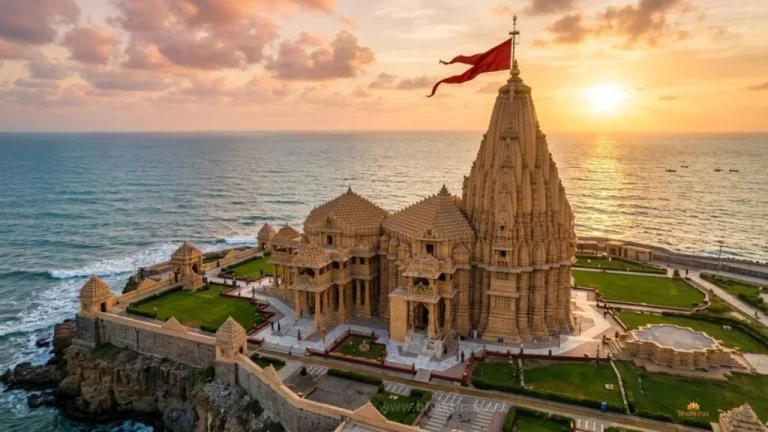
- SomnathPrabhas Patan, near Veraval, Gujarat
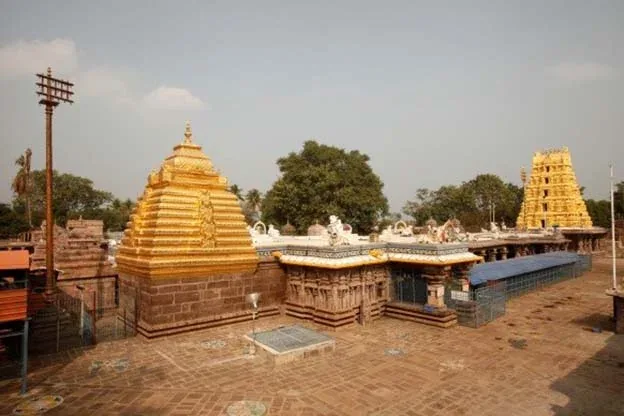
- Srisailam MallikarjunaSrisailam, Nallamala hills, Andhra Pradesh
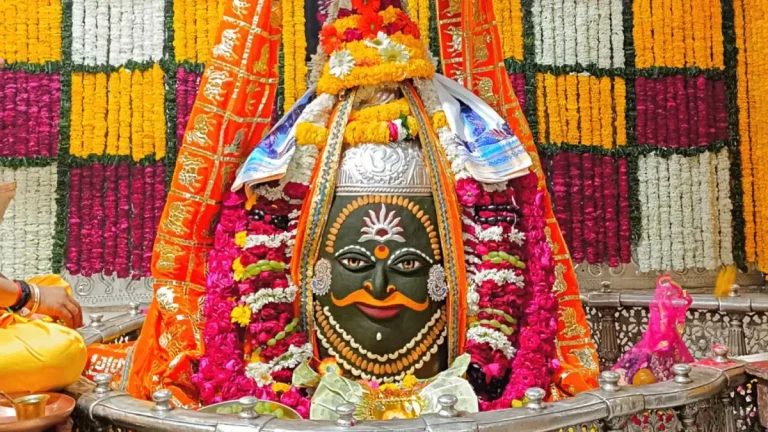
- MahakaleshwarUjjain, Madhya Pradesh
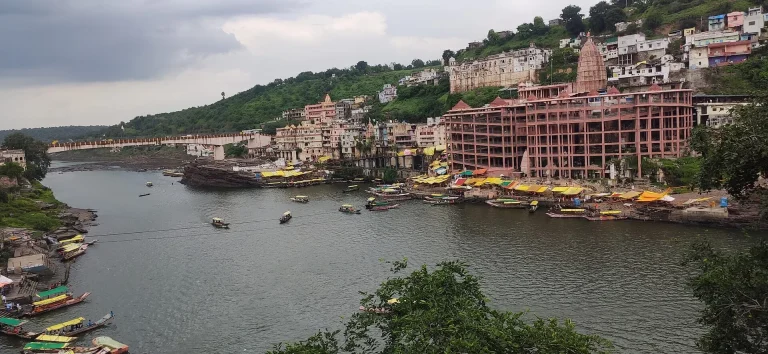
- Omkareshwar–MamleshwarMandhata island, Omkareshwar, Madhya Pradesh
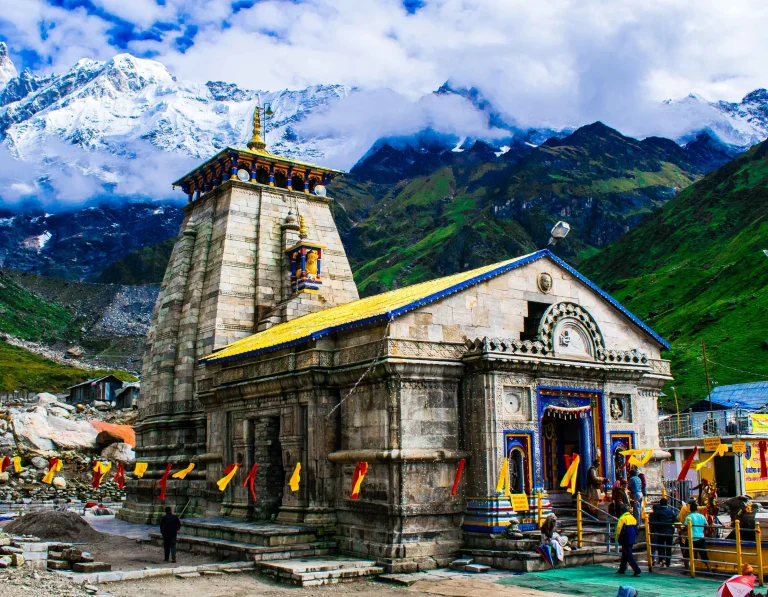
- KedarnathKedarnath, Rudraprayag district, Uttarakhand
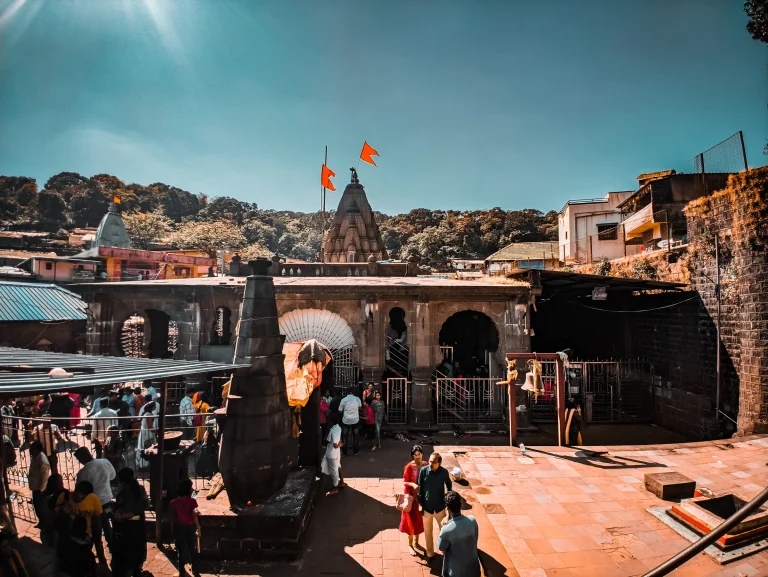
- BhimashankarBhimashankar, Sahyadri range, Maharashtra
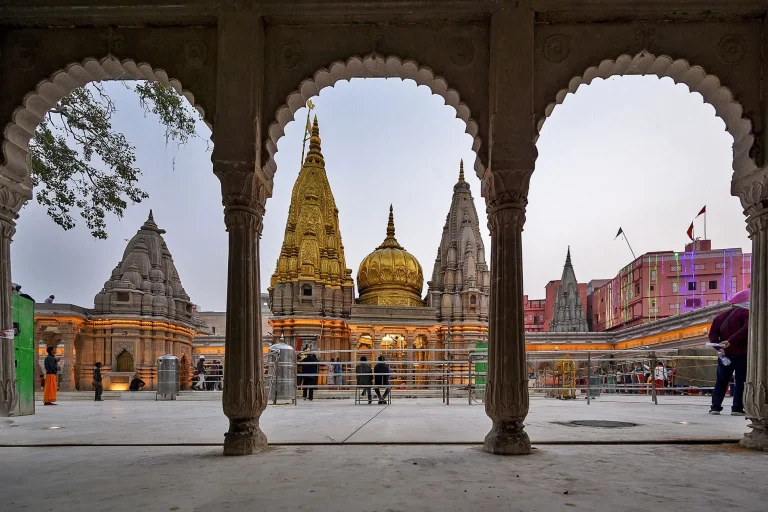
- Kashi VishwanathVaranasi, Uttar Pradesh
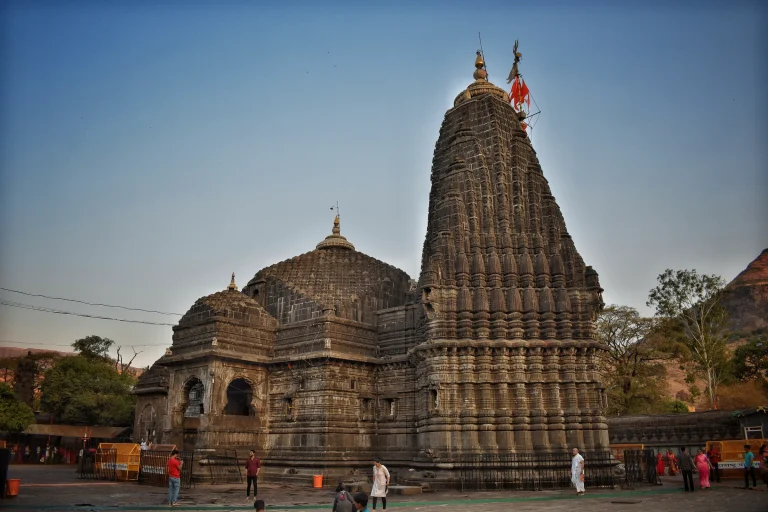
- TrimbakeshwarTrimbak, near Nashik, Maharashtra
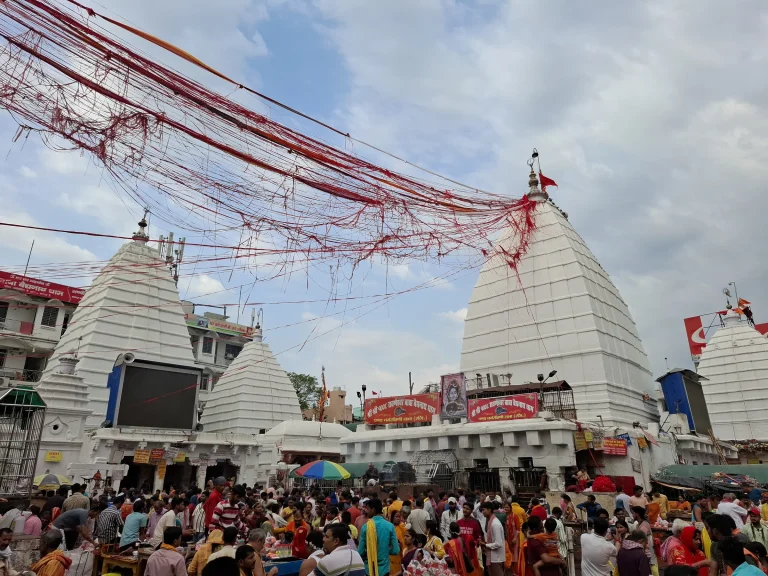
- VaidyanathaDeoghar, Jharkhand
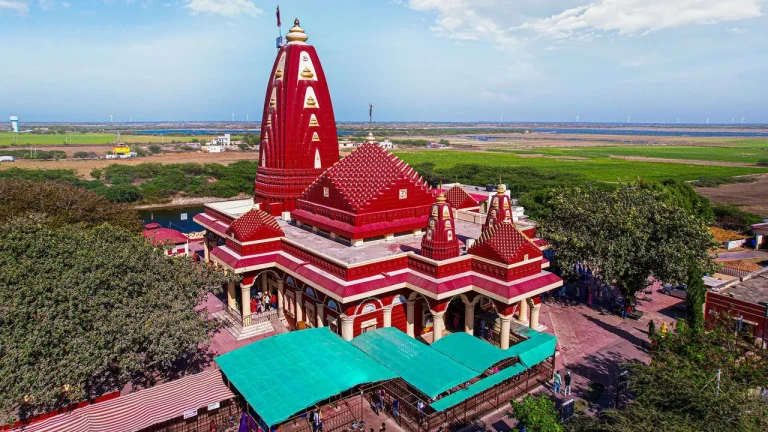
- NageshwarNear Dwarka, Gujarat
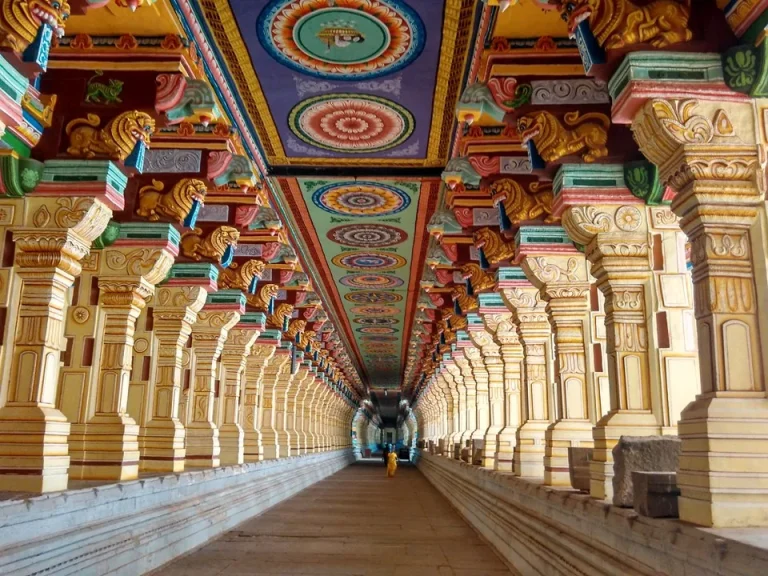
- RameswaramRameswaram, Pamban Island, Tamil Nadu
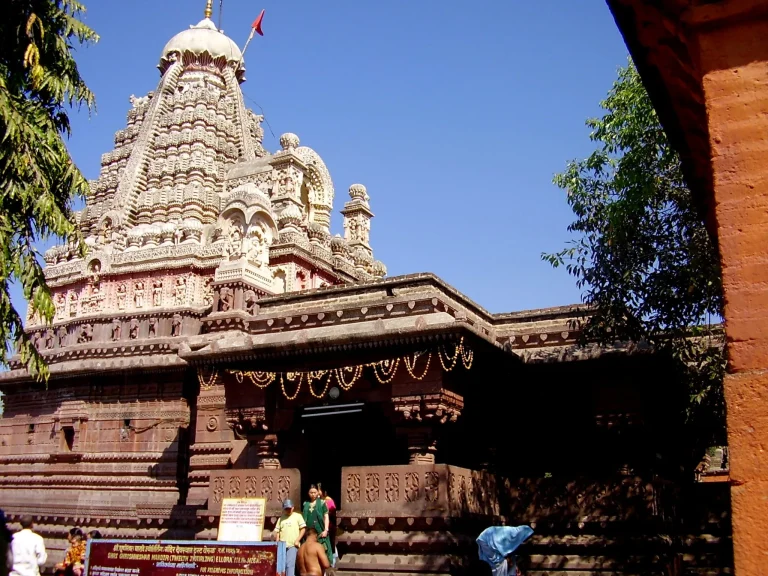
- GhrishneshwarVerul, near Ellora, Maharashtra
03 / ŚAIVISM: A LIVING CIVILISATIONAL TRADITION
Śaivism: A Living Civilisational Tradition
The traditions associated with Śaivism are so rich that they cannot be confined to one sect, one philosophy, one geographical region or one period of Indian history. It is a vast family of traditions united by the recognition of Śiva as supreme deity, liberating consciousness, cosmic lord, inner self, or the ultimate ground of being.
Its foundations extend to the Vedic Rudra: formidable, healing, sovereign over beings and medicines, feared for His arrows and invoked for protection. Across the centuries, Rudra-Śiva became the centre of devotional, ascetic, ritual, philosophical and artistic worlds of extraordinary depth.
The Śaiva textual heritage reveals this remarkable diversity. It includes traditions of public devotion, temple worship and pilgrimage; the ascetic disciplines of the Paśupatas and other Atimārga orders; the ritual and initiatory systems of the Mantramārga; the theological and liturgical traditions of Śaiva Siddhānta; the subtle philosophies of recognition and consciousness that flourished in Kashmir; the Tamil hymns of the Nāyaṉmārs; and many regional forms through which communities encountered Śiva in their own languages and landscapes.
Śaivism became one of the most influential religious forces across the Indian subcontinent and large parts of Southeast Asia. Its literary record expanded greatly from the fifth century onwards, preserving instructions on devotion, ethics, initiation, yoga, metaphysics, temple construction, consecration and liberation.
As is the current problem with colonial scholarship, its history should not be told as though an allegedly “primitive” form of worship slowly acquired philosophy and refinement. The distinction between worship, philosophy and sacred art belongs largely to modern systems of classification. Within the Śaiva world, a mantra may contain a complete metaphysics; a ritual gesture may express a doctrine of consciousness; a temple may embody cosmology; and a pilgrimage may become an inward discipline.
The devotee who pours water over the liṅga is not merely performing an external action. The offering remembers the descent of grace, the cooling of inner agitation, the cleansing of accumulated limitation and the return of the individual being to its source.
04 / THE LIṅGA: THE SIGN OF THE FORMLESS
The Liṅga: The Sign of the Formless
Few sacred forms have been more frequently misunderstood than the Śivaliṅga.
The Sanskrit word liṅga means a mark, sign, characteristic or indication—something through which an otherwise unseen reality becomes known. The liṅga does not claim to portray the physical appearance of Śiva. It reveals Him through a form that points beyond form.
Its upward movement suggests the axis joining earth and heaven. Its rounded, unbroken surface resists the boundaries of ordinary representation. It has no front or back, no single expression and no exclusive direction from which it must be approached. It allows Śiva to be present without reducing Him to one bodily image.
The liṅga may be worshipped as stone, earth, crystal, metal, light, water, mountain or space. It may be ritually installed by human hands or revered as svayambhū, self-manifested. In many temples, it is inseparable from its base, the pīṭha or yoni, signifying Śakti—the power through which consciousness becomes creation. Śiva is not an inactive absolute removed from the universe; through Śakti, He appears as the universe while remaining greater than every appearance.
Colonial and narrowly materialist interpretations often flattened the liṅga into a single biological explanation. Such readings ignored the theological, ritual and philosophical worlds in which it has been worshipped. Generative symbolism is certainly not absent from Indian thought, but generation itself is understood cosmically: the emergence of names and forms from the union of consciousness and power.
The liṅga is thus not a representation of one object within creation. It is the sign of that from which all objects, beings and worlds arise.
05 / WHEN THE LIṅGA BECAME LIGHT
When the Liṅga Became Light
The deepest meaning of the Jyotirlinga is disclosed through the celebrated account of the infinite column of fire.
Brahmā and Viṣṇu, each seeking the limits of Śiva’s manifestation, travelled in opposite directions. Viṣṇu descended in search of its base; Brahmā rose in search of its summit. Neither could find an end. The fiery column exceeded the reach of movement, perception and measurement.
This is not simply a tale about the superiority of one deity over others. It is a revelation concerning the limits of conditioned knowledge. The finite mind attempts to comprehend the infinite by travelling outward, measuring distance, naming forms and claiming mastery. Yet the source of awareness cannot be grasped as though it were another object placed before the observer. The infinite is known when pride falls silent.
A Jyotirlinga is therefore a liṅga of radiance—not because the stone must emit visible light, but because the form reveals the self-luminous consciousness by which all things are known. The sun illumines the world, but consciousness illumines even the sun. Śiva as jyotis is that light which does not depend upon another light in order to be seen.
Each Jyotirlinga preserves the memory of such a manifestation. In the narratives associated with them, Śiva appears in response to tapas, devotion, danger, illness, cosmic disturbance, moral crisis or the longing of a devotee. The circumstances differ, but the movement is the same: human limitation encounters divine infinitude.
The Lord who is beyond place consents to be present in a place. The One who cannot be contained allows Himself to be approached through a sanctum. The immeasurable becomes intimate.
This is the grace at the heart of the Jyotirlinga.
06 / TWELVE LIGHTS ACROSS BHāRATA
Twelve Lights Across Bhārata
The twelve shrines form a sacred journey across the varied body of Bhārata.
At Somnātha, the western sea meets a shrine associated with the waxing and waning moon, reminding the pilgrim that decline need not end in extinction and that renewal follows surrender.
At Mallikārjuna in Śrīśailam, Śiva and the Goddess are remembered amid forested hills, where parental compassion, devotion and the fragrance of jasmine enter the sacred identity of the place.
At Mahākāla in Ujjayinī, Śiva is Lord of Time and of that which devours time. In a city historically associated with astronomy and the reckoning of celestial movement, Mahākāla declares that every measure of time finally rests in the timeless.
At Oṁkāreśvara, the Narmadā flows around the island-sanctuary, and the sacred syllable Oṁ is contemplated not only as sound but as geography, movement and divine presence.
Kedāranātha rises in the Himalayas, where pilgrimage itself becomes austerity. The mountains strip the traveller of haste and entitlement. There, the landscape does not serve merely as a setting for worship; the mountain, snow, silence and difficult ascent participate in it.
Bhīmaśaṅkara, Tryambakeśvara and Gṛṣṇeśvara belong to the sacred worlds of the western and Deccan landscapes, where river sources, hills, caves, temple settlements and regional memories join the worship of Śiva.
Viśvanātha at Kāśī is the Lord of the Universe encountered in the city of liberation. Here death is not hidden from sacred life. The burning ghats and the ringing bells stand within the same field of vision. Kāśī teaches that impermanence, faced without evasion, can become a doorway to freedom.
Vaidyanātha is remembered as Śiva the divine physician, the healer not only of bodily affliction but of the deeper disease of separation from the sacred.
Nāgeśvara evokes Śiva’s sovereignty over fear, poison and the serpent powers associated with death, regeneration and awakened energy.
At Rāmeśvara, the pilgrimage reaches the southern sea. The shrine binds the worship of Śiva to the sacred memory of Rāma, reminding us that the devotional worlds of Bhārata were never as rigidly divided as later labels sometimes suggest.
Together, these shrines stretch across coasts, river valleys, mountains, forests, plateaus and cities. Their unity does not erase their regional character. Each has its own language of worship, architectural history, seasonal celebrations, culinary offerings, musical traditions, priestly lineages and local narratives. Śiva is one, yet His presence does not demand sameness.
The literature of Śaivism gave great importance to the creation and maintenance of temples, support for sacred institutions and the celebration of holy places. Purāṇic and regional māhātmyas praised entire sacred landscapes—Himalayan regions, Kāśī, Avanti, Prabhāsa, the Sahyādri ranges and numerous local kṣetras. These writings did not treat geography as spiritually empty land upon which religion was later imposed. Rivers, mountains, forests and settlements were understood as participants in sacred memory.
The tradition also travelled through language. Śaiva teachings were conveyed not only in learned Sanskrit but in Tamil, Telugu and other regional languages, enabling sacred knowledge to remain rooted in living communities rather than confined to a narrow intellectual class. The Śivadharmottara itself recognises the responsibility of the teacher to communicate through languages appropriate to the listener.
07 / SACRED GEOGRAPHY AND THE SUGGESTION OF A SPIRAL
Sacred Geography and the Suggestion of a Spiral
When the locations of the twelve Jyotirlingas are placed upon a map, modern observers sometimes trace between them a spiral or a succession of expanding curves. To some eyes, the arrangement recalls the form of a śaṅkha, the sacred conch; to others, it resembles the logarithmic spirals associated today with Fibonacci numbers.
The resemblance is compelling enough to invite contemplation, but it must be approached with intellectual honesty. No presently established inscription, architectural manual or early textual source proves that the twelve shrines were selected or built according to a single Fibonacci-based geographical design. Some of the sacred sites are unquestionably ancient, yet their temples have been rebuilt, expanded and re-identified across many centuries. Even the precise identification of a few Jyotirlinga locations has been preserved through differing regional traditions.
Yet refusing an unproven claim does not require us to dismiss the question itself.
Indian civilisation possessed sophisticated traditions of geometry, astronomical observation, calendrical calculation, architecture, prosody and combinatorial mathematics. Pingala’s analysis of Sanskrit metres laid an early foundation for the study of patterned combinations. Later scholars such as Virahāṅka, Gopāla and the Jain polymath Hemacandra articulated numerical recurrences equivalent to what Europe would eventually associate with Leonardo Fibonacci.
The sequence 1, 1, 2, 3, 5, 8, 13 and onward is thus not foreign to the intellectual history of Bhārata. Nor was geometry confined to abstract calculation. Number, rhythm, proportion and orientation shaped poetic metres, ritual altars, temple plans, calendars and visual art.
The śaṅkha offers an especially meaningful image. Its spiral seems to grow while remaining faithful to an unseen order. Its sound announces worship, drives away inauspiciousness and recalls primordial vibration. It begins in inward silence and expands into audible space.
Could a circuit of Jyotirlingas be contemplated in a similar way—as light unfolding through the land?
We cannot claim certainty. We may, however, permit the map to awaken a more important recognition: the sacred sites of Bhārata were never experienced as isolated points. They belonged to networks of rivers, pilgrimage paths, seasonal journeys, temple towns, monastic institutions, oral histories and celestial orientations. Sacred geography was relational.
A kṣetra was not holy merely because a structure stood there. The temple, water source, mountain, tree, legend, ritual calendar and community together formed the sacred place.
The spiral, whether intentional design or contemplative resemblance, becomes valuable when it restores this civilisational way of seeing. It encourages us to look at Bhārata not as a blank political outline divided into administrative units, but as a living body marked by journeys of remembrance.
08 / PILGRIMAGE AS INNER REORIENTATION
Pilgrimage as Inner Reorientation
A journey to the Jyotirlingas is measured in kilometres, but its meaning cannot be calculated by distance alone.
The pilgrim leaves behind familiar arrangements. Weather intervenes. The body tires. Plans change. One waits in long queues, walks barefoot on hot stone, bathes before sunrise, climbs difficult paths and shares space with strangers from distant regions. The imagined boundary between private devotion and collective life begins to soften.
Pilgrimage trains the body in humility.
At every shrine, the devotee encounters the same Śiva and yet not the same experience. At one place He is the healer; at another, the lord of time. Here He is found beside a river; there, beneath Himalayan snow. He is approached through Vedic recitation, regional song, silent meditation, elaborate abhiṣeka, a handful of water or the repetition of His five-syllabled mantra.
The outer journey gradually discloses an inner map.
Somnātha may become the restoration of hope. Mahākāla may become freedom from the fear of time. Kedāra may become endurance. Viśvanātha may become acceptance of mortality. Vaidyanātha may become healing. Rāmeśvara may become reconciliation. Oṁkāreśvara may become the return of scattered thought to its primal sound.
The pilgrim begins by seeking twelve places. In time, the twelve places begin to reveal one presence.
09 / THE LIGHT THAT AWAITS RECOGNITION
The Light That Awaits Recognition
This book is an invitation to enter that presence.
Its pages travel through architecture, sculpture, ritual, sacred narrative, regional history and landscape. They honour the artisans who carved stone, the rulers and communities who rebuilt temples after destruction, the priests who maintained daily worship, the ascetics who guarded lineages, the poets who sang of Śiva, and the countless unnamed pilgrims whose footsteps kept these routes alive.
The Jyotirlingas have witnessed splendour and devastation, royal patronage and foreign assault, neglect and renewal. Yet their continuity does not belong to stone alone. Temples survive because remembrance survives. A sanctum may be damaged and rebuilt, but the sacred relationship between deity, land and devotee can endure across generations.
To approach these shrines only as archaeological remains would be to miss their living heart. To approach them only through emotion, without regard for history, would also leave their story incomplete. The Jyotirlingas call for a fuller vision—one in which devotion does not fear scholarship, and scholarship does not strip the sacred of meaning.
They stand at the meeting point of visible and invisible worlds. Stone receives light. Geography becomes theology. Journey becomes discipline. Memory becomes presence.
Ultimately, the Jyotirlingas are reminders that the infinite may be encountered through the particular, that the eternal may reveal itself within time, and that light need not arrive from somewhere outside us.
It may already be present, waiting beneath the noise of the mind. The pilgrimage begins when we turn towards it.
ABOUT THIS FIELD ENTRY
Rooted in the Bharat Ke Wow archive.
This page is part of the Bharat Ke Wow series on the Dvādaśa Jyotirlingas. Sacred narratives are presented as temple tradition.
Read the original entry ↗