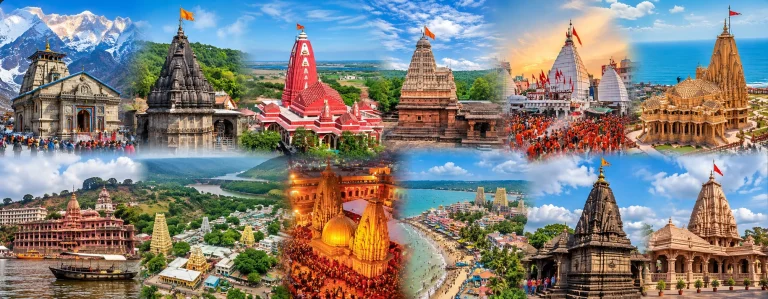


01 / INTRODUCTION
Kedarnath
The Jyotirlinga of the Himalayas
हिमाद्रिपार्श्वे च तटे रमन्तं सम्पूज्यमानं सततं मुनीन्द्रैः ।
सुरासुरैर्यक्षमहोरगाद्यैः केदारमीशं शिवमेकमीडे ॥
I praise Shiva as Kedareshvara, who delights upon the slopes of the Himalayas and is eternally worshipped by great sages, devas, asuras, yakshas, nagas and all beings.
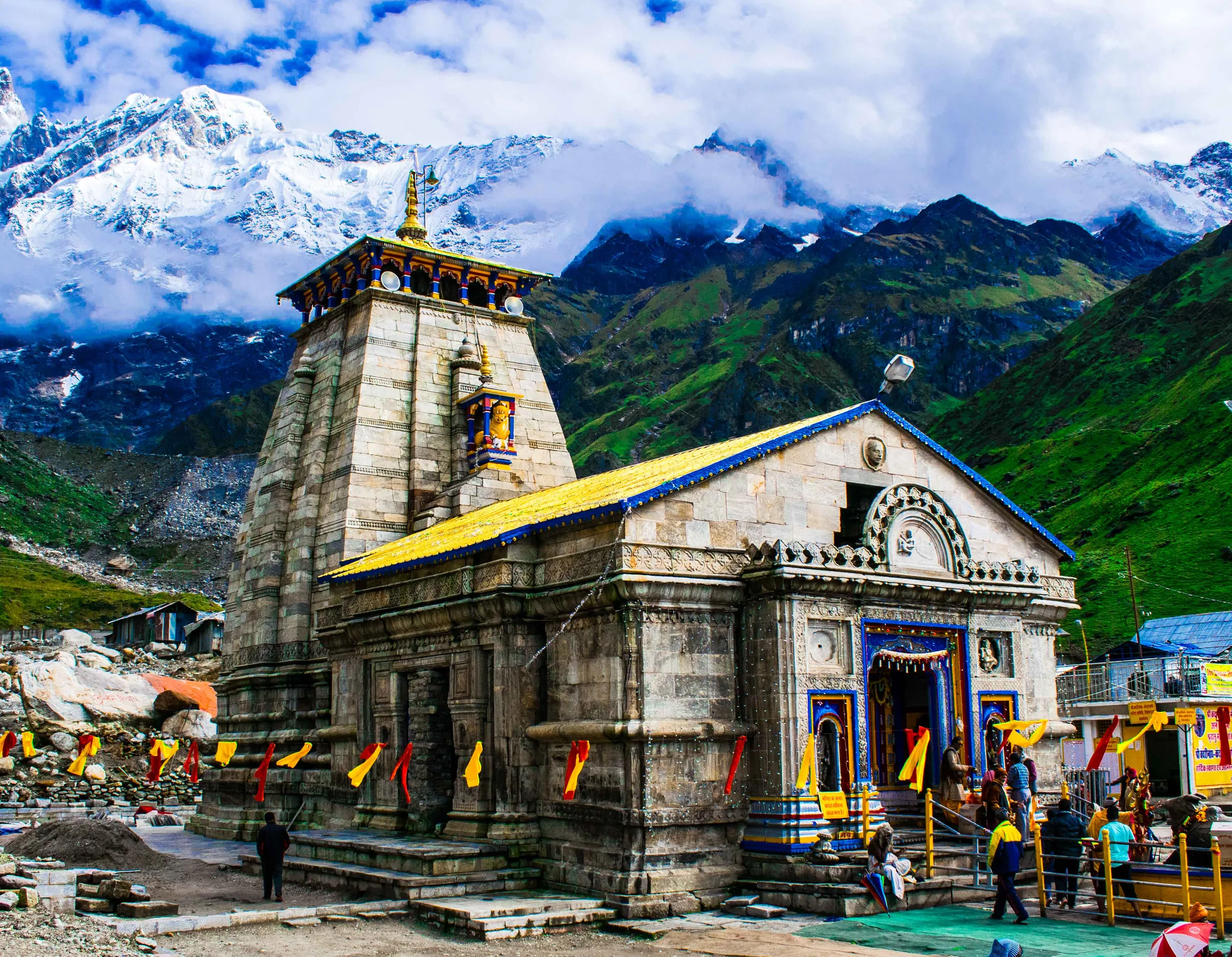
There are temples one approaches through streets, gateways and pillared corridors. Kedarnath is approached through the Himalayas themselves. Long before the stone shrine appears, the pilgrimage has already begun—in the climb from the Mandakini valley, in the thinning air, in the sudden change of weather and in the silence that settles between one footstep and the next. By the time the pilgrim sees the grey temple standing beneath walls of snow and rock, the distinction between landscape and sanctum has almost disappeared. The mountain seems to have gathered itself into a shrine, and the shrine appears to be an extension of the mountain.
Situated in the Rudraprayag district of Uttarakhand at an elevation of roughly 3,580 metres, Kedarnath is the highest of the twelve Jyotirlinga shrines. It stands near the headwaters of the Mandakini River, surrounded by the formidable peaks of the Garhwal Himalayas. The region was traditionally known as Kedara-khanda, the sacred domain of Kedara. For much of the year, deep snow isolates the shrine from the ordinary world. This seasonal isolation is not merely a practical circumstance; it has shaped the worship, rhythm and imagination of Kedarnath for centuries.
Among the Jyotirlingas, Kedarnath has a character entirely its own. The Linga is not a polished cylindrical form placed upon a conventional pedestal. It is a dark, irregular, upward-rising stone, traditionally understood as the hump of Shiva in the form of a bull. During the morning worship, the sacred form may be touched, bathed and anointed, creating an unusually intimate encounter between pilgrim and deity after the long and difficult ascent.
Kedarnath is also part of several sacred networks at once. It is one of the Dvadasha Jyotirlingas, one of Uttarakhand’s Chota Char Dham, and the principal shrine of the Panch Kedar, the five Himalayan manifestations of Shiva associated with the Pandavas. It is closely linked with Badrinath, the abode of Vishnu as Nara-Narayana, and with Adi Shankaracharya, whose memory remains inseparable from the revival of Himalayan pilgrimage. Kedarnath therefore becomes a meeting place of Shaiva and Vaishnava devotion, Purana and epic memory, rigorous tapas and tender grace.
The very name Kedarnath is understood as “the Lord of Kedara.” The Sanskrit word kedara may refer to a field, cultivated land or land nourished by water. In the sacred imagination, however, the meaning deepens. Kedara becomes the field in which the seed of spiritual effort is sown and the harvest of liberation is gathered. This is especially fitting for a shrine where every step demands effort. The pilgrim brings fatigue, fear, hope, remorse and prayer to this sacred field, and what grows from them depends upon the sincerity with which they are offered.
The mountain setting reinforces another ancient understanding of Shiva. He is the Lord who dwells beyond the settled world—among peaks, forests, rivers and spaces where ordinary identities fall away. Yet He is also Ashutosha, the One who is quickly pleased, and Bhaktavatsala, tender towards those who seek Him. Kedarnath holds these two aspects together. The approach is severe; the welcome, once received, is profoundly compassionate.
02 / SACRED ORIGIN / STHALA PURANA
Sacred Origin / Sthala Purana
The principal Puranic account of Kedareshvara is preserved in the Shiva Purana, Kotirudra Samhita, and begins not with the Pandavas but with Nara and Narayana, the twin sages and manifestations of Vishnu. At Badarikashrama, they performed intense tapas directed towards Shiva. Each day they fashioned a parthiva linga, a form of Shiva made from earth, and worshipped it with unwavering concentration and devotion.
The use of an earthen Linga carries a profound symbolism. A parthiva linga is created from the earth, worshipped and ultimately returned to the elements. It expresses the simple truth that the Divine may be invoked through even the humblest material when the mind is steady and the heart sincere. Nara and Narayana, themselves divine manifestations, did not consider the worship of Shiva unnecessary. Their tapas instead reveals a harmony between traditions: Vishnu worshipping Shiva and Shiva responding with grace.
Day after day, Nara and Narayana continued their worship without demanding a vision or a sign. At last, pleased by their unwavering discipline, Shiva manifested before them and invited them to ask for a boon. The sages did not seek celestial pleasures or extraordinary powers. They asked that Shiva remain permanently in that sacred region for the welfare of all beings.
Shiva accepted their prayer and established Himself as Kedareshvara Jyotirlinga. Thus, according to this account, Kedarnath was born from tapas performed not for oneself but for the world. The shrine stands because two sages asked the Lord to remain where future generations could approach Him. Their prayer transformed a remote Himalayan landscape into an enduring tirtha.
The Shiva Purana further praises the fruits of remembering and worshipping Kedareshvara, describing the devotee as being freed from distress and lifted beyond the cycle of rebirth through sincere worship and the sanctity of the tirtha. These descriptions are best understood within the spiritual vision of pilgrimage rather than as a mechanical transaction. The mountains do not flatter the pilgrim; they strip away distraction. In that vulnerable state, remembrance can become deeper than years of casual worship.
The Nara-Narayana tradition also explains the intimate relationship between Kedarnath and Badrinath. The two shrines are not rival centres placed on opposite sides of a sectarian boundary. They belong to a shared sacred landscape. Badrinath remembers the tapas of Nara and Narayana, while Kedarnath remembers the Shiva who answered that tapas. For many traditional pilgrims, worship at both shrines represents a completion: the seeker bows to Vishnu, who worshipped Shiva, and to Shiva, who remained because of Vishnu’s prayer.
03 / SACRED LEGENDS
Sacred Legends
The best-known legend of Kedarnath is associated with the Pandavas after the Kurukshetra war. They had won a kingdom, but victory brought no peace. The battlefield had been filled with the deaths of relatives, teachers, friends and countless warriors. Dharma had required terrible action, yet the burden of that action remained. The Pandavas understood that royal success could not erase moral pain, and they sought Shiva, hoping for forgiveness and freedom from the weight of violence.
The Mahabharata’s pilgrimage traditions know Kedara as a sacred tirtha and celebrate the purifying power of difficult holy places. The detailed account of Shiva assuming the form of a bull, however, belongs principally to Puranic, regional and pilgrimage traditions associated with the Himalayan Kedar region. This distinction is important because it reveals how sacred memory develops around a place, with epic characters, local geography and theological teaching woven together until the landscape itself becomes a narration.
According to the cherished tradition, the Pandavas first searched for Shiva in Kashi. Shiva, unwilling to grant them an easy meeting, withdrew towards the Himalayas. He did not reject them forever; rather, He required that their repentance become a journey. The brothers followed Him northwards, through the region now associated with Guptakashi, the “hidden Kashi,” where the Lord concealed Himself.
Shiva then assumed the form of a powerful bull and mingled with a herd. Bhima, whose strength had decided many moments during the war, sensed that this was no ordinary animal. In one popular telling, he stretched his legs across the mountain path so that the herd would have to pass beneath him. Every animal moved through except one. Bhima recognised Shiva and reached for the bull.
At that moment, the bull began to sink into the earth. Bhima seized its hind portion, but the Lord disappeared beneath the ground. The hump remained visible at Kedarnath. Other portions manifested at four further places: the arms at Tungnath, the face at Rudranath, the navel and middle portion at Madhyamaheshwar, and the matted locks at Kalpeshwar. Together, these five shrines became the Panch Kedar. A related tradition associates the head of the bull with Pashupatinath in Nepal, extending the sacred body of Shiva across the Himalayan world.
The story is sometimes told as a dramatic chase, but its deeper movement is inward. The Pandavas cannot command Shiva to appear merely because they are heroic kings. Their power, reputation and past achievements are of no use. Bhima’s physical strength can hold the bull for a moment, but it cannot possess the Divine. Shiva reveals Himself only after pride gives way to repentance.
The form left at Kedarnath is the hump—the part of the animal that bears weight. The symbolism is striking. The Pandavas arrived carrying the unbearable weight of war, and Shiva manifested as the very form that carries burdens. In worshipping the hump, they placed their burden upon Him—not to deny responsibility, but to transform remorse into penance and service. Forgiveness here is not forgetfulness. It is the grace that allows a person to continue after seeing clearly what has been done.
Tradition holds that the Pandavas established worship at the five Kedar shrines and performed yajna and tapas before beginning their final northward journey. Their story gives Kedarnath a special place for those who live with regret. The shrine does not ask whether one’s life has been untouched by error. It asks whether one is willing to climb, to bow and to become truthful in the presence of Shiva.
04 / HISTORICAL JOURNEY
Historical Journey
The historical identity of Kedarnath is inseparable from the sacred geography of Kedara-khanda, the Himalayan region described in the Skanda Purana as one of Shiva’s beloved realms. In this sacred geography, rivers, glaciers, caves, meadows and peaks are not merely scenery surrounding a temple. Each forms part of the tirtha, and the journey between them becomes a form of worship.
The Mandakini River forms the living axis of the Kedarnath valley. Emerging from the glacial region, it accompanies the pilgrim through much of the journey. Its waters can appear gentle, yet the river can become fierce during extreme weather. Within the sacred imagination of Kedarnath, the Mandakini carries both blessing and warning, reminding the pilgrim that the Himalayan landscape is simultaneously nurturing and formidable.
The earliest history of the present temple structure remains uncertain. Tradition attributes an original shrine to the Pandavas and credits Adi Shankaracharya with reviving or rebuilding the temple and restoring the pilgrimage in the early medieval period. The present structure has undergone repair and renewal across many generations. Rather than assigning every surviving stone to one particular moment, the temple is better understood as a living structure preserved through successive generations of priests, rulers, pilgrims and craftsmen.
The memory of Adi Shankaracharya is particularly strong at Kedarnath. Behind the temple stands the memorial associated with the Acharya, who, according to hagiographical traditions, reached the Himalayan shrine and attained mahasamadhi there. The precise historical details surrounding his final departure are preserved differently across traditions, but Kedarnath firmly maintains his association with the sacred mountain.
The priestly traditions of Kedarnath themselves reflect the wider unity of Bharat. The chief priestly tradition is associated with southern India and with the line of Jangama or Veerashaiva priests connected by tradition with arrangements attributed to Adi Shankaracharya. At the same time, local priestly families guide pilgrims, preserve genealogical connections and perform worship on their behalf. A Himalayan shrine is thus served through traditions that connect Garhwal with the far south of India.
05 / TEMPLE ARCHITECTURE
Temple Architecture
The first sight of Kedarnath Temple is unforgettable precisely because the building does not attempt to compete with the mountains. It stands low and solid upon a broad stone platform, its grey walls rising with a severe simplicity that perfectly suits its surroundings. Behind the shikhara, the Himalayan peaks soar far above the temple. At many monumental temples, architecture creates the impression of a cosmic mountain. At Kedarnath, the actual mountain is already present; the temple needs only to mark the place of encounter.
The temple is constructed from massive, carefully dressed stone slabs fitted together with remarkable precision. The scale and weight of the masonry are particularly striking in a region where transportation has always been difficult. Its broad platform raises the shrine above the surrounding ground, while its thick walls and compact form respond naturally to the snow, wind and cold of the high Himalayas. Its beauty does not depend upon excessive ornamentation. It comes instead from proportion, endurance and restraint.
A large stone Nandi faces the entrance, watchful and patient. The outer doorway is framed with carved forms and seasonal decoration, while the assembly hall contains images connected with Shiva, Parvati, Krishna, Kunti and the Pandavas. The legends associated with the shrine therefore gather physically around the pilgrim as one enters the temple.
The sanctum is comparatively small and dark. There, rising directly from the ground, is the natural, uneven form of Kedara. The Linga is sometimes described as conical or triangular, but such words capture only its outline. It does not appear manufactured. Its surface seems to belong to the mountain itself. This is one reason Kedarnath feels different from many other shrines: the devotee is not merely shown a symbol of Shiva but brought before a piece of living rock understood as a self-manifested presence.
The temple’s inner spaces are modest, and during crowded periods darshan may last only moments. Yet that brevity can sharpen attention. A pilgrim who has walked for many hours may have only a few seconds near the sacred form. In those seconds, the stone, the fragrance of ghee and incense, the chanting of mantras and the warmth of bodies gathered in the cold sanctum combine into an experience beyond elaborate description.
Behind the temple, the memorial associated with Adi Shankaracharya provides another layer to the architectural and spiritual landscape. The shrine and the memorial stand together beneath the Himalayan peaks, creating a visual reminder of the Acharya’s long journey across Bharat and his role in renewing sacred centres of worship.
06 / SPIRITUAL SIGNIFICANCE
Spiritual Significance
Kedarnath is especially associated with repentance, purification and release from burdens. The story of the Pandavas gives this spiritual meaning a human face. Even those who fought for dharma were not untouched by sorrow. They did not use righteous intention as an excuse to avoid self-examination. They sought Shiva because they understood that the soul must become honest before it can become free.
For this reason, many pilgrims come to Kedarnath carrying private grief. Some seek forgiveness after a mistake; some pray for ancestors; some come after illness or loss; some arrive without a clearly formed request at all. The mountain receives each differently. The climb has a way of bringing hidden emotions to the surface, and the exhaustion of the journey strips away the ordinary social performance through which people often conceal what they carry within.
The Jyotirlinga is traditionally understood as Shiva’s limitless pillar of light—the Reality without beginning or end. At Kedarnath, that limitless light is encountered through dark stone. The apparent contrast is central to Shiva worship. Light is not always dazzling. Sometimes it is the awareness discovered in silence, the clarity found after pride has broken, or the courage that remains after suffering.
Devotees believe that worship at Kedarnath removes sins, calms fear, grants spiritual strength and leads towards moksha. These blessings are best understood through the meaning of the legends. Shiva does not erase the past as though it never happened. He gives the devotee the capacity to carry it differently. The burden that once crushed the pilgrim becomes the ground of compassion; remorse becomes discipline; sorrow becomes prayer.
Kedarnath is also sought for health, family welfare, stability and the fulfilment of worthy desires. Rudrabhisheka is offered for peace and protection, while the Mahamrityunjaya Mantra is recited in times of illness and danger. Yet the deeper gift of Kedara may be freedom from the demand that life unfold exactly according to one’s wishes.
The physical yatra itself reflects this transformation. At the beginning, the pilgrim measures distance, weather and personal stamina. Near the end, the attention often shifts from “How far must I go?” to “How can I take the next step?”This is the discipline of sadhana in its simplest form. Kedarnath does not ask for mastery of the entire path at once; it asks for sincerity in the step that is presently possible.
A true pilgrimage does not end when the devotee leaves the shrine. The temple slowly disappears behind the bends, yet its form remains inwardly visible—the dark stone, the lamps, the sound of bells and the mountain rising behind it. The encounter begins to bear fruit in the manner in which the pilgrim returns to ordinary life.
07 / WORSHIP, RITUALS & FESTIVALS
Worship, Rituals & Festivals
Worship at Kedarnath follows the daily rhythm of a Himalayan shrine, beginning early when the mountain air is at its coldest and the first light has barely touched the surrounding peaks. Morning worship includes forms of abhisheka and archana such as Mahabhisheka, Rudrabhisheka, Laghu Rudrabhisheka, Shodashopachara, Ashtopachara and Panchopachara. The chanting of Rudra hymns, the Panchakshari Mantra—Om Namah Shivaya—and traditional stotras fills the sanctum with sacred sound.
One of Kedarnath’s most distinctive customs is the anointing of the irregular Linga with ghee. Popular tradition connects this offering with the Pandavas. After Bhima struggled to hold Shiva in the form of the bull, the brothers are said to have applied ghee to the Lord’s body in reverence and tenderness. Even today, ghee remains associated with the morning worship of Kedara.
The ritual carries an inner symbolism as well. Ghee is the refined essence of milk and a sacred offering in yajna. To apply it to Kedara is therefore to offer what has been clarified and purified. The pilgrim arrives with an unrefined mixture of thoughts, fears and desires; worship asks that these too be transformed into something worthy of the sacred fire.
During the morning period, depending upon temple regulations and crowd conditions, devotees may receive closer darshan and participate in prescribed forms of worship. In the evening, the mode of worship changes. The sacred form is adorned, lamps are offered and darshan becomes more ceremonial. The Lord who was encountered in the intimacy of dawn is now seen in royal splendour through the glow of the aarti.
The temple’s worship tradition includes recitations such as Shiva Ashtottara, Shiva Sahasranama, Shiva Mahimna Stotra and Shiva Tandava Stotra, along with prayers of forgiveness. Bhog offerings, daily yajna or havan, lamp offerings and Akhanda Jyoti Seva form part of the devotional life of the shrine. On special occasions, Annakoot and other seasonal observances are performed. The precise schedule may change according to weather, festivals and administrative arrangements, but the essential rhythm remains: awakening, bathing, adorning, feeding, praising and resting the Lord.
An important presence in the sacred order of Kedarnath is Bhairavanatha, whose shrine stands upon a height near the main temple. Revered as the kshetrapala, or guardian of the region, Bhairava is traditionally believed to protect the sacred precinct when the Kedarnath temple closes during winter and the valley falls silent beneath snow. For many pilgrims, offering respects to Bhairavanatha forms an important part of completing the Kedarnath yatra.
The most distinctive annual ritual of Kedarnath is, however, the descent of the Lord to Ukhimath for the winter. As autumn deepens and heavy snow approaches, the upper shrine can no longer remain accessible to ordinary pilgrimage. Yet worship does not cease. The utsava form of the Lord is ceremonially placed in a decorated doli and carried down the valley in a procession marked by music, mantra and devotion.
The procession reaches the Omkareshwar Temple at Ukhimath, which becomes the winter seat of Kedarnath. There, worship continues throughout the months when the high shrine is sealed by snow. This movement is not understood as abandonment of the mountain temple. Rather, it reveals that divine presence can travel with the community. Kedarnath remains silent beneath the snow while Kedara receives daily worship in the lower valley.
When spring returns and an auspicious opening date is declared, the doli begins its ascent once again. Villages along the route welcome the Lord, and priests, residents and pilgrims gather in anticipation of the reopening. The first darshan is therefore experienced not simply as the beginning of a pilgrimage season, but as a reunion between deity, place and people.
This annual cycle gives Kedarnath a rare liturgical rhythm. Many temples mark sacred time through festivals; Kedarnath also marks it through geography. The Lord moves with the seasons. Snow closes one doorway and opens another, teaching that sacred presence remains constant even when a particular path becomes inaccessible.
08 / HISTORICAL MEMORY & THE FLOOD OF 2013
Historical Memory & the Flood of 2013
The story of Kedarnath in the modern era cannot be told without remembering the catastrophic floods of June 2013. Extreme rainfall, flooding and debris flows devastated the Kedarnath valley. Settlements, bridges and paths were swept away, and thousands of lives across Uttarakhand were lost or forever changed. The disaster remains a deep wound in the memory of the region, and any account of the temple’s survival must begin with respect for those who died, those who lost loved ones and the communities that endured the long aftermath.
The main stone temple survived with comparatively limited structural damage even as the surrounding area was devastated. A massive boulder came to rest behind the shrine and diverted part of the force of water, mud and rock around the building. Devotees came to call this boulder Bhima Shila, seeing in its position a protective grace associated with Kedarnath Mahadeva and recalling Bhima’s ancient connection with the shrine.
The survival of the temple can be contemplated through several different understandings. Faith sees grace in the boulder and the enduring sanctum. Architecture points to the massive stone construction, compact form and raised platform. Geology explains the movement of debris and the manner in which the boulder altered the flow. These understandings need not be enemies. For the pilgrim, the physical causes are themselves part of the wonder: nature’s forces, stone craftsmanship and an astonishingly placed rock came together while the valley suffered devastation.
After the disaster, conservation and restoration work was undertaken with the involvement of the Archaeological Survey of India and other agencies. Damaged stones and surfaces were treated, debris was cleared and the precinct was reorganised. Renewed pathways and facilities have made pilgrimage possible again, even as the valley remains ecologically fragile.
The deeper lesson of 2013 should not be reduced simply to the claim that the temple could never be harmed. The Himalayas demand humility. Kedarnath’s survival can instead be understood as a call towards responsible pilgrimage, careful construction and respect for rivers, slopes and weather. To worship Shiva as Lord of the elements while ignoring the vulnerability of His mountain realm would be a contradiction.
09 / WHAT MAKES KEDARNATH UNIQUE
What Makes Kedarnath Unique
Kedarnath is unlike any other Jyotirlinga because here the journey itself becomes part of the temple. At many sacred centres, the pilgrim travels towards a shrine and enters a clearly defined sacred precinct. At Kedarnath, the mountains begin the process of transformation long before the temple comes into view. The climb, the cold, the thin air, the Mandakini and the changing Himalayan landscape all become part of the pilgrimage.
The Linga itself is equally distinctive. Rather than a conventionally shaped polished stone, the sacred form is an irregular natural rock traditionally understood as the hump of Shiva in His bull form. The physical form preserves the central legend of the Pandavas and gives the devotee the sense of encountering something that belongs to the mountain itself.
Kedarnath is also unique as the principal shrine of the Panch Kedar. The sacred body of Shiva is believed to have manifested across five Himalayan locations—Kedarnath, Tungnath, Rudranath, Madhyamaheshwar and Kalpeshwar—turning the entire region into a vast sacred geography.
Its seasonal movement between Kedarnath and Ukhimath is another extraordinary feature. When the high Himalayas become inaccessible, the deity does not cease to receive worship. The utsava form descends to the winter seat, and when spring returns, the Lord makes the journey back to the mountain. Sacred time is therefore experienced through the movement of the deity across the landscape.
Above all, Kedarnath is unique because the boundary between temple and mountain almost disappears. The shrine does not need to imitate a cosmic mountain because the Himalayas themselves surround it. The peaks become its walls, the sky its dome, the Mandakini its sacred river and the long path to the temple its circumambulation.
10 / PILGRIMAGE GUIDE
Pilgrimage Guide
The traditional road journey towards Kedarnath generally passes through Rishikesh, Devprayag, Srinagar, Rudraprayag, Agastyamuni, Guptakashi and Sonprayag, before reaching Gaurikund. Each stage represents a gradual movement away from the plains and deeper into the Himalayas. Sonprayag functions as an important transit point, while Gaurikund is the traditional base for the final ascent.
From Gaurikund, Kedarnath is reached by a steep mountain route of roughly seventeen kilometres, although the effective distance may vary as paths are repaired or realigned. Pilgrims traditionally undertake the journey on foot, while authorised pony, palanquin and helicopter services may also be available subject to current regulations and weather conditions. The route passes through changing terrain, and rain, cold, fog and falling temperatures can arrive quickly even when the morning begins clear.
Kedarnath should never be approached as an ordinary sightseeing excursion. The altitude reduces oxygen, and the body requires time to adjust. Pilgrims should therefore prepare appropriately, carry warm and rain-protective clothing, remain hydrated, walk at a measured pace and pay attention to official weather and health advisories. Elderly travellers and those with relevant health or mobility concerns require particular care.
Yatra registration and route regulations may change from season to season. Helicopter services should be booked only through officially authorised channels, and pilgrims should be cautious of agents promising impossible schedules or guaranteed access. In the Himalayas, weather and terrain ultimately determine the journey. A delayed darshan is better than a dangerous ascent.
The most rewarding approach to Kedarnath is an unhurried one. The journey itself contains a sequence of sacred impressions—the confluence at Rudraprayag, the temples of Guptakashi, the traditions of Gaurikund, the sound of the Mandakini and finally the first glimpse of the upper valley. To rush towards the temple merely for a photograph is to miss much of what Kedarnath offers.
Accommodation ranges from simple dharamshalas and guesthouses to camps and hotels at lower points such as Guptakashi, Phata, Sitapur and Sonprayag. Facilities near the temple are necessarily limited and depend upon weather and seasonal conditions. The pilgrim should expect simplicity. At Kedarnath, comfort is valuable, but excess is out of place.
The pilgrimage should also be undertaken responsibly. The popularity of Kedarnath has grown enormously, bringing improved access but also considerable pressure upon a fragile Himalayan environment. Waste, excessive plastic, noise and unregulated construction can have consequences far beyond the immediate pilgrimage season. A responsible pilgrim carries back waste, follows designated paths, respects animals used for transport, keeps sound levels restrained and never treats the rivers as disposal channels.
Reverence must extend beyond the sanctum. The people of the valley are not scenery but custodians and participants in the living tirtha. Kedarnath itself teaches restraint through its form. The temple is powerful because it is not excessive: stone, lamp, mantra, mountain and sky are enough. The most fitting offering may therefore be simplicity—taking only what is needed, leaving the place cleaner and allowing the silence of the Himalayas to remain audible.
11 / SOURCES & REFERENCES
Sources & References
The principal scriptural foundation for the Kedareshvara tradition is the Shiva Purana, Kotirudra Samhita, particularly the account of Nara and Narayana’s tapas and Shiva’s manifestation as Kedareshvara. The Skanda Purana’s description of Kedara-khanda further expands the sacred geography of the Himalayan region, treating its rivers, glaciers, caves, meadows and peaks as integral elements of the tirtha.
The Pandava tradition belongs to a broader layer of epic, Puranic and regional sacred memory. The Mahabharata recognises Kedara as a sacred tirtha, while the detailed account of Shiva assuming the form of a bull and the emergence of the Panch Kedar is preserved principally through Puranic and Himalayan pilgrimage traditions.
The traditions associated with Adi Shankaracharya, the temple’s priestly lineages, the seasonal movement to Ukhimath and the worship of Bhairavanatha further demonstrate that Kedarnath is not sustained by one text or one legend alone. It is a living sacred tradition carried through scripture, pilgrimage, ritual, landscape and community.
Kedarnath cannot ultimately be understood through legend alone, history alone or landscape alone. The shrine lives where all three meet. The Shiva Purana remembers Nara and Narayana shaping earthen Lingas and asking Shiva to remain for the world. The Pandava tradition remembers warriors climbing towards forgiveness and finding the Lord in the burden-bearing form of a bull. The stone temple remembers generations who built, repaired, worshipped and returned. The Mandakini remembers both gentleness and force.
At many sacred places, the pilgrim enters the temple and leaves the world outside. At Kedarnath, the world outside has already become the temple. The peaks are walls, the sky is the dome, the river is the ablution and the long path is the circumambulation. The sanctum gathers this vastness into one dark, irregular stone.
A pilgrim may arrive asking Shiva to remove a burden. Kedarnath often gives a subtler blessing: the strength to face the burden truthfully, the humility to seek forgiveness and the wisdom to place what cannot be carried alone at the feet of the Divine. This is why the journey remains alive across centuries. It is not merely a visit to a remote shrine. It is a movement from noise to silence, from pride to surrender and from the weight of the past towards the clear, cold light of grace.
When the final bells fade and the pilgrim begins the descent, the temple grows smaller against the mountains. Yet Kedara does not feel diminished. The eye begins to understand what the legends have been saying all along: Shiva was never confined to the building. He is present in the rock beneath one’s feet, the river beside the path, the breath that must be taken carefully and the quiet awareness that accompanies the traveller home.
12 / PHOTOGRAPHS
From the whole to the detail.
Select a photograph to explore it at a larger scale.
13 / LOCATION & MAP
Place the story on the map.
PLACE THIS STORY ON THE MAP
Kedarnath, Rudraprayag district, Uttarakhand
Uttarakhand, India
ABOUT THIS FIELD ENTRY
Rooted in the Bharat Ke Wow archive.
This page is part of the Bharat Ke Wow series on the Dvādaśa Jyotirlingas. Sacred narratives are presented as temple tradition.
Read the original entry ↗