


01 / INTRODUCTION
Bhimashankar Jyotirlinga
The Light of the Sahyadri
yaṁ ḍākiniśākinikāsamāje niṣevyamāṇaṁ piśitāśanaiśca ।
sadaiva bhīmādipadaprasiddaṁ taṁ śaṅkaraṁ bhaktahitaṁ namāmi ॥
I bow to that Lord Shankara, the benefactor of His devotees, who is eternally served in the company of Dakinis and Shakinis and by supernatural beings, and who is forever renowned as Bhimashankara.
Among the twelve Jyotirlingas, Bhimashankar occupies a distinctive place in the sacred geography of Bharat. Situated amidst the Sahyadri mountain range of Maharashtra, the shrine brings together three dimensions of sacred experience that are rarely found so intimately connected: the ancient Puranic story of Shiva’s battle against demonic power, the historical legacy of the Maratha period, and the living forest ecosystem that surrounds the temple. The shrine lies at the source of the Bhima River, one of the important waterways of the Deccan, whose origin is itself woven into the sacred traditions surrounding the manifestation of Bhimashankara.
The physical setting of Bhimashankar is almost inseparable from its spiritual character. Rising to nearly 3,500 feet, the temple is frequently enveloped by mist and low clouds. The surrounding Sahyadri forests create an atmosphere in which the boundary between the natural and the sacred appears unusually thin. The landscape is not merely a backdrop to the temple; it forms part of the pilgrimage itself.
The forests surrounding the temple are today protected within the Bhimashankar Wildlife Sanctuary, preserving a remarkable range of biodiversity. Among its most celebrated inhabitants is the Malabar Giant Squirrel, locally known as the Shekru, while the monsoon brings the phenomenon of bioluminescent fungi that can cause portions of the forest floor to glow. The survival of these forests is closely connected with the traditional practice of Devrai, or sacred groves, through which local communities preserved sections of the forest as belonging to the deity.
Bhimashankar therefore presents an especially powerful expression of the idea of a sacred landscape. Shiva is worshipped within the stone temple, but His presence is also experienced through the mountain, the forest, the river and the creatures that inhabit the surrounding wilderness. The shrine becomes not merely a building within nature but the spiritual centre of an entire ecosystem.
02 / SACRED ORIGIN / STHALA PURANA
Sacred Origin / Sthala Purana
The principal Puranic account of Bhimashankar is preserved in the Koti Rudra Samhita of the Shiva Mahapurana. It is a story of vengeance, devotion and the eventual triumph of Dharma over unrestrained ego. Unlike traditions in which Shiva manifests in response to the quiet penance of a sage, the origin of Bhimashankar emerges from a violent confrontation between a powerful demon and a king whose only defence is unwavering devotion to Shiva.
The story begins in the aftermath of the conflict between Bhagavan Rama and Ravana. Karkati, belonging to the Rakshasa lineage, lived in the dense forests of the Dakini region of the Sahyadris. Her husband, the mighty Kumbhakarna, had been slain by Rama in Lanka. Left to raise her son Bhima alone, Karkati developed a deep resentment towards the Devas and the Dharma that she believed had brought about the destruction of her family.
As Bhima grew into adulthood, he inherited the immense physical strength of his father, but his mind became increasingly dominated by the desire for revenge. When he learned the full story of his lineage and the death of Kumbhakarna at the hands of Vishnu’s avatar, grief hardened into a determination to challenge the gods. Knowing that his natural strength alone would not be sufficient, he undertook severe tapasya to Bhagavan Brahma. His penance was so intense that it disturbed the celestial realms, and Brahma eventually appeared before him and granted him a boon of immense strength and invincibility.
Empowered by this boon, Bhima embarked upon a campaign of conquest. He defeated Indra, occupied the heavens and drove the Devas into exile. He then turned his attention towards the mortal realm, particularly towards those who practised Vedic rituals and worshipped Shiva. Among his most important victims was King Sudakshina, described as a Rajarshi—a king who lived with the wisdom of a sage.
Sudakshina was defeated and imprisoned in a dark underground chamber. Yet imprisonment could not weaken his devotion. In the solitude of his cell, he fashioned a Shiva Linga from the earth itself and continued his worship through meditation, mental abhisheka and the chanting of Shiva’s names. His body was imprisoned, but his mind remained free.
Bhima regarded this devotion as a direct challenge to his authority. He entered the dungeon and demanded that Sudakshina abandon Shiva and worship him instead. When the king calmly declared that Shiva alone was the true master of the universe, Bhima raised his sword against the earthen Linga. At the very moment when the weapon was about to strike, the small clay icon did not break. Instead, it burst forth with an overwhelming radiance, and Bhagavan Shiva manifested from within it as Bhimashankara.
The ensuing battle between Shiva and Bhima shook the region. The sage Narada and the Devas descended to intervene, fearing that the clash between Shiva’s wrath and the demon’s boon-protected strength could threaten the cosmic order. Shiva finally destroyed Bhima with His trident. At the request of the gods, the sages and King Sudakshina, He agreed to remain at the site eternally in the form of a Jyotirlinga. Thus the place where a devotee’s earthen Linga had been threatened became the permanent abode of the Lord who protects devotion.
The story gives Bhimashankar a profound theological identity. The Lord does not manifest merely to defeat a demon. He manifests because the devotion of a helpless human being is threatened. Sudakshina possesses no army, no weapon and no worldly power. His strength lies entirely in surrender. Bhimashankara therefore becomes, above all, the protector of sincere devotion.
03 / SACRED LEGENDS
Sacred Legends
A second tradition associated with Bhimashankar connects the sacred landscape with Tripurasura, the demon of the three cities. This narrative adds a cosmic dimension to the shrine, linking it with Shiva’s destruction of the three citadels and the restoration of universal balance. The tradition appears in local folklore and other Puranic accounts alongside the better-known story of Bhima.
Tripurasura possessed three extraordinary flying fortresses—one of gold in the heavens, one of silver in the atmosphere and one of iron upon the earth. They could be destroyed only by a single arrow at the rare moment when the three cities aligned. As the demon used his power to create havoc across the worlds, the Devas again turned to Shiva for protection.
To accomplish the task, Shiva fashioned a cosmic chariot from the elements of creation itself. The earth became its frame, the sun and moon its wheels, the four Vedas its horses and Mount Mandara its axle. When the three fortresses finally aligned, Shiva released the Pashupata arrow, destroying the cities and the demon within them.
The tradition places the climax of this cosmic battle in the Sahyadris. After the immense exertion of the destruction of Tripurasura, Shiva rested upon the cool mountains. The heat generated by His body was so great that the gods invoked Parvati to manifest as Kamalaja Mata, the Lotus Mother, to cool Him. As Shiva sat in meditation, sweat flowed from His body, gathered in the hollows of the mountain and became the Bhima River.
This legend gives a sacred explanation for the origin of the river that rises at Bhimashankar. The Bhima is therefore not simply a geographical watercourse. Within the sacred imagination of the kshetra, it emerges from the body of Shiva after His victory over demonic forces.
The same tradition explains the phrase “Dakinyam Bhimashankaram” found in the Dvadasha Jyotirlinga Stotram. The Dakini and Shakini are described as supernatural female beings associated with the surrounding forests, and Shiva’s destruction of the demon establishes Him as the Lord and protector of this wild territory. The forest itself consequently becomes part of the sacred story.
04 / HISTORICAL JOURNEY
Historical Journey
The physical temple of Bhimashankar is itself a record of Maharashtra’s architectural history. Its present form combines the austere strength of medieval Deccan stonecraft with the more elaborate architectural expression of the Maratha period. The shrine is therefore not the product of a single historical moment but a structure that evolved through successive phases of construction and patronage.
The earliest architectural core is associated with the thirteenth century and the Hemadpanthi tradition. This style is named after Hemadpant, the celebrated minister associated with the Yadava period, and is particularly known for its use of massive stone blocks fitted together through a form of dry masonry without conventional mortar or lime binders. The technique gives the structure a powerful sense of solidity and permanence.
The temple’s present grandeur owes much to the patronage of Nana Phadnavis, one of the most influential statesmen of the Peshwa period. In the eighteenth century, he commissioned the construction of the Sabhamandapa and the massive tiered Shikhara, adding a distinctly Maratha dimension to the older temple. The pillars of the hall carry intricate carvings of human figures, deities and natural motifs, while the exterior walls function almost as a stone narrative, depicting scenes from the Ramayana, Mahabharata and the divine acts of Shiva.
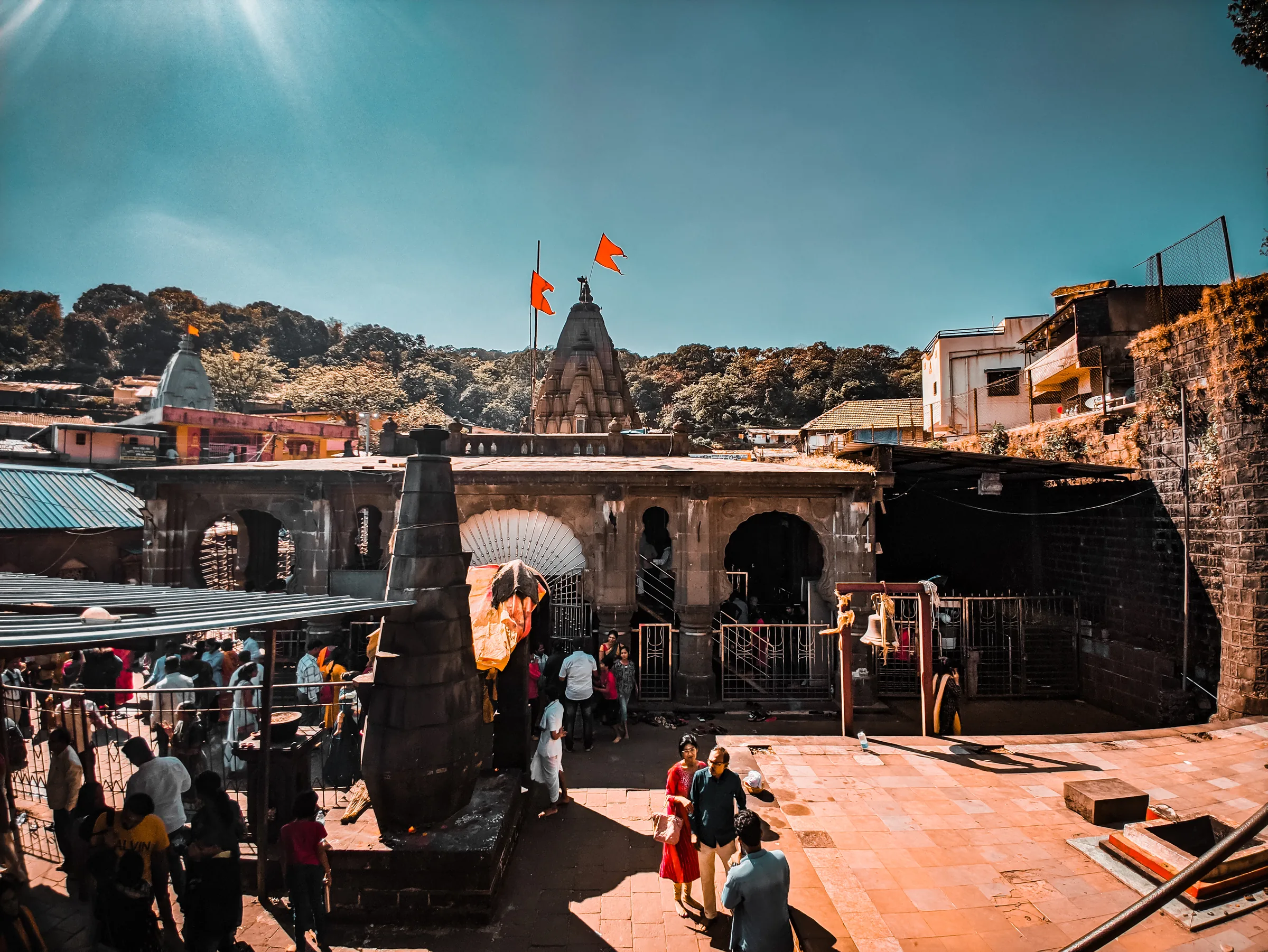
The history of Bhimashankar is also connected with the military history of the Marathas through an unusual object: the enormous bronze bell that hangs in the temple courtyard. Unlike an ordinary Hindu temple bell, this bell is a Portuguese church bell, decorated with a bas-relief of the Virgin Mary and the infant Jesus. Its presence records a remarkable episode in the history of the Maratha-Portuguese conflict.
In 1739, Chimaji Appa, the younger brother of Peshwa Bajirao I, led the Maratha campaign against the Portuguese stronghold of Vasai. After a determined siege, the Marathas captured the fort, ending Portuguese dominance over an important section of the western coast. The victory became one of the notable military achievements of the Maratha Empire.
As an offering of gratitude and a symbol of victory, Chimaji Appa is said to have taken five large bells from Portuguese churches and distributed them among prominent Shiva temples. One of these eventually reached Bhimashankar. The bell, cast in 1712 CE, remains an unusual historical object within the temple complex, where a European Christian religious object was transformed into part of the devotional life of an ancient Hindu shrine.
05 / TEMPLE ARCHITECTURE
Temple Architecture
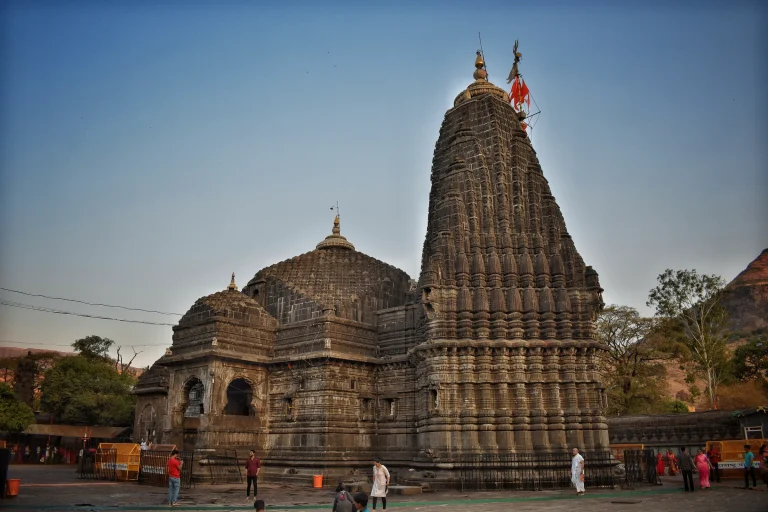
The architectural identity of Bhimashankar is primarily Nagara, expressed through its curvilinear shikhara and structured mandapa, but it is deeply influenced by the Hemadpanthi traditions of the Deccan. The resulting structure is a distinctive synthesis of northern architectural vocabulary and regional stone craftsmanship.
The Garbhagriha represents the oldest architectural layer. It lies below the surrounding ground level, requiring devotees to descend five stone steps into a small, cool chamber. Within this intimate sanctum the self-manifested Linga rests in a shallow pit. The descent into the sanctum creates a physical movement away from the outer world and into a more enclosed sacred space.
The Linga itself possesses a distinctive vertical crack. According to the tradition preserved in the source, the right side represents the masculine principle of Shiva while the left represents the feminine principle of Shakti, giving the form an association with Ardhanarishvara, the Divine in whom Shiva and Shakti are united.
Above and around the ancient core are the later additions of the Maratha period. The Sabhamandapa, commissioned under Nana Phadnavis, is supported by richly carved pillars. Its sculptures depict human figures, deities and natural motifs, while the exterior walls contain narrative scenes from the great epics and the various leelas of Shiva. The temple thus becomes not only a place of worship but a visual retelling of sacred literature in stone.
The tiered Shikhara, also associated with the eighteenth-century renovation, rises above this combination of medieval and Maratha craftsmanship. Its presence gives the temple a strong vertical emphasis, contrasting with the dense forest surrounding it. The sacred structure appears to emerge from the Sahyadri landscape while simultaneously directing the eye upwards towards the Divine.
The Digvijay Dwar, or entrance gateway, carries a Maratha fortification influence, further reflecting the historical period in which the temple was renewed. This combination of temple architecture and architectural elements associated with Maratha military structures gives Bhimashankar a character quite distinct from the monumental temple complexes of other regions.
The Portuguese bell hanging in the courtyard forms perhaps the most unexpected architectural and historical element within the complex. Its presence alongside medieval stonework, Maratha carvings and the ancient Jyotirlinga creates an extraordinary layering of India’s religious and political history.
06 / SPIRITUAL SIGNIFICANCE
Spiritual Significance
The central spiritual message of Bhimashankar emerges from the contrast between Bhima and Sudakshina. One possesses immense physical strength, a divine boon and the power to conquer the worlds, yet remains consumed by ego and vengeance. The other is imprisoned, stripped of worldly power and reduced to worshipping a simple earthen Linga. Yet it is the apparently powerless king whose devotion brings Shiva into the world.
Bhimashankara therefore represents the victory of devotion over arrogance. The demon’s strength is ultimately temporary because it is rooted in ego, while the king’s devotion endures because it is rooted in surrender. The Lord appears not because His devotee possesses worldly power, but because the devotee refuses to abandon Him even when all worldly support has disappeared.
The earthen Linga is particularly meaningful in this context. Sudakshina creates it from the earth of his prison, performs mental abhisheka and continues chanting Shiva’s names. The Divine responds to sincerity rather than grandeur. The Jyotirlinga emerges from an object fashioned by the hands of a captive king, showing that no material circumstance can prevent genuine devotion from reaching Shiva.
The sacred environment of Bhimashankar adds another dimension to this spirituality. Here the forest is not separate from the temple. The traditional Devrai system preserves the understanding that the forest belongs to the deity, and therefore that harming the trees or animals is itself an offence against the sacred order. The spiritual protection of the shrine has thus historically extended into ecological protection.
The Bhima River provides another expression of Shiva’s sacred presence. Its origin is associated with Shiva’s exertion and divine energy after His victory over demonic forces. The river carries this presence outward from the mountain, nourishing the Deccan and linking the remote shrine with a much wider geographical region.
The source also associates Bhimashankar with relief from mental ailments and emotional instability, and with the planet Mars and the zodiac sign Capricorn in Jyotisha traditions. These associations are presented as part of the devotional understanding of the shrine rather than as historical claims.
Ultimately, Bhimashankar teaches that divine strength is not the same as worldly power. The demon who conquers the three worlds is destroyed, while the imprisoned king who possesses nothing but faith becomes the instrument through which the Jyotirlinga manifests.
07 / WORSHIP, RITUALS & FESTIVALS
Worship, Rituals & Festivals
The daily rhythm of Bhimashankar begins in the early hours of the morning. The temple opens at approximately 4:30 AM, beginning with the Kakad Aarti, followed by rounds of Mahapuja and Abhishekam. The early morning atmosphere, with the forest still wrapped in mist and the surrounding mountains quiet, gives the first worship of the day a distinctive character.
The worship of the Jyotirlinga is centred on abhisheka, archana, mantra and darshan. The temple’s daily cycle continues through the day with further worship and aartis. According to the source, the principal aartis take place at approximately 4:30 AM, 12:00 PM and 7:30 PM, while the temple generally remains open until around 9:30 PM.
The most important annual festival is Mahashivratri, when the temple attracts enormous numbers of devotees. The shrine remains immersed in worship, prayer and chanting, while pilgrims wait in long queues for darshan of Bhimashankara. The source records the traditional belief that even a momentary darshan during this sacred period carries immense spiritual merit.
The spiritual character of the worship is closely connected with the story of the Jyotirlinga’s manifestation. Sudakshina’s unwavering worship despite imprisonment becomes an enduring model for the devotee. The temple therefore represents a form of worship in which external circumstances need not determine the intensity of inner devotion.
The sacred waters around the temple also form part of the ritual landscape. Mokshakunda Tirtha, situated behind the temple, is traditionally associated with the sage Kaushika’s attainment of liberation after years of penance and is regarded as a customary place for pilgrims to take a holy dip before entering the sanctum.
Kusharanya Tirtha is identified as the precise source of the Bhima River and is traditionally associated with healing qualities. Nearby, Gupt Bhimashankar marks a place where the river disappears underground before re-emerging several kilometres downstream. The hidden movement of the river becomes a natural metaphor for the hidden and unmanifest nature of the Divine.
08 / WHAT MAKES BHIMASHANKAR UNIQUE
What Makes Bhimashankar Unique
Bhimashankar’s greatest distinction is that the sacred kshetra extends far beyond the temple walls. The Jyotirlinga stands within a mountain ecosystem that includes dense forest, sacred groves, waterfalls, streams and the source of the Bhima River. The temple and the surrounding landscape are therefore experienced as one sacred unit.
The Devrai tradition is especially significant. For generations, local communities such as the Mahadev Koli have regarded sections of the forest as belonging to the deity. Trees and animals were protected because harming the forest was understood as offending the sacred order. This traditional reverence helped preserve gene pools and species that disappeared from less protected areas.
The sanctuary is particularly renowned for the Indian Giant Squirrel, or Shekru, the state animal of Maharashtra. Its ability to move between the forest canopies and the survival of its habitat are closely linked with the continued forest cover. The source records a density of approximately 13.9 squirrels per square kilometre within the sanctuary.
The forest also contains rare bioluminescent fungi that appear during the monsoon and can cause sections of the forest floor to glow. An ancient climber, Xantolis tomentosa, has been recorded in the Ahupe grove with an estimated age of approximately 800–1,000 years. Such features make Bhimashankar remarkable not only as a religious centre but also as a repository of ecological memory.
The Portuguese bell provides another singular feature. Within an ancient Shiva temple in the Sahyadris hangs a bell taken from a Portuguese church during the Maratha campaign against Vasai. It represents an unusual moment in which military history, religious history and temple tradition became physically embodied in a single object.
The underground sanctum and the unusual form of the Linga further distinguish the temple. The devotee must descend into the cool chamber to encounter the Jyotirlinga, reinforcing the sense of entering an interior and hidden sacred realm.
09 / PILGRIMAGE GUIDE
Pilgrimage Guide
The journey to Bhimashankar is itself an experience of the Sahyadris. The temple is approximately 127 kilometres from Pune and around 250 kilometres from Mumbai, making road travel the principal means of reaching the shrine. State buses and private taxis connect the pilgrimage centre with the major cities of Maharashtra, particularly during the monsoon and winter pilgrimage seasons.
For pilgrims who wish to approach the shrine through the forest rather than by the regular road route, trekking paths from the base village of Khandas provide a more demanding pilgrimage experience. The Shidi Ghat and Ganesh Ghat routes offer climbs that generally take several hours and pass through the Sahyadri landscape.
The pilgrimage should ideally include not only darshan of the Jyotirlinga but also the sacred waters and natural surroundings of the kshetra. A visit to Mokshakunda Tirtha, followed by darshan of Bhimashankara, allows the pilgrim to experience the temple within its traditional ritual geography. Kusharanya Tirtha and Gupt Bhimashankar can further deepen the understanding of the sacred origin of the Bhima River.
The surrounding forest is itself worthy of reverence. The pilgrim should remember that Bhimashankar is simultaneously a major religious centre and a sensitive ecological region. The Devrai tradition provides an important lesson: pilgrimage need not mean merely visiting a temple; it can also mean protecting the landscape in which the deity is believed to reside.
Accommodation in the region is primarily oriented towards pilgrims. The source identifies the MTDC Resort near the temple as providing basic rooms and dormitories, while Jungle Holiday Resort, approximately seven kilometres away, offers a more comfortable stay amidst the surrounding greenery.
The temple is generally open from around 4:30 AM to 9:30 PM, with the major aartis traditionally taking place in the early morning, at midday and in the evening. Timings may naturally vary according to festivals and temple arrangements.
The monsoon gives Bhimashankar a particularly dramatic appearance, when the forest becomes dense, the mountains disappear beneath mist and water flows abundantly through the landscape. At the same time, pilgrims should approach the region with appropriate caution because forest trails and mountain roads can become difficult during heavy rainfall.
10 / SOURCES & REFERENCES
Sources & References
The principal scriptural source for the Bhimashankar tradition presented here is the Koti Rudra Samhita of the Shiva Mahapurana, particularly the narrative of Bhimasura, King Sudakshina and the manifestation of Shiva as Bhimashankara. The text presents the Jyotirlinga as the divine response to the devotion of a king who remained steadfast even under imprisonment and threat.
The alternate tradition concerning Tripurasura adds another layer to the sacred identity of the kshetra, connecting Bhimashankar with Shiva’s destruction of the three cities and the restoration of cosmic balance. The same tradition provides the sacred explanation for the origin of the Bhima River from Shiva’s divine perspiration after the battle.
The architectural history is represented through the surviving medieval core, the Hemadpanthi construction tradition and the eighteenth-century Maratha additions associated with Nana Phadnavis. The Portuguese bell preserves a separate historical memory connected with Chimaji Appa and the Maratha victory at Vasai.
The sacred geography of Bhimashankar is further expressed through Mokshakunda, Kusharanya Tirtha and Gupt Bhimashankar, while the surrounding Devrai traditions demonstrate how religious belief contributed to the preservation of the forest ecosystem.
There is also a regional tradition concerning the identification of Bhimashankar with Kamarup in Assam. The source notes that while the Sahyadri shrine is the most widely accepted location for the sixth Jyotirlinga, the Assam tradition points to the mention of Kamrup in the story of King Sudakshina and interprets the term Dakini differently. The source presents this as a genuine regional and theological debate rather than attempting to resolve it conclusively.
11 / THE ETERNAL SILENCE OF THE SAHYADRI
The Eternal Silence of the Sahyadri
Bhimashankar ultimately stands at the meeting point of Shiva, forest and river. The Puranic story speaks of a demon whose immense power was destroyed by the Lord. The temple’s stones preserve the memory of medieval craftsmanship and Maratha patronage. The Portuguese bell recalls the political struggles of eighteenth-century Maharashtra. The Bhima River carries the sacred memory of Shiva outward into the Deccan. And the forest continues to shelter species that have survived because generations regarded the land as belonging to the deity.
This makes Bhimashankar different from a shrine whose sacredness is confined to its sanctum. Here, the forest itself becomes an extension of the temple. The mist that moves through the trees, the sound of water emerging from the mountain, the ancient stone beneath the pilgrim’s feet and the movement of the Shekru through the canopy all become part of the experience of the Jyotirlinga.
The story of Sudakshina gives the shrine its deepest human message. When Bhima demanded that the imprisoned king abandon Shiva, Sudakshina possessed nothing with which to defend himself except faith. He shaped an earthen Linga and continued his worship. Shiva emerged from that fragile form with the radiance of a thousand suns. The lesson is simple but profound: the strength of devotion does not depend upon the strength of the devotee’s circumstances.
Bhimashankara is therefore the Lord who appears when devotion is threatened, the Lord who destroys arrogance, and the Lord who transforms the landscape itself into a sacred refuge.
In the quiet of the Sahyadri forest, the ancient Jyotirlinga continues to stand at the source of the Bhima. The bells of the temple sound through the mist, the river begins its journey towards the plains, and the forest shelters life in countless forms.
Here, the fierce Shiva of the Puranas is not separated from the gentleness of nature.
The demon is destroyed, the river is born, the forest remains—and Bhimashankara continues to shine.
12 / PHOTOGRAPHS
From the whole to the detail.
Select a photograph to explore it at a larger scale.
13 / LOCATION & MAP
Place the story on the map.
PLACE THIS STORY ON THE MAP
Bhimashankar, Sahyadri range, Maharashtra
Maharashtra, India
ABOUT THIS FIELD ENTRY
Rooted in the Bharat Ke Wow archive.
This page is part of the Bharat Ke Wow series on the Dvādaśa Jyotirlingas. Sacred narratives are presented as temple tradition.
Read the original entry ↗