


01 / INTRODUCTION
Trimbakeshwar, Maharashtra
The Jyotirlinga Where the Godavari Is Born
सह्याद्रिशीर्षे विमलेवसन्तं गोदावरीतीरपवित्रदेशे ।
यद्दर्शनात् पातकमाशुनाशं प्रयाति तं त्र्यम्बकमीशमीडे ॥
“I praise Shiva as Tryambaka, dwelling upon the pure heights of the Sahyadri, in the sacred land beside the Godavari, whose darshan swiftly destroys the burden of sin.”
Some sacred places are known primarily by the temple that stands there. Trimbakeshwar is known equally by a mountain, a river and a story of compassion. The sacred shrine rests at the foot of Brahmagiri, where monsoon clouds descend upon the dark slopes of the Sahyadri and springs emerge among rocks, roots and caves. From these heights begins the sacred journey of the Godavari, one of the great rivers of peninsular India. Between the mountain and the river stands Tryambakeshwar Jyotirlinga, a shrine in which Shiva is worshipped not only as the Lord of the three eyes but also in a mysterious threefold form associated with Brahma, Vishnu and Maheshvara.
The sacred origin of Trimbakeshwar is preserved principally through the story of Gautama Rishi and his wife Ahalya. It is a story that begins in a time of terrible drought and hunger and unfolds through generosity, envy, false accusation, penance, divine revelation and forgiveness. At its heart lies a remarkable spiritual principle: Gautama does not receive Shiva’s grace because he seeks greatness for himself. He receives it because he cannot bear the suffering of others. When water disappears from the earth, he seeks a source that will nourish everyone. When falsely accused, he does not respond with vengeance. And when Shiva finally appears before him and offers a boon, Gautama asks not for personal prosperity but for the descent of Ganga for the welfare of the world.
Trimbakeshwar is situated approximately twenty-eight kilometres from Nashik in Maharashtra, close to the base of Brahmagiri, traditionally revered as the source region of the Godavari. From its beginnings here, the river travels roughly 1,465 kilometres before reaching the Bay of Bengal, nourishing fields, towns, temples and communities along its course. To stand at Trimbak is therefore to stand near the beginning of a great civilisational river. What appears first as a small emergence of water eventually becomes one of the major river systems of Bharat. The sacred imagination understands this physical reality through the language of grace: a stream may begin quietly, but its blessing expands as it travels.
02 / THE MEANING OF TRYAMBAKA
The Meaning of Tryambaka
The name of the deity appears in several forms—Tryambaka, Tryambakeshvara, Trimbaka and Trimbakeshwar. The Sanskrit Tryambaka is most commonly understood as “the three-eyed one,” one of the ancient epithets of Shiva. His right eye is associated with the sun, his left with the moon, and the eye upon his forehead with fire, knowledge and the power that burns through illusion. The two ordinary eyes perceive the world of opposites—pleasure and pain, gain and loss, self and other. The third eye sees beyond these divisions. It is the eye of jnana, the awareness before which falsehood cannot remain concealed.
At Trimbakeshwar, however, the name carries another cherished meaning. The Jyotirlinga is revered in a threefold form associated with Brahma, Vishnu and Shiva, representing creation, preservation and dissolution. Unlike the familiar upright linga found in many temples, the sacred form here lies within a hollow depression in the sanctum. Within this cavity are three small forms traditionally identified with the Trimurti. The shrine thus gathers the cosmic cycle into one sacred space: that which arises, that which is sustained and that which ultimately returns to its source.
The name Tryambaka also connects the shrine with one of the most famous mantras dedicated to Shiva—the Mahamrityunjaya Mantra:
ॐ त्र्यम्बकं यजामहे सुगन्धिं पुष्टिवर्धनम् ।
उर्वारुकमिव बन्धनान्मृत्योर्मुक्षीय मामृतात् ॥
“We worship the three-eyed, fragrant Lord who nourishes all life. May He release us from the bondage of death, as a ripe fruit is released from its stem, but not from immortality.”
The connection is particularly meaningful at Trimbakeshwar. Here a river is born, nourishes life and eventually reaches the sea. The temple is also a major centre for ancestral rites and contemplation of mortality. Birth, nourishment, death and release are therefore not separate ideas in the sacred landscape of Trimbak. They are different movements within the same cycle.
03 / PURANIC ORIGIN
Puranic Origin
Gautama and Ahalya on Brahmagiri
The Shiva Purana begins the sacred history of Trimbakeshwar with Gautama Rishi and Ahalya, his virtuous wife. Their ashrama stood upon Brahmagiri in the southern region. Gautama is described as a rishi of profound tapas, but his greatness becomes most evident not through supernatural powers but through the manner in which he responds to the suffering of others.
Ahalya is an integral part of this story. She is not merely a figure standing beside Gautama. The Purana presents her as sharing his hardship, service and worship. When Gautama is accused, she too experiences insult and exile. When he undertakes circumambulation and worship of parthiva lingas, she participates beside him. Their spiritual life is therefore presented as a shared vrata, sustained through trust and steadfastness.
Brahmagiri itself is more than a geographical backdrop. In the sacred imagination it is regarded as a body of Shiva, a mountain of tapas and the womb from which the Godavari emerges. Its caves, ridges and springs preserve memories of sages and ascetics. The climb towards Gangadwar takes the pilgrim through a landscape where water appears and disappears among rocks and vegetation. The mountain does not present a broad river at its summit; instead it reveals beginnings—drops, channels and hidden movement. The pilgrim is thereby taught to honour what is small because of what it may become.
The Hundred-Year Drought
The Shiva Purana speaks of a terrible drought lasting one hundred years. The duration expresses a calamity so prolonged that ordinary remedies have failed. The earth becomes barren, water disappears and living beings are forced to leave. Sages, families, animals and birds scatter in search of survival. Those who remain endure through austerity and control of the breath.
Gautama responds to this suffering through penance directed towards Varuna, the lord of waters. For six months he remains absorbed in pranayama and worship. When Varuna finally appears, Gautama asks for rain. Varuna explains that he cannot overturn the decree of the gods and therefore asks Gautama to choose another boon. Gautama does not ask for a private source of water for himself and his household. Instead, he asks for divine and everlasting water that will provide enduring benefit.
Varuna instructs him to dig a small pit, only a hand’s depth. Gautama obeys. Varuna fills it with perennial water and declares that gifts, rites, tapas, yajnas and shraddha performed there will bear imperishable fruit. Gautama then uses this water not merely for himself but to cultivate the barren land and sustain other households. His ashrama becomes prosperous, but its prosperity is measured by the number of beings it can support.
This is the true beginning of the Trimbakeshwar story. Before the Jyotirlinga manifests and before the Godavari descends, there is the dharma of water shared.
The Purana itself pauses to praise this quality. A truly good person cannot bear the suffering of another. Kindness, humility, service and control of the senses are described as qualities that uphold the world. Gautama’s tapas therefore becomes meaningful because it is directed outward. His spiritual accomplishment becomes service.
When Gratitude Became Envy
Gautama’s generosity eventually becomes the source of jealousy. The sages who depend upon the water he has secured begin to resent him. One day, when Gautama’s disciples go to collect water, they encounter the wives of other sages, who insist on drawing water first. Ahalya later comes herself, calms the women and obtains the water needed for Gautama’s daily rites.
The irony is central to the story. The very people who benefit from Gautama’s compassion become envious of the one who saved them from starvation. The Purana does not hide this contradiction. Religious learning and ritual knowledge do not automatically free a person from jealousy. Sacred knowledge without self-examination can itself become another form of pride.
The sages therefore worship Ganesha and ask him to create an obstacle that will drive Gautama from the hermitage. Ganesha warns them that Gautama has saved their lives and that harming a benefactor will bring ruin. Yet they persist. Bound by the force of their worship and request, Ganesha agrees to the course of events while making clear that their intention is wrong.
The Frail Cow in the Field
Ganesha assumes the form of a weak and trembling cow and enters Gautama’s field, where she begins eating the grain. When Gautama sees her, he does not attack her in anger. Instead, he gently tries to drive her away with a small bunch of grass. The moment the grass touches her, the cow falls dead.
The other sages, who have been waiting nearby, immediately accuse Gautama of killing the cow. The man who had kept them alive is suddenly declared impure and unfit to remain among them. Gautama, Ahalya and their disciples are insulted and driven away. The sacred story turns dramatically from gratitude to accusation.
The Purana preserves more than one version of this episode. In one form, Ganesha himself has taken the form of the cow; in another account belonging to a different kalpa, the hostile sages create an artificial cow. Both versions preserve the central truth: Gautama is innocent, and an appearance of guilt has been deliberately created to expel him.
Yet Gautama does not immediately respond in anger. The sacredness of the cow and the seriousness of gohatya weigh so heavily upon his conscience that even what was accidental causes him profound grief. His response reveals the refinement of his character: a coarse mind searches immediately for excuses, while a sensitive mind first asks whether harm has occurred.
The Parthiva Linga and the Patience of the Innocent
Gautama accepts exile and establishes another hermitage. Even there, the other sages declare that he is unfit to perform rites for the gods or ancestors. After living in distress for some time, he approaches them and asks for a means of purification.
The demands placed upon him are severe. He is instructed to perform elaborate circumambulations, observe vows, bring Ganga to the place, make and worship a crore of earthen Shiva lingas, circumambulate Brahmagiri and finally bathe in Ganga and perform abhisheka with one hundred pots of water. These demands are presented as a form of humiliation rather than genuine guidance. Yet Gautama accepts the path of worship.
He and Ahalya circumambulate Brahmagiri, fashion parthiva lingas from earth and worship Shiva. Their disciples serve them. The same soil that had once produced grain during the drought now becomes the material of worship.
The parthiva linga is itself a profound symbol. Made from earth, worshipped with devotion and eventually returned to the elements, it carries no pride of permanence. Gautama’s public honour has been broken and his place in the community has been taken away, yet the ground beneath him remains available for worship.
Ahalya remains beside him. She too has endured insult and exile, yet she participates in the vrata without allowing the conduct of others to determine the quality of her own spiritual life. Together they embody a quiet form of strength: the world may change around them, but their relationship with the Divine does not.
When Shiva Appeared
Pleased by the worship of Gautama and Ahalya, Shiva finally appears with His ganas. He asks Gautama to choose a boon. Gautama bows and asks simply, “Make me sinless.”
Shiva’s answer overturns the judgment of the community. Gautama was already pure. He had been deceived by ungrateful men, and far from carrying the stain placed upon him, his holiness was such that even seeing him could purify others. Shiva then reveals the entire plot.
Gautama’s response is extraordinary. He does not ask Shiva to punish those who wronged him. Instead, he says that the sages had actually helped him, because without their actions he might never have performed the worship that brought him the direct vision of Shiva. What was intended as harm had become the cause of his highest spiritual good.
Shiva is deeply pleased and again offers him a boon. Gautama could have asked for anything—prosperity, immortality, celestial status or fame. Instead, he asks that Ganga come to this place for the welfare of the worlds.
04 / THE DESCENT OF GAUTAMI GODAVARI
The Descent of Gautami Godavari
The Shiva Purana describes Ganga’s manifestation in a mysterious manner. Shiva gives Gautama a portion of the essence of earth and heaven preserved from an earlier time. The waters of Ganga assume the form of a goddess and appear before Gautama. He praises her as the sanctifier of the world and asks that she purify him.
Ganga initially intends to return to her own abode after fulfilling Gautama’s request. Shiva, thinking of the welfare of living beings, asks her to remain upon earth. Ganga agrees on the condition that her greatness be recognised and that Shiva Himself remain beside her with Parvati and His ganas.
The gods, sages, sacred rivers and holy places assemble and worship Shiva, Parvati, Ganga and Gautama. They too ask Ganga to remain. The Purana associates her continuing presence with the entry of Brihaspati, or Jupiter, into Simha, the sign of Leo, when the gods and sacred rivers come to Gautami.
Ganga accepts. Shiva remains as Tryambaka, and Ganga becomes famous as Gautami. The two are therefore inseparable in the origin of the tirtha. Trimbakeshwar is not a temple that merely happens to stand beside a river. The river and the Jyotirlinga arise from the same sacred event.
Gangadwar and the First Flow
At Gautama’s request, Ganga descends from Brahmagiri. Her first current is described as flowing through the branches of an udumbara tree. Gautama bathes joyfully, followed by his disciples and other sages. The place becomes known as Gangadwar—the doorway of Ganga.
The hostile sages also come to bathe. But when Ganga sees them, she disappears. The river that cleanses sin refuses to become a convenience for those who remain unrepentant. The episode conveys an important spiritual principle: sacred water is not a mechanical solvent. Physical bathing without inner transformation cannot constitute true purification.
Once again Gautama intercedes for those who have harmed him. He asks Ganga to grant them darshan and allow them to benefit from the sanctity of the place. Ganga initially calls them ungrateful and unworthy, but Gautama reminds her that one who helps even a person who has caused harm becomes sanctified through that very act.
With Ganga’s permission, Gautama creates a sacred enclosure or tank below Gangadwar. The river flows there and the place becomes known as Kushavarta. Tradition regards it as the point from which the Godavari, after appearing and disappearing in the upper reaches, takes a stable and visible course.
05 / KUSHAVARTA AND THE SACRED RIVER
Kushavarta and the Sacred River
Kushavarta is more than a tank associated with the origin of a river. It is a sacred tirtha where generations of pilgrims have descended its stone steps to offer water to the sun, remember ancestors and perform rites under the guidance of priests. During important observances, its waters become surrounded by mantra, bells, flowers and the continuous movement of pilgrims.
The association with ancestors is particularly strong. Families come here to perform shraddha, tarpana, Tripindi rites and other observances intended to bring peace and continuity. The offering of water becomes a symbolic acknowledgement that no individual begins with himself. Life flows through generations just as a river flows through many lands.
Kushavarta also occupies an important place in the Simhastha observances at Trimbakeshwar. Shaiva ascetics and akhadas gather here for prescribed bathing occasions, while other groups traditionally bathe at Nashik. This arrangement developed historically, but its sacred foundation lies in the Puranic promise that the gods, rivers and tirthas come to Gautami when Jupiter enters Leo.
The Godavari then begins her long journey eastward. From Trimbak she moves towards Nashik and Panchavati, crosses Maharashtra, Telangana and Andhra Pradesh and eventually reaches the Bay of Bengal through a broad delta. Along the way she supports agriculture, towns, temples and countless communities. Her sacred names preserve her origin: she is Gautami, because Gautama brought her through tapas; Godavari, surrounded by traditional explanations; and Dakshina Ganga, the Ganga of the South.
The story also carries a responsibility for the present. The Godavari may be worshipped as Mother, but devotion cannot be separated from protection. The river carries the consequences of human settlement—waste, pollution, reduced flows and careless construction. Gautama’s original tapas was undertaken because living beings lacked water. To honour that tapas today must therefore include a commitment to protect the water that continues to sustain life.
06 / TEMPLE ARCHITECTURE
Temple Architecture
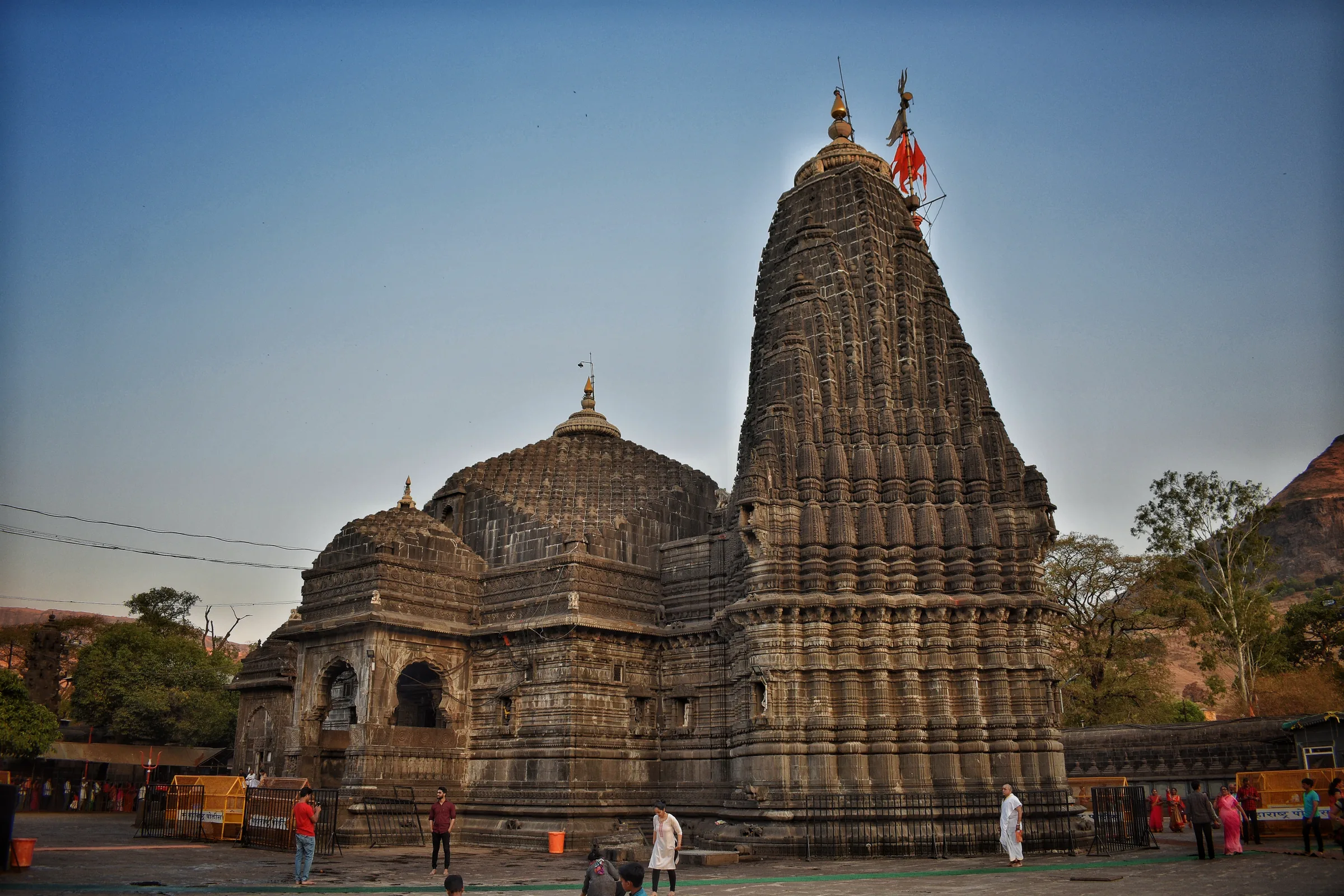
The present Trimbakeshwar Temple was constructed in the eighteenth century under the patronage of Peshwa Balaji Bajirao, known as Nanasaheb Peshwa, upon the site of an older shrine. Built primarily from dark basalt, the temple seems to emerge naturally from the geology of the Sahyadri. During the monsoon the stone becomes almost black and reflective, while sunlight reveals its grey and brown carved surfaces.
Four gateways open towards the cardinal directions, giving the temple a strong sense of orientation within the sacred landscape. The central shrine is approached through increasingly enclosed spaces, moving from the active exterior into the darker sanctum. Bells, queues, priests, wet stone and the fragrance of offerings accompany the pilgrim’s approach.
The garbhagriha is comparatively dark. The Jyotirlinga is not raised prominently above the surrounding surface but lies within a hollow depression. Water naturally gathers around the sacred form, giving the sanctum the atmosphere of a protected spring rather than simply a chamber containing an object.
This unusual form is one of the defining architectural and theological features of Trimbakeshwar. Within the hollow are the three small forms associated with Brahma, Vishnu and Shiva. The shrine thereby expresses the cosmic cycle through its very physical form. Creation, preservation and dissolution are not placed in separate sanctuaries; they are gathered into one sacred depth.
On prescribed occasions the sacred form is adorned with a ceremonial golden mask or crown. The outward splendour does not replace the hidden linga. Rather, the hidden form is temporarily revealed through ornament and ritual. This movement between concealment and adornment is deeply appropriate to Shiva, who can simultaneously be the ash-smeared ascetic and the jeweled Lord.
The Peshwa reconstruction was also part of a larger system of temple renewal in western India. Temple patronage did not end with the construction of stone walls. Endowments supported priests, musicians, attendants, festivals and the wider economy of pilgrimage. The survival of a tirtha therefore depends upon both architecture and the inherited systems of service that allow worship to continue generation after generation.
07 / BRAHMAGIRI AND THE SACRED LANDSCAPE
Brahmagiri and the Sacred Landscape
Behind the temple rises Brahmagiri, broad, dark and frequently wrapped in cloud. The mountain is revered as the source region of the Godavari and as a sacred manifestation of Shiva. Pilgrims climb its steps and old pathways towards Gangadwar and other shrines, following a landscape that reveals the sacred geography gathered symbolically within the temple below.
The ascent can be demanding, particularly during the monsoon, when stone becomes slippery and streams cross the path. Yet the difficulty is itself part of the pilgrimage. The mountain remembers Gautama’s circumambulation, and to walk around Brahmagiri is to follow the shape of his penance.
Pradakshina is more than walking in a circle. It reverses the ordinary human tendency to make oneself the centre. The pilgrim moves while the sacred remains still. At Trimbak, circumambulation also recalls the false penance imposed upon Gautama and the genuine grace that eventually emerged from it. A path intended to shame him became a path to Shiva.
Several local goddesses, including Nilambika and Kolambika, also belong to the sacred field of Brahmagiri and Trimbak. Their presence reminds the pilgrim that the sacred mountain cannot be understood through Shiva alone. Shakti is present as earth, cave, vegetation, river and protective mother. The story itself requires Ahalya, Parvati and Ganga; without them, the sacred field would be incomplete.
08 / SPIRITUAL LINEAGE: SANT NIVRUTTINATH
Spiritual Lineage: Sant Nivruttinath
Trimbakeshwar’s spiritual identity extends beyond its Puranic and Shaiva traditions. The town is closely associated with Sant Nivruttinath, the elder brother and guru of Sant Dnyaneshwar. According to the Nath tradition, Nivruttinath received initiation from Gahininath in the Trimbak region. He later guided the young Dnyaneshwar, whose Dnyaneshwari brought the philosophical vision of the Bhagavad Gita to Marathi-speaking devotees with extraordinary depth and tenderness.
Nivruttinath’s samadhi at Trimbakeshwar draws Varkari pilgrims and connects the town with the great bhakti heritage of Maharashtra. Trimbak therefore becomes more than a Puranic tirtha or Jyotirlinga. It is also a centre of ritual learning, yogic transmission and devotional memory, where Shaiva, Nath and Varkari traditions meet.
The guru-disciple relationship is particularly meaningful beside the source of the Godavari. A true teaching flows. It begins in the concentrated realisation of one person, enters the heart of another, takes the language of the people and travels across generations. Gahininath to Nivruttinath, Nivruttinath to Dnyaneshwar, and Dnyaneshwar to innumerable devotees form another sacred river flowing from Trimbak.
09 / WORSHIP AND RITUALS
Worship and Rituals
The daily worship at Trimbakeshwar reflects the unique threefold character of the Jyotirlinga. The morning worship is associated with Brahma, the midday worship with Mahadeva, and the evening worship with Vishnu. The day itself thus becomes an offering to the Trimurti.
Morning carries the symbolism of creation. The sanctum opens, lamps are offered and the world appears newly made. Midday belongs to Mahadeva, when the sun is strongest and activity reaches fullness. Shiva is understood here not merely as dissolution but as the still axis within action. Evening belongs to Vishnu, the principle of preservation, as the day moves towards rest and continuity.
Important forms of worship include Rudrabhisheka and Laghurudra, in which water, milk and other prescribed substances are offered with Vedic recitation, particularly the Sri Rudram. The chanting of Namakam and Chamakam surrounds the sacred form with the many names and expressions of Rudra. At a river-source tirtha, the symbolism of abhisheka becomes especially resonant: water is offered to Shiva beside the very place from which sacred water emerges.
The ceremonial golden mask is displayed on selected occasions, while processional traditions bring the deity into public view. When the deity leaves the sanctum, the town itself becomes an extension of the temple. Priests, musicians, families and pilgrims participate in the transformation of the streets into sacred space.
10 / FESTIVALS AND SACRED OBSERVANCES
Festivals and Sacred Observances
Mahashivaratri is among the great festivals of Trimbakeshwar. Night vigil, fasting, mantra and repeated worship honour Shiva as the consciousness that remains when ordinary activity falls silent. The festival’s atmosphere naturally resonates with the deeper meaning of Tryambakeshwar as a place of transformation and release.
The Mondays of Shravana also attract large numbers of devotees. Kartika observances include lamps, kirtana and processional worship. The festivals are not merely additions to the temple calendar; each recalls the sacred story. Every pot of water offered in worship can recall Gautama’s tapas, and every night spent in devotion echoes the patience through which Gautama and Ahalya awaited Shiva’s grace.
Simhastha
One of the most significant large-scale observances associated with Trimbakeshwar is Simhastha, the Kumbha gathering of Nashik and Trimbakeshwar. The Shiva Purana connects the greatness of Gautami with the entry of Jupiter into Leo, when gods, tirthas and sacred rivers are said to assemble upon her banks, bathe and worship Tryambaka.
During Simhastha, the sacred landscape is transformed. Ascetics arrive with their lineages and standards; pilgrims travel from distant regions; discourses, initiations, annadana, processions and ritual baths unfold across the region. The arrangement of bathing traditions between Nashik and Trimbakeshwar reflects a long historical development, with different ascetic orders associated with the two centres.
The shahi snana, or ceremonial bath of the akhadas, is the most visible expression of the festival. Yet the deeper meaning is larger than spectacle. The Purana imagines even sacred rivers as requiring renewal. They cleanse others for years and then return to Gautami. Holiness is therefore not a static possession. Even that which purifies must periodically return to its source.
Such enormous gatherings also carry a modern responsibility. A festival celebrating the sacredness of water requires adequate sanitation, waste management, transport and protection of the river. The ancient promise of purification therefore creates a contemporary obligation: a pilgrimage to the river must not leave the river wounded.
11 / RITES FOR ANCESTORS AND SPIRITUAL RELEASE
Rites for Ancestors and Spiritual Release
Trimbakeshwar is widely known as a centre for rites concerning ancestors, untimely death, unresolved obligations and the desire for spiritual release. Families come to perform shraddha, tarpana, Tripindi Shraddha, Narayana Bali, Nagabali and related observances under appropriate guidance. These belong to complex textual and regional traditions, and their performance varies according to circumstance.
At their heart lies a serious religious understanding: the living remain connected with the departed through memory, gratitude, responsibility and the consequences of action. Grief does not always settle neatly. Death may come suddenly; duties may remain incomplete; reconciliation may never have taken place. Ritual gives form to emotions and responsibilities that ordinary conversation cannot always resolve.
Water is central to these acts. An offering poured from the hands may be physically small, yet it is accompanied by name, lineage and intention. The Godavari becomes the witness between the visible and invisible worlds.
The Gautama legend gives these rites an important ethical balance. Purification is not obtained by blaming unseen forces for every hardship. Gautama accepts responsibility before knowing the truth, but Shiva eventually reveals that false guilt must also be removed. The tirtha therefore teaches both humility and discernment. One should examine one’s duties honestly without surrendering to manipulation or needless fear.
12 / SPIRITUAL SIGNIFICANCE
Spiritual Significance
The deepest significance of Trimbakeshwar lies in the convergence of Shiva, water, mortality, ancestry and liberation.
The Mahamrityunjaya mantra provides a powerful key to understanding the shrine. It does not ask that the body never die. It asks to be released from bondage to death—the fear, attachment and ignorance that make mortality unbearable. The image of the ripe fruit falling naturally from its stem suggests that liberation is not violent escape but maturity.
Trimbakeshwar’s landscape makes this teaching visible. The Godavari is born, nourishes life and eventually enters the sea. Gautama is bound by false accusation and released through Shiva’s revelation. The hostile sages are bound by envy and offered the possibility of release through repentance. Ancestors are remembered so that grief and duty may find completion. And the threefold linga holds creation, preservation and dissolution together in one sacred depth.
The story of Gautama also gives the shrine its moral centre. His first virtue is compassion. During the drought, he does not seek merely to save himself; he seeks water for everyone. His second virtue is humility. When accused, he does not immediately assume that his reputation makes him incapable of error. His third virtue is steadiness, as he and Ahalya continue worship even after their social world collapses. His fourth virtue is freedom from vengeance. When Shiva exposes the plot, Gautama does not ask for punishment but seeks the purification even of those who wronged him.
This makes the Trimbakeshwar legend more than a story explaining the origin of a river. It becomes a teaching about how a human being should respond to suffering.
The greatest blessing of Trimbakeshwar is therefore purification, but purification can take many forms. It may be freedom from remorse through sincere atonement. It may be freedom from false guilt. It may be the washing away of resentment. It may be the restoration of gratitude towards ancestors, teachers, land and water.
The threefold linga adds another dimension. Creation without preservation becomes restless novelty. Preservation without change becomes stagnation. Dissolution without wisdom becomes destruction. A complete life must know when to begin, what to sustain and what to release.
The third eye of Tryambaka offers still another perspective. Human beings often suffer because they see only the immediate event. Gautama could have seen only humiliation and exile. Shiva’s grace enabled him to see the larger field in which even suffering had become the path to divine vision. The third eye does not deny pain; it reveals a larger reality in which pain can be transformed.
13 / UNIQUE FEATURES OF TRIMBAKESHWAR
Unique Features of Trimbakeshwar
Among the twelve Jyotirlingas, Trimbakeshwar possesses several features that make it unmistakably unique.
The first is the threefold Jyotirlinga. Rather than the familiar upright form, the sacred presence lies within a hollow depression and contains the three forms associated with Brahma, Vishnu and Shiva. The cosmic cycle is thus expressed through the very form of the shrine.
The second is its inseparable connection with the Godavari. Shiva and the river do not simply happen to coexist here; according to the Puranic account, Ganga’s descent as Gautami and Shiva’s continued presence as Tryambaka arise from the same sacred episode.
The third is the presence of Brahmagiri, which transforms the temple into part of a much larger sacred landscape. The pilgrim can move from the temple to Kushavarta, Gangadwar and the mountain paths, following the geography of Gautama’s tapas.
The fourth is Trimbakeshwar’s relationship with ancestral rites, making the shrine particularly significant for families seeking ritual completion and remembrance.
The fifth is its connection with Sant Nivruttinath and the Nath and Varkari traditions, giving the town a spiritual history that extends beyond its Puranic Shaiva identity.
And perhaps the greatest uniqueness is the way all these traditions meet in one place: Jyotirlinga, river source, mountain, Trimurti, Mahamrityunjaya, ancestral rites, Nath lineage and Kumbha pilgrimage.
14 / PILGRIMAGE TO TRIMBAKESHWAR
Pilgrimage to Trimbakeshwar
The temple is generally the first centre of a pilgrimage to Trimbakeshwar, but a meaningful visit extends beyond the temple walls. The dark stone temple, sculpted shikhara and crowded courtyard prepare the pilgrim for the unusual sanctum where the sacred form rests below the surrounding surface. Since access procedures and timings can change, particularly during festivals and periods of heavy monsoon weather, pilgrims should follow current instructions from the temple authorities.
Kushavarta should be approached as a sacred ritual tirtha rather than a recreational tank. Families may be performing rites of grief and remembrance, and visitors should therefore maintain an atmosphere of quiet respect. Photography, loud conversation and careless behaviour can disturb moments of profound personal significance.
The ascent towards Brahmagiri and Gangadwar requires physical care. During the monsoon, the mountain becomes particularly beautiful but also more difficult to traverse, with slippery steps, sudden rain, mist and strong water flow. The elderly, children and those who may have difficulty with the climb should judge the route realistically. Faith does not require recklessness.
Trimbak can be reached by road from Nashik and remains active throughout the year, with especially large gatherings during Mahashivaratri, Shravana Mondays, Nivruttinath observances and Simhastha periods. Weather conditions can affect access, and official safety instructions should always be respected.
15 / A RESPONSIBLE PILGRIMAGE
A Responsible Pilgrimage
There is an important lesson in the Trimbakeshwar tradition that deserves to extend into the modern pilgrimage experience.
Gautama sought water because living beings were suffering.
Any pilgrimage that damages the water therefore contradicts the very tapas through which the Godavari became sacred. Pilgrims should avoid unnecessary packaging, use designated disposal facilities and take care not to leave offerings where they can block or pollute natural channels.
Responsible pilgrimage also includes respect for the people of Trimbak. Priests, shopkeepers, sanitation workers, police personnel, drivers, residents and volunteers all carry the burden created by large pilgrim crowds. Patience, courteous speech and fair dealings are therefore part of dharma. The town is not merely a backdrop for a visitor’s spiritual experience; it is a living home.
The responsibility extends far beyond Trimbak because the Godavari itself travels far beyond Trimbak. A river cannot be protected only at its source. Every community along its course participates in her condition. A pilgrim who returns from Trimbakeshwar should therefore carry home not merely a souvenir but a renewed discipline concerning water—using it carefully, preventing pollution and supporting the restoration of local lakes, wells and streams.
The best souvenir from a river-source tirtha is not an object. It is a changed relationship with water.
16 / PHOTOGRAPHS
From the whole to the detail.
Select a photograph to explore it at a larger scale.
17 / LOCATION & MAP
Place the story on the map.
PLACE THIS STORY ON THE MAP
Trimbak, near Nashik, Maharashtra
Maharashtra, India
ABOUT THIS FIELD ENTRY
Rooted in the Bharat Ke Wow archive.
This page is part of the Bharat Ke Wow series on the Dvādaśa Jyotirlingas. Sacred narratives are presented as temple tradition.
Read the original entry ↗