

01 / INTRODUCTION
Nageshwar Jyotirlinga, Dwarka
Lord of the Serpents
याम्ये सदङ्गे नगरेऽतिरम्ये विभूषिताङ्गं विविधैश्च भोगैः ।
सद्भक्तिमुक्तिप्रदमेकमीशं श्रीनागनाथं शरणं प्रपद्ये ॥
“I take refuge in Lord Naganatha, the one Lord who grants true devotion and liberation, who dwells in the beautiful southern city and whose form is adorned with many sacred offerings.”
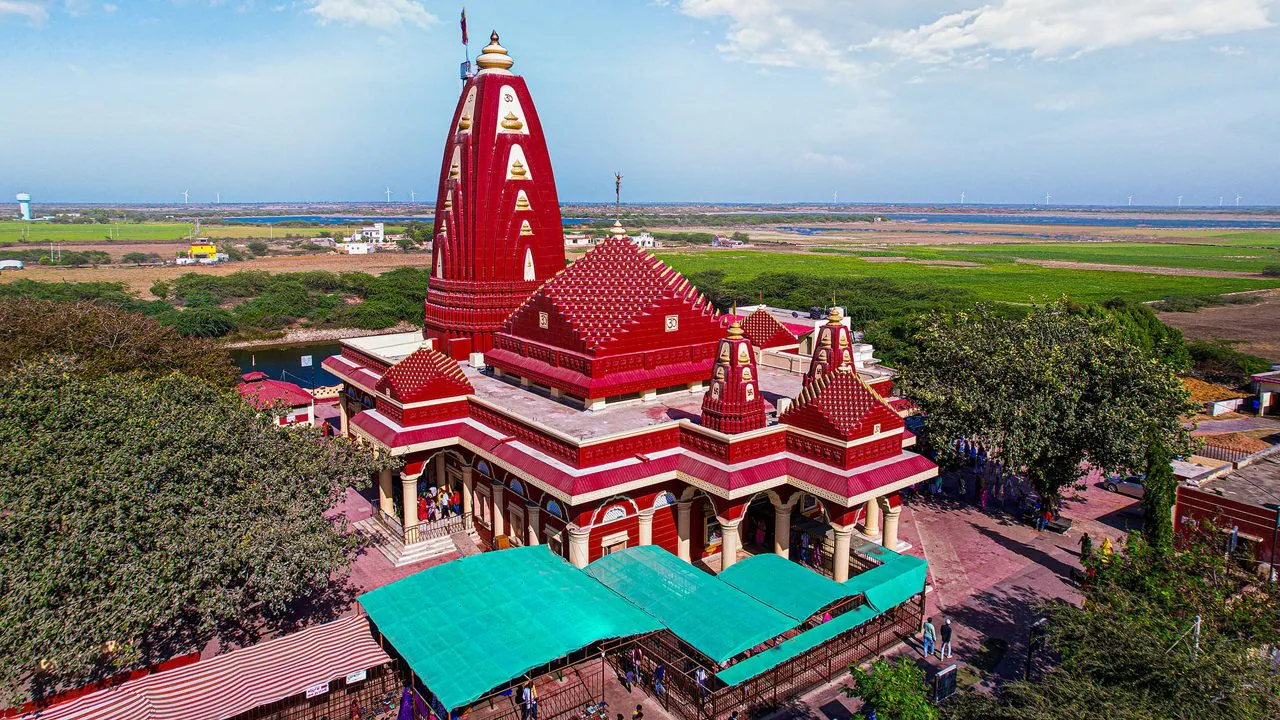
On the western coast of Gujarat, near the sacred city of Dwarka, stands Nageshwar Jyotirlinga, one of the twelve revered self-manifested forms of Lord Shiva. Also known as Nagnath or Nageshwara, the shrine occupies a distinctive place within the sacred geography of Saurashtra. Its identity is inseparably associated with the serpent, with protection from poison and evil, and with the promise that Shiva comes to the aid of a devotee who remains steadfast even when surrounded by fear and oppression.
The name Nageshwar, commonly understood as “Lord of the Serpents,” carries a deep Shaiva symbolism. The serpent is one of the most recognisable emblems of Shiva, representing power, time, immortality and the disciplined energy that remains under divine mastery. Shiva wears serpents not as symbols of fear but as ornaments, demonstrating His sovereignty over forces that ordinary human beings regard with dread. At Nageshwar, this symbolism becomes especially powerful because the shrine has traditionally been associated with protection from poison, venom and destructive forces.
The sacred story of Nageshwar centres upon Supriya, an unwavering devotee of Shiva who is imprisoned by the demon Daruka in the forest of Darukavana. Even when surrounded by violence and deprived of freedom, Supriya refuses to abandon the name of Shiva. Her faith becomes the very means through which Shiva manifests Himself, destroys the oppressive force and protects His devotee. The Lord then remains at that sacred place as Nageshwar, transforming the forest of fear into a permanent field of divine protection.
Nageshwar’s significance is further enriched by its setting. The temple stands within the wider sacred landscape of Dwarka, a region dominated by the memory of Krishna and the Vaishnava tradition. Nearby are the Dwarakadhisha Temple, Rukmini Temple and Gopi Talav. Thus the pilgrim who comes to Nageshwar enters a landscape in which Shaiva and Vaishnava traditions meet naturally, reminding us that the sacred geography of Bharat has never been confined within rigid boundaries between different forms of the Divine.
The present Nageshwar temple is modern in its physical form, although the sanctity of the site is regarded as ancient. The shrine contains an underground sanctum, a distinctive architectural feature, and is accompanied by an enormous seated image of Shiva and a colossal Nandi. Together, the ancient story and the modern temple create a sacred space in which the memory of Puranic devotion continues to be expressed through contemporary pilgrimage.
02 / PURANIC ORIGIN
Puranic Origin
The principal sacred story of Nageshwar is found in the Shiva Purana and centres upon the devotee Supriya and the demon Daruka. The ancient forest of Darukavana is described as a place where righteous people and devotees suffered under the oppression of demonic forces. Amid this atmosphere of fear lived Supriya, whose strength did not come from armies, wealth or political authority. Her strength was the simple but unwavering remembrance of Shiva.
Daruka, together with Daruki in some versions of the story, represented the misuse of power. The demon’s rule was characterised by domination and fear, while Supriya embodied faith and surrender. When she and other devotees were imprisoned, the ordinary means of resistance were unavailable to them. Yet Supriya continued to invoke Shiva. Her captivity therefore became the setting for a deeper kind of freedom—the freedom of a mind that refuses to surrender its connection with the Divine.
The story presents an important contrast. Daruka possesses physical power and uses it to control others. Supriya possesses no comparable worldly strength, yet she remains inwardly unshaken. Her devotion becomes the force that ultimately overturns the demon’s authority. Shiva responds to her call, manifests Himself, destroys the oppressive force and rescues His devotee.
Having protected Supriya and restored divine order, Shiva chooses to remain in Darukavana as the Jyotirlinga Nageshwar. The significance of this act is profound. Shiva does not simply appear momentarily to defeat a demon and then disappear. He transforms the place of suffering into a permanent sacred centre. The forest where devotees had once been imprisoned becomes a place where generations of devotees can seek refuge.
The tradition therefore presents Nageshwar as a shrine born from the promise of Shiva’s protection. The Lord remains because the devotee called upon Him with unwavering faith. The Jyotirlinga becomes the permanent presence of that divine response.
The source also preserves another Puranic account associated with the Vamana Purana, involving the ascetic Valakhilyas. These sages were devoted to Shiva and performed prolonged worship. Shiva, wishing to test their patience and single-mindedness, appeared before them in an unconventional form—a naked ascetic adorned with serpents. The wives of the sages became distracted by His extraordinary appearance, causing the ascetics to become agitated and curse Him. The cosmic order was disturbed, and Brahma and Vishnu approached Shiva. Shiva ultimately promised to remain in Darukavana forever as the Jyotirlinga.
These two traditions approach the sanctity of Nageshwar from different directions. One emphasises the unwavering devotion of Supriya and Shiva’s protection of the oppressed. The other presents Shiva as the mysterious ascetic whose presence tests the limitations of conventional understanding. Both ultimately lead to the same sacred conclusion: Shiva remains at Darukavana as Nageshwar.
03 / HISTORICAL BACKGROUND
Historical Background
The physical history of Nageshwar is considerably more uncertain than its Puranic antiquity. Unlike some major temples whose ancient structural remains provide a continuous archaeological record, no substantial premodern ruins or inscriptions survive at the present site that can conclusively establish the history of an ancient temple building. The source therefore makes an important distinction between the antiquity of the sacred tradition and the age of the structure visible today.
The site may have been revered for generations through the worship of a Swayambhu Linga, even before a monumental temple existed. This possibility is consistent with the nature of many Jyotirlinga traditions, in which the sacred presence is understood to precede the architecture. A shrine may change, a hall may be rebuilt and a tower may rise where an earlier structure once stood, while the sacred Linga continues to be regarded as the original divine presence.
Local tradition also associates an earlier shrine with the Pandavas, although the source does not provide archaeological evidence establishing such a structure. Such traditions are nevertheless important to the cultural memory of the temple because they demonstrate how the shrine has been incorporated into the wider sacred narratives of Bharat.
The present temple belongs largely to the modern period. The source records that as recently as the late twentieth century, Nageshwar remained a comparatively modest shrine, consisting of an older hall and sacred Linga. There was a perception among devotees that while several other Jyotirlingas had received grand architectural patronage and rebuilding under kings, Nageshwar had remained comparatively undeveloped. The present complex emerged from the subsequent process of renovation and expansion.
The modern development of the shrine has therefore given physical expression to a sacred tradition that is considerably older than the present buildings. This distinction is important. The antiquity of a tirtha does not always depend upon the survival of an ancient structure. At Nageshwar, the continuity of devotion to the Linga and the persistence of its Puranic identity are central to its historical significance.
The temple’s location within the Dwarka region also places it within one of India’s most important pilgrimage landscapes. The sacred geography surrounding Dwarka includes Krishna’s principal shrine, Rukmini’s temple, Gopi Talav and other places associated with the Vaishnava traditions of western India. Nageshwar thus participates in a larger pilgrimage network rather than existing in isolation.
04 / TEMPLE ARCHITECTURE
Temple Architecture
The present Nageshwar temple combines traditional Gujarati architectural principles with modern engineering. Its design draws upon Maru-Gurjara architectural traditions and Vastu principles, while its monumental scale reflects its modern reconstruction. The temple faces west and is arranged according to a symbolic plan that has been compared to the human body in a reclining or shayana posture.
The entrance, or Mahadvara, is understood symbolically as the feet of this sacred body. The great assembly hall, or Sabha Mandapa, corresponds to the chest, while the Garbhagriha represents the head. This progression from the entrance towards the sanctum gives the architecture a symbolic dimension: the pilgrim does not simply enter a building but moves inward through a representation of the human form towards the centre where Shiva resides.
One of the most unusual architectural features of Nageshwar is its subterranean sanctum. The floor of the Garbhagriha lies approximately four and a half feet below the surrounding level, requiring the devotee to descend towards the sacred Linga. The movement downwards creates a powerful psychological transition from the open temple complex into the enclosed and intimate space of the deity.
Above the sanctum rises a tall octagonal shikhara, while the entrance porch is adorned with carved images of Ganesha and Hanuman. The principal assembly hall is spacious enough to accommodate more than a thousand devotees. Stone pillars, lotus-shaped capitals, flute-like columns, arches and traditional motifs such as the swastika and kalasha contribute to the visual character of the interior. The 108-pillared mandapa has openings on several sides, allowing the coastal breeze to move through the building.
The sacred Linga itself is described as being carved from local Dwarka-shila stone. It has a distinctive tri-mukhi, or three-faced, rudraksha-like form, with small chakra-like disks upon its surface. The Linga is traditionally oriented towards the south even though the temple’s architectural orientation is different. The source also associates this unusual orientation with the saint Namdev, who is said to have worshipped at the shrine.
The underground placement of the Linga is perhaps the most striking feature of the temple. Rather than rising visibly above the pilgrim, Shiva is encountered through descent. The devotee moves below the ordinary ground level before approaching the sacred form. This creates a sense of entering a hidden interior world, appropriate to a shrine whose name invokes the mystery of serpents and whose principal deity is traditionally associated with the subterranean and concealed dimensions of existence.
Outside the sanctum stands the enormous eighty-foot seated statue of Shiva, shown in meditation upon a lotus. Visible from a considerable distance, the image dominates the surrounding landscape. A colossal black Nandi stands as the guardian of the inner shrine, while marble floors, gardens and a sacred pond contribute to the monumental character of the modern complex.
The temple therefore combines two contrasting scales. Within the sanctum is the intimate sacred Linga approached by descending into the earth. Outside stands an immense image of Shiva visible across the landscape. The first draws the pilgrim inward; the second announces Shiva’s presence outwardly across the surrounding region.
05 / SACRED LEGENDS
Sacred Legends
The central sacred legend of Nageshwar is the story of Supriya and Daruka, a story in which devotion triumphs over fear. Supriya’s greatness lies precisely in her simplicity. She is not presented as a mighty ruler or a warrior capable of defeating Daruka through physical force. Her strength is the refusal to abandon Shiva’s name even when imprisoned.
The demon’s power depends upon fear. Supriya’s devotion breaks that power because fear cannot fully control one whose mind has taken refuge in the Divine. When Shiva manifests, He does not merely rescue a single devotee. He restores the moral order of the entire forest. The place once associated with demonic domination becomes a Jyotirlinga.
This is why Nageshwar is traditionally understood as a protective form of Shiva. The Lord who destroys Daruka is also the Lord who remains afterwards. His protection is not temporary. It is transformed into an eternal presence.
The serpent symbolism of Nageshwar gives this protection another dimension. The serpent is feared because of its venom, yet Shiva wears the serpent around His own neck. What terrifies ordinary human beings becomes an ornament of the Lord. In this sense, Nageshwar represents mastery over poison—both literal and symbolic. The poison of fear, anger, hatred and destructive power can be brought under the discipline of Shiva.
The second legend involving the Valakhilyas further deepens the mystery of Shiva. The sages believe themselves to understand the proper form of asceticism, yet Shiva appears in a manner that unsettles their expectations. Their reaction reveals the limitations of outward judgement. The Divine cannot always be confined within the forms that human beings consider respectable or familiar. Shiva’s promise to remain at Darukavana transforms their disturbance into another manifestation of the Jyotirlinga.
The identity of Darukavana itself is the subject of an important traditional and scholarly question. In Puranic descriptions, the term is commonly understood as “deodar forest,” referring to the Himalayan conifer. Such forests are associated more naturally with regions such as Uttarakhand than with the landscape of Kutch and Gujarat. This has led to debate over whether the original Darukavana should be located elsewhere, whether the name was subsequently applied to the Dwarka shrine, or whether there may have been a textual association with another form such as “Dwarakavana.”
Nevertheless, the living tradition of Dwarka identifies the present Nageshwar temple with Darukavana, and for generations pilgrims have worshipped here as the place where Shiva rescued Supriya and remained as Nageshwar. The distinction between textual geography and living sacred geography is therefore part of the story itself.
06 / SPIRITUAL SIGNIFICANCE
Spiritual Significance
The spiritual message of Nageshwar begins with steadfast devotion. Supriya demonstrates that devotion is not measured by external power or social status. A person may be imprisoned, deprived of possessions and surrounded by danger, yet remain inwardly free through remembrance of Shiva. Her story teaches that the Divine hears sincere devotion even when the devotee has no worldly means of defence.
Nageshwar therefore becomes a shrine of refuge. The traditional verse itself describes Naganatha as the Lord who grants devotion and liberation. These two blessings are closely connected. Devotion begins as the turning of the mind towards Shiva, while liberation represents the ultimate freedom that arises when the individual recognises the Divine as the deepest refuge.
The serpent symbolism further enriches the spiritual meaning. Serpents represent power, time and immortality, but they also embody forces that can be dangerous when uncontrolled. Shiva’s serpents are not destroyed; they are mastered. The Lord demonstrates that spiritual power does not require the annihilation of difficult forces but their transformation and control.
This symbolism extends naturally to the idea of poison. Nageshwar is traditionally believed to protect devotees from venom and evil. Yet poison can be understood spiritually as well. Anger, hatred, jealousy, fear and uncontrolled desire can poison the mind just as physical venom harms the body. To take refuge in Nageshwar is therefore to seek Shiva’s protection from the forces that disturb inner equilibrium.
The underground sanctum reinforces this inward movement. The pilgrim descends below the surface before encountering the Linga. The journey into the earth can be understood symbolically as a movement beneath the external layers of life, towards the hidden centre of consciousness. Shiva is not encountered only in the vast image visible from afar; He is encountered most intimately in the quiet depth of the sanctum.
Nageshwar also occupies a special position within the Dwarka pilgrimage because it places Shaiva devotion alongside Krishna’s Vaishnava tradition. A pilgrim can worship Shiva at Nageshwar and Krishna at Dwarakadhisha without perceiving any contradiction. The sacred landscape itself becomes an expression of the unity underlying different approaches to the Divine.
The story of Supriya ultimately gives the shrine its most enduring spiritual teaching: when fear surrounds the devotee, remembrance becomes strength. Shiva may appear to be distant, but the devotee’s sincere invocation establishes the bridge through which grace manifests.
07 / FESTIVALS AND RITUALS
Festivals and Rituals
The daily worship of Nageshwar follows the established rhythm of Shaiva ritual. The temple is open from morning until evening, with darshan traditionally available during the morning and evening periods. The day includes several forms of Nitya Puja, including Abhisheka, Alankara and Dhoop-Aarti, through which the Linga is bathed, adorned and worshipped with light and fragrance.
Abhisheka occupies a central place in the worship of Nageshwar. Water and other prescribed substances are offered upon the Linga while sacred mantras are recited. Devotees may participate in Rudrabhisheka and other forms of personal worship, allowing the ancient practice of bathing Shiva to become a direct act of devotion.
The temple permits devotees to touch the sacred Linga during prescribed rituals, an unusual privilege in many major Shiva temples. The physical act of touching the sacred form creates a powerful sense of intimacy between devotee and deity. The pilgrim does not merely look upon Nageshwar from a distance but approaches, touches and offers worship directly.
Mahashivaratri is the principal annual festival. The temple remains active through the night, illuminated by lamps as thousands of devotees gather for continuous worship, chanting and devotional singing. The night vigil, or jagarana, reflects the central spirit of Shivaratri—the turning of consciousness away from ordinary activity towards Shiva. Milk, honey and other traditional offerings are used in worship, while kirtans and mantras continue through the hours of darkness.
The month of Shravan is another important period. Mondays during Shravan receive special attention, with additional Jalabhisheka and elaborate decoration of the shrine. For Shaiva devotees, water offered to Shiva during this sacred month carries particular significance, and the temple receives large numbers of pilgrims.
The association of Nageshwar with serpents gives Nagapanchami a distinctive place in the temple calendar. Snake imagery and Naga deities are honoured, and devotees pray for protection from venom and from the difficulties traditionally associated with serpent affliction or Sarpa Dosha. Local tradition particularly associates worship at Nageshwar on Nagapanchami with protection from venom.
On Mondays and especially during Shravan Mondays, lamps are floated upon the temple pond while bhajans are sung along its banks. The combination of water, light, mantra and song creates an atmosphere in which the symbolism of Nageshwar becomes visible: Shiva, the Lord of serpents and protector from poison, is worshipped beside sacred water under the glow of lamps.
08 / PILGRIMAGE INFORMATION
Pilgrimage Information
Nageshwar lies approximately 18–20 kilometres from Dwarka, along the road towards Beyt Dwarka. The shrine is therefore easily incorporated into a larger Dwarka pilgrimage. Dwarka itself is served by rail and by airports at Jamnagar and Porbandar, while the railway station at Dwarka connects the region with major cities including Mumbai, Delhi and Ahmedabad.
For most pilgrims, Dwarka provides the practical base for visiting Nageshwar. Accommodation is more readily available in the city, while the temple itself lies a short drive away. Dharamshalas, guesthouses and private hotels in Dwarka allow pilgrims to combine visits to Nageshwar with the many other sacred sites of the region.
The climate of coastal Gujarat should also be considered when planning a pilgrimage. The source identifies October to March as the most comfortable period, when temperatures are generally pleasant and the monsoon has passed. The summer months can become extremely hot, while the monsoon may bring heavy rain and make travel more difficult, particularly towards Beyt Dwarka.
A visit to Nageshwar is most naturally combined with the other sacred centres around Dwarka. Pilgrims commonly visit Dwarakadhisha, the principal Krishna shrine, as well as the Rukmini Temple and Gopi Talav. The sacred geography encourages the pilgrim to experience the region as a connected network of tirthas rather than as isolated temples.
Traditional pilgrimage practice includes bathing in sacred water or the temple pond before entering, offering Bilva leaves and flowers to Shiva, touching the Linga during permitted rituals and performing pradakshina around the sanctum. The source also records the practice of releasing konda grass into the sacred pond.
Because the temple remains a living centre of worship, the pilgrim’s conduct is as important as the route taken to reach it. The underground sanctum, the sacred Linga and the ongoing rituals require reverence and discipline. Photography and mobile phones are prohibited within the Garbhagriha, while the outer areas allow greater freedom.
09 / UNIQUE FEATURES
Unique Features
Nageshwar possesses several features that distinguish it from the other Jyotirlingas.
Its foremost uniqueness is its association with serpents. The very name Nageshwar identifies Shiva as Lord of the Nagas, while the temple’s traditions connect the deity with protection from poison, venom and evil. This gives the shrine a particular character within the Shaiva pilgrimage tradition.
The subterranean Garbhagriha is another remarkable feature. The devotee descends below the normal ground level to encounter the sacred Linga. Among the Jyotirlinga temples, this underground arrangement gives Nageshwar an especially distinctive architectural and spiritual atmosphere.
The Linga itself is unusual in appearance, being described as a tri-mukhi, three-faced, rudraksha-shaped formcarved from local Dwarka-shila stone. Small chakra-like markings are visible upon it, and its southward orientation is associated in the tradition with the saint Namdev.
The enormous eighty-foot seated Shiva statue is another defining feature of the modern temple complex. Seated in meditation upon a lotus and visible from considerable distance, it provides a monumental external representation of the same Shiva who is encountered in intimate form within the underground sanctum.
The massive Nandi guarding the inner shrine complements this image. The polished black figure, with carefully rendered horns and eyes, embodies the traditional devotion of Nandi towards Shiva while contributing to the monumental scale of the modern complex.
Nageshwar is also distinctive because of the way it sits within the Dwarka pilgrimage landscape. Here Shiva worship exists alongside the great Krishna tradition of Dwarakadhisha. Gopi Talav, Rukmini Temple and the wider coastal geography further enrich the pilgrimage. The resulting sacred landscape brings Shaiva and Vaishnava traditions into immediate proximity.
The temple’s connection with the coastal communities of Okhamandal adds another local dimension. Fisherfolk and boatmen have traditionally revered Nagnath as a protector against the dangers of the sea, poison and storms. A local shrine dedicated to Jalapateshvara, Shiva in connection with the waters, further reflects the relationship between the deity and the maritime life of the region.
Finally, the distinction between the ancient sacred tradition and the modern physical temple is itself significant. Nageshwar demonstrates how a tirtha can retain an ancient identity even when its visible architecture has been substantially rebuilt. The sacred continuity resides not only in stone but in story, worship, memory and pilgrimage.
10 / SCRIPTURAL REFERENCES
Scriptural References
The principal scriptural foundation of Nageshwar is the Shiva Purana, which associates the Jyotirlinga with the ancient forest of Darukavana. The central narrative describes the suffering of devotees under demonic oppression, the steadfast devotion of Supriya and the intervention of Shiva, who destroys the demonic force and remains permanently as Nageshwar.
The name Naganatha or Nageshwar is reflected in the traditional Jyotirlinga verse:
याम्ये सदङ्गे नगरेऽतिरम्ये विभूषिताङ्गं विविधैश्च भोगैः ।
सद्भक्तिमुक्तिप्रदमेकमीशं श्रीनागनाथं शरणं प्रपद्ये ॥
The verse presents Naganatha as the one Lord who grants devotion and liberation and in whom the devotee takes refuge. Its emphasis upon bhakti and mukti captures the central spiritual promise of the shrine.
The Vamana Purana is associated with the second tradition involving the Valakhilya sages. In that account, Shiva tests the ascetics by appearing in an unconventional form and ultimately promises to remain in Darukavana as the Jyotirlinga. This tradition adds a different dimension to the identity of Nageshwar, presenting Shiva as the mysterious Lord who transcends conventional expectations.
The identification of Nageshwar with Darukavana has also generated discussion concerning sacred geography. The term Darukavana is traditionally interpreted as a deodar forest, and the source notes that genuine deodar forests are associated with Himalayan regions rather than coastal Gujarat. This has led to questions about whether the original textual Darukavana was elsewhere, whether the name was later applied to the Dwarka shrine, or whether a textual association such as Dwarakavana may have influenced the identification.
At the same time, the living tradition of Dwarka has firmly identified Nageshwar with the sacred Darukavana of the Puranic story. For generations, pilgrims have come here believing that this is the place where Shiva answered Supriya’s call, defeated the forces of oppression and chose to remain forever as the Jyotirlinga.
The significance of Nageshwar therefore lies not merely in the antiquity of its stones or the certainty of its geographical identification. Its enduring power comes from the continuity of the sacred story. A devotee imprisoned by fear calls upon Shiva. Shiva comes. The oppressor is destroyed. The devotee is protected. And the Lord remains.
That is the promise embodied in Nageshwar.
The serpent that others fear becomes Shiva’s ornament. The forest that once represented danger becomes a place of refuge. The devotee who possesses no worldly power becomes the cause of divine manifestation. And the hidden Linga beneath the earth continues to receive the prayers of those who come seeking protection, devotion and liberation.
At Nageshwar, Shiva is the Lord of the Serpents—but to the devotee, He is also the Lord who transforms poison into protection and fear into faith.
11 / PHOTOGRAPHS
From the whole to the detail.
Select a photograph to explore it at a larger scale.
12 / LOCATION & MAP
Place the story on the map.
PLACE THIS STORY ON THE MAP
Near Dwarka, Gujarat
Gujarat, India
ABOUT THIS FIELD ENTRY
Rooted in the Bharat Ke Wow archive.
This page is part of the Bharat Ke Wow series on the Dvādaśa Jyotirlingas. Sacred narratives are presented as temple tradition.
Read the original entry ↗