

01 / INTRODUCTION
Vaidyanatha Jyotirlinga
The Supreme Healer
पूर्वोत्तरे प्रज्वलिकानिधाने सदावसन्तं गिरिजासमेतम् ।
सुरासुराराधितपादपद्मं श्रीवैद्यनाथं तमहं नमामि ॥
“I bow to Sri Vaidyanatha, who eternally dwells in the sacred northern region with Goddess Girija, whose lotus feet are worshipped by gods and asuras alike.”
Among the twelve Jyotirlingas, the ancient self-manifested forms of Shiva, Vaidyanatha occupies a distinctive place. The shrine at Deoghar in Jharkhand is revered not only as one of the twelve great abodes of Shiva but also as a prominent Shakti Peetha, making it a rare sacred confluence of Shaiva and Shakta traditions. The name Vaidyanatha, derived from Vaidya, the physician, presents Shiva as the Divine Healer—the Lord who restores not merely the body but also the deeper afflictions of the human spirit. The very name Deoghar, traditionally understood as “the House of the Gods,” reflects the sacred character that has surrounded this region for centuries.
The sacred identity of Vaidyanath Dham is inseparable from the legend of Ravana, the great king of Lanka and one of the most intense devotees of Shiva described in the Puranic tradition. His extraordinary penance, his offering of his own heads, Shiva’s appearance as the Divine Physician, and the eventual establishment of the Jyotirlinga at Deoghar form the central narrative of the shrine. The story is remarkable because devotion and power appear together in Ravana, yet Shiva’s grace ultimately transforms the tale into one of healing, surrender and the limits of worldly strength.
Vaidyanatha is also a place where the masculine and feminine dimensions of the Divine are understood as eternally united. The shrine is traditionally identified with the Hriday Peeth, where the heart of Goddess Sati is believed to have fallen. Thus, the Divine Physician Shiva and the compassionate heart of Shakti are brought together in one sacred landscape.
The temple stands in Deoghar in the Santhal Parganas region of Jharkhand. Over the centuries, its identity has expanded beyond the shrine itself to encompass pilgrimage traditions, hereditary priestly communities, sacred ponds, surrounding temples and the enormous annual movement of Kanwariyas during the month of Shravan. Deoghar is therefore not simply a town containing a temple. Its social and cultural rhythm has been shaped by the presence of Baba Baidyanath.
At the heart of this vast tradition remains a simple idea: the Divine can heal what appears broken. Ravana’s severed heads are restored, the devotee’s suffering is offered to Shiva, and the pilgrim comes carrying the burdens of life to place them before the Lord who is worshipped as Vaidyanatha.
02 / PURANIC ORIGIN
Puranic Origin
The principal legend of Vaidyanatha begins in the Treta Yuga with Ravana, the mighty ruler of Lanka. Although remembered in the Ramayana primarily as the adversary of Rama, the Puranic and local traditions surrounding Vaidyanath Dham remember another aspect of his character: his extraordinary devotion to Shiva and his profound knowledge of sacred learning. Ravana’s desire was not modest. He wished to bring Shiva Himself permanently to Lanka, believing that the presence of his chosen deity would make his kingdom invincible.
Ravana undertook severe tapas on Mount Kailash. When ordinary prayers failed to move Shiva, his devotion took an extreme form. He prepared a sacrificial fire and began offering his own heads one after another. Each head may be understood symbolically as representing an aspect of his complex personality—his intellect, ambition, pride, worldly knowledge and desire. When he was prepared to sacrifice his final head, the intensity of his surrender compelled Shiva to appear before him.
Shiva appeared not merely as the distant ascetic Lord but as a Vaidya, a divine physician. He restored Ravana’s severed heads and joined them once again to his body. This extraordinary act of restoration became the foundation of the name Vaidyanatha. Shiva was revealed as the One who could repair what had been destroyed and restore life to what had been severed.
The story continues with the arrival of the Ashvini Kumaras, the divine physicians of the gods. Nasatya and Dasra, masters of rejuvenation and restoration, descended from heaven upon witnessing Shiva’s manifestation. Recognising in Shiva the ultimate source of the healing arts, they worshipped the sacred Linga. Their worship further established the identity of the deity as Vaidyanatha, the Lord of Physicians. The tradition thus places every form of healing—medicine, herbs, restoration and the knowledge of life—ultimately beneath the greater healing power of Shiva.
Shiva then granted Ravana the object of his desire: a sacred Jyotirlinga, described in the tradition as the Kamna Linga, the wish-fulfilling Linga, or the Atma-Linga. Ravana was given one strict condition. The Linga was an embodiment of Shiva’s own essence and was extraordinarily heavy. If Ravana placed it upon the ground during his journey to Lanka, it would become permanently fixed there. Confident in his strength, Ravana accepted the condition and began his journey southward.
The gods, however, feared the consequences of Shiva’s permanent presence in Lanka under Ravana’s protection. They approached Vishnu, who devised a means by which the Linga would remain upon earth. As Ravana travelled through the region traditionally known as Haritaki-van, Varuna entered his body through the ritual act of achamana, producing an irresistible physical need. Ravana searched for someone to hold the sacred Linga temporarily and encountered a shepherd, identified in different traditions either with Vishnu in disguise or with the local devotee Baiju Gadariya.
Ravana entrusted the Linga to him with strict instructions not to place it upon the ground. But the delay became unbearable, and the shepherd finally set the Linga down. The sacred form immediately became immovable. When Ravana returned, he attempted to uproot it with all his strength. Unable to move it, he pressed his thumb upon the stone in frustration, leaving a depression that tradition says can still be seen and felt upon the sacred Linga. Thus the place where Ravana intended only to pause became the permanent abode of Vaidyanatha.
The Puranic tradition also connects the shrine with the cosmic symbolism of the Jyotirlinga itself. The Shiva Purana’s Kotirudra Samhita, in the account cited by the source, presents the Jyotirlinga as a physical anchor of the beginningless and endless pillar of light through which Shiva revealed His transcendence in the dispute between Brahma and Vishnu. The Vaidyanatha Linga is described as Swayambhu, self-manifested, and possessing the quality of Bhukti-vardhana—the ability to bless worldly life while simultaneously guiding the soul towards liberation.
Ravana’s tapas is described in particularly intense terms. He undertook Panchagni tapas, standing surrounded by four fires while the sun became the fifth fire above him. During winter he subjected himself to the opposite ordeal, immersing himself in icy waters. His body became the field upon which his devotion was tested. The story therefore gives Vaidyanatha’s healing symbolism a deeper meaning: even the body, through discipline and surrender, can become an instrument of spiritual transformation.
03 / HISTORICAL BACKGROUND
Historical Background
The antiquity of Baidyanath Dham is preserved through both scriptural memory and historical tradition. The Shiva Purana and Matsya Purana establish the sacred importance of the site, while historical accounts cited in the source place the temple’s prominence as a major religious centre at least as far back as the eighth century CE. Over time, royal patronage, temple rebuilding and pilgrimage gradually shaped the complex that exists today.
During the period associated with the Later Guptas, particularly the reign of Adityasena Gupta, Deoghar is said to have gained prominence as an important tirtha. Later, during the Mughal period, the sacred landscape received further patronage. Raja Man Singh, the Rajput general associated with Emperor Akbar, is credited in the source with constructing or developing the Mansarovar pond, which became an important place of ritual purification for pilgrims approaching the temple.
The Gidhaur dynasty played an important role in the later history of the shrine. Raja Puran Mal is traditionally credited with building or extensively renovating the principal temple structure in 1596, including the pyramidal tower. The Gidhaur rulers regarded themselves as guardians of the shrine, and their patronage is remembered in the temple’s golden vessels and other features.
The historical timeline preserved in the source also contains traditions of an earlier Baijnath temple at Kiragrama, attributed to merchants Ahuka and Manyuka in 1204 CE, followed by later renovations and additions. It records a renovation associated with Raja Sawai Man Singh in the seventeenth century and another tradition placing the construction of the present Deoghar temple in the eighteenth century under Raja Bijay Sen of the Lohara dynasty. These accounts reflect the layered history of the shrine, where successive generations have repaired, enlarged and renewed an already ancient centre of worship.
The arrival of British administration introduced another chapter in the temple’s history. In 1788, Mr. Keating, the first English collector of Birbhum, became involved in the management of the shrine. Attempts at administrative interference were eventually withdrawn after the strength of the local religious community and the established priestly system became evident. Control returned to the Sardar Panda, the chief priest, beginning a more formalised system of autonomous temple administration that, according to the source, continues under a government-appointed board.
The history of Vaidyanatha is therefore not the history of a single building. It is the history of an enduring tirtha repeatedly renewed by rulers, priests, pilgrims and local communities. Stone may be rebuilt, towers may be repaired and administrative systems may change, but the sacred identity of Baba Baidyanath has continued across the centuries.
04 / TEMPLE ARCHITECTURE
Temple Architecture
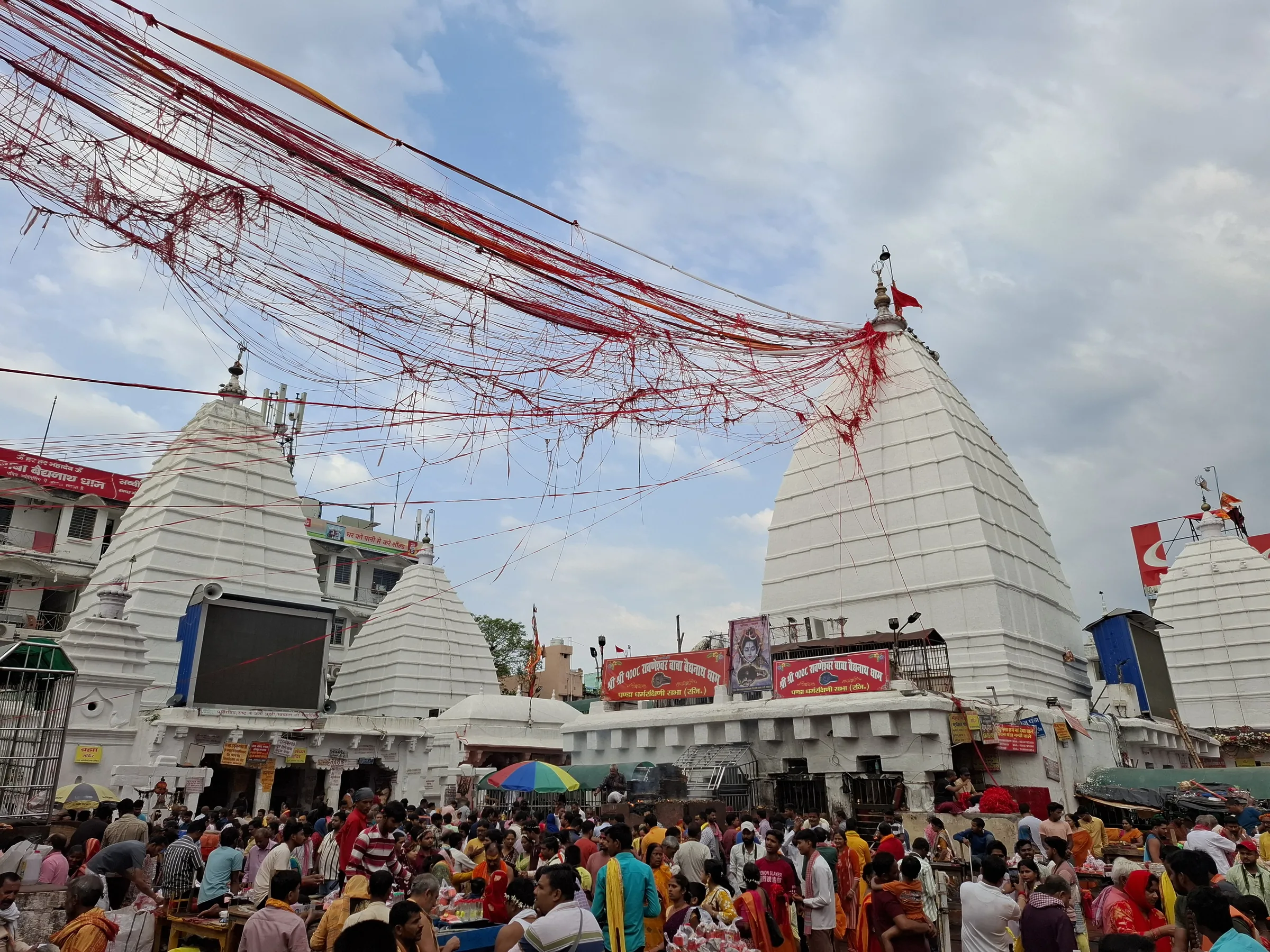
The Baidyanath temple complex is enclosed within a sacred precinct containing twenty-two temples, creating a compact religious landscape in which numerous forms of the Divine are brought together. The predominant architectural character is described as Nagara, with pyramidal shikharas and substantial stone masonry. The complex reflects the accumulation of centuries of construction, renovation and royal patronage rather than the work of a single architectural period.
At the centre stands the principal shrine of Lord Vaidyanath. The main temple faces east and is comparatively plain in its exterior treatment, placing emphasis upon the sanctity of the interior rather than elaborate external ornamentation. Its shikhara rises approximately seventy-two feet above the ground in a pyramidal form, traditionally compared in appearance to a blooming lotus.
The most striking feature at the summit is the Panchashula, the five-pointed spear that crowns the temple. Most Shaiva temples are identified visually with the familiar trishula, but the Panchashula expresses a more expansive understanding of Shiva’s cosmic sovereignty. Its five points correspond to the five cosmic acts, or Panchakrityas: Srishti, creation; Sthiti, preservation; Samhara, dissolution; Tirobhava, concealment; and Anugraha, grace.
The symbolism is particularly appropriate to Vaidyanatha. Creation, preservation and dissolution are visible movements of the world, while concealment and grace operate within the deeper field of consciousness. The final act, Anugraha, is the act through which Shiva reveals the truth and liberates the soul. Thus the Panchashula rising above the temple is not merely an architectural ornament. It becomes a declaration of Shiva’s complete sovereignty over existence—from its emergence and dissolution to its concealment and final release.
Near the golden vessels at the summit is the Chandrakanta Mani, described as an eight-petaled lotus jewel associated with lunar energy. The source tradition holds that it channels this energy towards the Jyotirlinga and enhances its healing character. Together with the golden vessels associated with the Maharaja of Gidhaur, it contributes to the distinctive sacred skyline of the temple.
The twenty-two temples within the complex create a miniature sacred universe. Among them are shrines dedicated to Maa Parvati, Maa Kali, Maa Annapurna, Lakshmi Narayan, Kaal Bhairav, Maa Saraswati, Gauri Shankar and Suryanarayan. Each adds another dimension to the spiritual life of the complex—power, nourishment, prosperity, protection, knowledge, divine union and health.
The relationship between the Shiva and Parvati temples is especially significant. They are connected by the red Gathbandhan thread, symbolising the unbreakable bond of divine marriage. The physical connection between the two shrines becomes a powerful visual expression of the unity of Shiva and Shakti.
05 / SACRED LEGENDS
Sacred Legends
The legend of Vaidyanatha is fundamentally a story of restoration. Ravana’s sacrifice is extreme, but Shiva does not glorify the physical suffering itself. What receives divine recognition is the intensity of his surrender. Shiva appears as Vaidya and restores the very heads that Ravana had sacrificed. The physician therefore becomes a central image of the shrine: Shiva does not merely destroy; He repairs, restores and makes whole.
The presence of the Ashvini Kumaras deepens this symbolism. The divine physicians themselves come to worship Shiva, acknowledging Him as the source from which all healing ultimately arises. Medicines, herbs and the sciences of restoration may operate at the level of the body, but the sacred tradition sees their ultimate foundation in the Divine Physician.
The establishment of the Linga at Deoghar adds another dimension to the legend. Ravana’s immense strength proves insufficient to move the sacred form once Shiva has chosen to remain there. The Linga therefore becomes a reminder that divine presence cannot be possessed by worldly power. Ravana wishes to carry Shiva to Lanka, but Shiva establishes Himself where He chooses.
The depression traditionally attributed to Ravana’s thumb provides a physical point of connection between the legendary past and the experience of the present pilgrim. A story that belongs to the mythic age is encountered through the stone itself. The devotee does not merely hear about Ravana’s frustration; tradition says that the mark of that moment remains within the sacred Linga.
The sacred identity of Vaidyanatha is further expanded through its association with Goddess Sati. The shrine is revered as the Hriday Peeth, the place where Sati’s heart is believed to have fallen when Vishnu’s Sudarshana Chakra divided her body following the destruction of Daksha’s sacrifice. The heart, traditionally understood as the seat of emotion, love and life-force, gives the shrine a compassionate dimension that complements Shiva’s identity as the healer.
Thus the shrine brings together two complementary symbols. Shiva is the Divine Physician who restores what has been broken, while Shakti is present as the heart—the centre of life, feeling and compassion. Their union is reflected ritually in the Gathbandhan, in which the temples of Shiva and Parvati are symbolically bound together.
The local tradition surrounding Baiju Gadariya adds another layer to the story. While the broader Puranic account identifies the divine intervention with Vishnu, local folklore remembers the simple shepherd who temporarily held the Linga and thereby became connected with the establishment of Baidyanath’s sacred identity. This coexistence of Puranic and regional memory is characteristic of a living tirtha, where the great cosmic narrative and local devotion continue side by side.
06 / SPIRITUAL SIGNIFICANCE
Spiritual Significance
The deepest significance of Vaidyanatha lies in the meaning of healing. The ordinary understanding of a physician is one who treats physical disease. Vaidyanatha expands that meaning. Shiva as the Divine Physician addresses the deeper afflictions of existence—the wounds created by fear, attachment, ignorance and the consequences of one’s actions. The restoration of Ravana’s heads therefore becomes a symbol of a larger possibility: that what has been damaged need not remain permanently broken.
The tradition surrounding the shrine has consequently associated Vaidyanatha with those who seek relief from illness. The source records a long-standing belief that the temple draws devotees suffering from chronic ailments, including skin diseases and mental afflictions. Water that has bathed the Jyotirlinga is regarded by devotees as possessing healing power, while the disciplined physical effort of pilgrimage itself can be experienced as a form of purification and renewal.
Yet the spiritual significance of the shrine goes beyond physical healing. The fivefold symbolism of the Panchashula places Anugraha, divine grace, at the highest point of Shiva’s activity. The ultimate cure is therefore not simply the removal of suffering. It is the restoration of the soul to its true nature through grace.
The concept of Bhukti-vardhana associated in the source with the Vaidyanatha Linga adds another important dimension. The shrine does not reject worldly life in favour of liberation alone. Rather, it is understood as blessing the devotee with the capacity to live in the world while simultaneously guiding the consciousness towards Mukti. Enjoyment and liberation are not necessarily enemies when life is lived in awareness of the Divine.
The presence of the Shakti Peetha makes this understanding still richer. Shiva as healer and Sati as heart represent complementary dimensions of spiritual restoration. Healing requires both consciousness and compassion, both transcendence and tenderness. The masculine and feminine principles are therefore not separate powers competing for prominence; they are understood as eternally united.
The pilgrimage itself can also be understood as an act of healing. The Kanwariya carries sacred water over a long distance, accepts physical hardship, observes discipline and finally pours the water upon Shiva. The burden carried upon the shoulders becomes a visible representation of the burdens of worldly existence. To surrender the water at the feet of Vaidyanatha is therefore to symbolically surrender one’s burdens to the Divine Physician.
07 / FESTIVALS AND RITUALS
Festivals and Rituals
The daily ritual life of Baidyanath Dham follows an established schedule, beginning in the early hours of the morning. The temple opens at approximately 4:00 AM for the Sarkari Puja, a formal sixteen-step ritual performed by the head priest. The rhythm of worship continues through the day and into the evening, creating a continuous cycle of offering, adornment and prayer.
One of the most distinctive rituals of the temple is the Gathbandhan Puja. Married couples and devotees seeking harmony in marriage or fulfilment of family-related aspirations purchase long red threads. These are tied to the Panchashula of the Shiva temple and extended across the courtyard towards the shikhara of the Parvati temple. The resulting red threads create a striking visual expression of the sacred union of Shiva and Shakti. The ritual symbolises marital harmony, longevity and the continuity of family life.
Another distinctive feature is Sparsh Darshan, the opportunity for devotees to touch the sacred Linga. Unlike some major Jyotirlinga shrines where devotees remain separated from the sanctum, Baidyanath permits direct physical contact under the prescribed temple arrangements. Devotees may touch the sacred stone, perform Jalabhisheka and offer Bel leaves. This direct contact is particularly meaningful in a temple whose central identity is healing, for the touch of the Kamna Linga is traditionally believed to transmit restorative grace.
The great annual expression of devotion at Baidyanath is the Shravani Mela, which transforms Deoghar during the month of Shravan. Millions of devotees, known as Kanwariyas, undertake the arduous journey carrying sacred Ganga water to the feet of Baba Baidyanath. The pilgrimage begins at Sultanganj, where devotees collect Gangajal, place it in decorated bamboo Kanwars and then walk barefoot for roughly 105 to 108 kilometres to Deoghar.
The Kanwar pilgrimage is governed by discipline. Devotees traditionally observe vegetarianism and celibacy, wear saffron clothing and take care that the Kanwar does not touch the ground. Throughout the journey the air resounds with the cry “Bol Bam!”, the repeated invocation of Shiva. The physical burden of the Kanwar becomes a spiritual symbol: the devotee carries the weight of worldly existence and finally lays it before the Divine Physician.
The culmination comes when the sacred Ganga water is poured over the Vaidyanatha Linga. The water begins its journey in one sacred place and is finally offered at another, linking the Ganga and Vaidyanatha through the body and effort of the pilgrim. The entire journey becomes an extended act of surrender.
Mahashivaratri and the month of Shravan bring particularly large numbers of devotees to the temple, while the daily Shringar Aarti and other established forms of worship continue throughout the year. The festival calendar therefore transforms the temple periodically, but the underlying rhythm of worship never ceases.
08 / PILGRIMAGE INFORMATION
Pilgrimage Information
Deoghar lies in the Santhal Parganas division of Jharkhand, approximately 243 kilometres from Ranchi. The city has developed a substantial pilgrimage infrastructure, with access by air through Deoghar Airport and by rail through Deoghar and Jasidih. Accommodation ranges from traditional dharamshalas to modern hotels, allowing the town to receive pilgrims throughout the year.
The temple remains open daily from the early morning into the evening, with extended activity during major festivals and especially during Shravan. Visitors should observe the customary expectations of modest dress and temple discipline. The source particularly recommends participation in the Sarkari Puja or the evening Shringar Aarti for those wishing to experience the ritual life of the shrine more fully.
For the pilgrim, however, the journey to Vaidyanatha is not merely a matter of reaching Deoghar. The sacred experience begins with preparation. During Shravan, the Kanwariya undertakes the journey itself as a vrata. The water is collected at Sultanganj, carried with discipline and finally offered to Shiva. In this form of pilgrimage, the road becomes part of the temple, the walking becomes part of the worship and the physical effort becomes part of the prayer.
The temple precinct itself should be approached with awareness of its living character. It is simultaneously a place of worship, a centre of hereditary priestly service, a destination for families seeking blessings and healing, and a major pilgrimage institution. The Panda community, traditionally composed largely of Maithil Brahmins, has served pilgrims for generations. These hereditary priests preserve ritual knowledge and maintain records of pilgrim families, creating relationships that may extend across many generations.
The Sardar Panda occupies the leading position within this priestly system. The Pandas are not merely ritual specialists but also custodians of oral history and participants in the traditional Jajmani system, through which particular priestly families maintain relationships with devotees from particular regions of India. This social structure has helped preserve the continuity between the temple and the families who return to Baba Baidyanath generation after generation.
A visit to Deoghar can also extend beyond the central temple to the sacred landscape around the town. The surrounding hills and sites, including Trikut Pahar and Tapovan, form part of the wider geography through which the religious identity of Deoghar has developed. The temple stands at the centre of a sacred landscape whose influence extends into the cultural and economic life of the region.
09 / UNIQUE FEATURES
Unique Features
Vaidyanatha possesses a combination of characteristics that distinguishes it within the Dwadasha Jyotirlinga tradition.
Its first great distinction is its identity as the Lord of Physicians. The legend itself explains the name through Shiva’s restoration of Ravana’s severed heads, while the arrival of the Ashvini Kumaras reinforces the connection between the shrine and divine medicine. The temple’s healing traditions continue to attract devotees who seek relief from physical and spiritual suffering.
Its second distinction is its status as both a Jyotirlinga and a Shakti Peetha. The association with the heart of Sati gives the shrine a powerful Shakta dimension alongside its Shaiva identity. The union of Shiva and Shakti is not merely philosophical; it is enacted visibly through the Gathbandhan linking the Shiva and Parvati temples.
The third is the Panchashula, a rare five-pointed emblem crowning the temple. Its symbolism goes beyond the familiar threefold functions of creation, preservation and dissolution to include concealment and grace. In the context of Vaidyanatha, this makes the temple’s highest architectural point a reminder that Shiva’s ultimate act is not destruction but liberation through grace.
The fourth is the presence of twenty-two shrines within the temple complex, allowing the pilgrim to encounter multiple dimensions of Hindu sacred thought within a relatively compact space. Shiva and Parvati, Kali, Annapurna, Lakshmi Narayan, Bhairava, Saraswati, Surya and other deities together form a complete sacred circuit around the principal Jyotirlinga.
The fifth is Sparsh Darshan, the tradition that permits devotees to touch the sacred Linga and perform Jalabhisheka directly. In a temple devoted to Shiva as Vaidya, this physical intimacy with the sacred form has particular emotional and spiritual significance.
The sixth is the extraordinary scale of the Shravani pilgrimage. The Kanwariyas transform the journey from Sultanganj to Deoghar into a moving river of devotion. Sacred Ganga water is carried by millions of devotees and finally offered to Vaidyanatha, making the physical journey itself one of the defining expressions of devotion to the shrine.
The shrine also possesses a distinctive living social tradition through the Pandas of Deoghar, whose hereditary relationships with pilgrim families have preserved an unusual continuity between the temple and devotees across generations.
There is, however, an important traditional question concerning the identity of the Vaidyanatha Jyotirlinga. Parli Vaijnath in Maharashtra also lays claim to being the Vaidyanatha Jyotirlinga. The source records traditions connecting Parli with Savitri and Satyavan, Markandeya and later renovations associated with Ahilyabai Holkar. It also points to the phrase “paralyāṁ vaidyanāthaṁ ca” in the Dvadasha Jyotirlinga Stotram as support for Parli’s claim.
This does not diminish the sanctity of Deoghar. Rather, it reveals an important feature of India’s sacred geography: different regions may preserve ancient traditions identifying their own shrine with a great Puranic sacred name. For a book on temples, this distinction is worth preserving rather than presenting the matter as though there were no traditional complexity.
10 / SCRIPTURAL REFERENCES
Scriptural References
The sacred identity of Vaidyanatha is grounded principally in the Shiva Purana, particularly the Kotirudra Samhita, where the Jyotirlinga tradition and the penance of Ravana are described. The source identifies Chapter 28 of the Kotirudra Samhita as an important textual reference for the Vaidyanatha tradition. The Linga is described as Swayambhu, self-manifested, and as possessing the power to grant both worldly fulfilment and the path towards liberation.
The Ravana narrative occupies a central place in this scriptural tradition. His extraordinary tapas, including Panchagni austerity and exposure to extreme cold, demonstrates the intensity of his devotion to Shiva. The sacrifice of his heads culminates in Shiva’s appearance as the Divine Physician and the restoration of his body. The story thereby provides the theological foundation for the name Vaidyanatha.
The Matsya Purana is also associated with the sacred antiquity of the site and, in the tradition presented in the source, with the Shakti Peetha identity of Deoghar. The heart of Sati is believed to have fallen here, giving the shrine its designation as Hriday Peeth and establishing the presence of Shakti alongside the Jyotirlinga of Shiva.
The Sanskrit verse traditionally associated with the shrine celebrates Vaidyanatha as the Lord who eternally dwells with Girija and whose feet are worshipped by both gods and asuras. Its language places the deity within the larger sacred world of Shiva while simultaneously emphasising His independent sanctity as the Divine Physician.
The tradition also preserves the verse:
vaidyābhyāṃ pūjitaṃ satyaṃ liṅgam etat purātanam ।
vaidyanātham iti prakhyātaṃ sarva-kāma-pradāyakam ॥
The ancient Linga, worshipped by the divine physicians, is celebrated as Vaidyanatha, the giver of fulfilment. The presence of the Ashvini Kumaras in the narrative therefore becomes more than an episode in a legend; it becomes a scriptural affirmation of Shiva as the ultimate source of healing.
The Dvadasha Jyotirlinga tradition also gives rise to the question of Parli Vaijnath, whose claim is supported by the reading “paralyāṁ vaidyanāthaṁ ca”. The coexistence of Deoghar’s strong Puranic and living devotional tradition with Parli’s textual and regional claim is part of the broader history of Jyotirlinga traditions and should be acknowledged when presenting Vaidyanatha in a comprehensive temple volume.
Ultimately, the scriptural and traditional identity of Vaidyanatha converges upon one profound image: Shiva as the One who restores. Ravana comes with an extreme offering and receives restoration. The Ashvini Kumaras, themselves divine physicians, bow before the source of their own knowledge. The heart of Sati gives the shrine its Shakti dimension. The Panchashula rises above the temple proclaiming the five cosmic acts, culminating in grace. And generations of pilgrims continue to arrive at Deoghar carrying their burdens, hopes and prayers.
Vaidyanatha therefore stands not merely as a place where Shiva is worshipped as a physician, but as a sacred reminder that the deepest healing is the restoration of the relationship between the individual and the Divine. In Deoghar, the Lord of Physicians remains the one before whom the broken, the burdened and the hopeful come to surrender—and from whom they seek the grace to become whole again.
11 / PHOTOGRAPHS
From the whole to the detail.
Select a photograph to explore it at a larger scale.
12 / LOCATION & MAP
Place the story on the map.
PLACE THIS STORY ON THE MAP
Deoghar, Jharkhand
Jharkhand, India
ABOUT THIS FIELD ENTRY
Rooted in the Bharat Ke Wow archive.
This page is part of the Bharat Ke Wow series on the Dvādaśa Jyotirlingas. Sacred narratives are presented as temple tradition.
Read the original entry ↗