


01 / INTRODUCTION
Somnath, Gujarat
The First Jyotirlinga
तत्राद्यः सोमनाथो हि चन्द्रदुःखक्षयङ्गरः।
क्षयकुष्ठादिरोगाणां नाशकः पूजनान्मुने॥
शिवावतारः सोमेशो लिङ्गरूपेण संस्थितः।
सौराष्ट्रेशुभदेशे च शशिना पूजितः पुरा॥
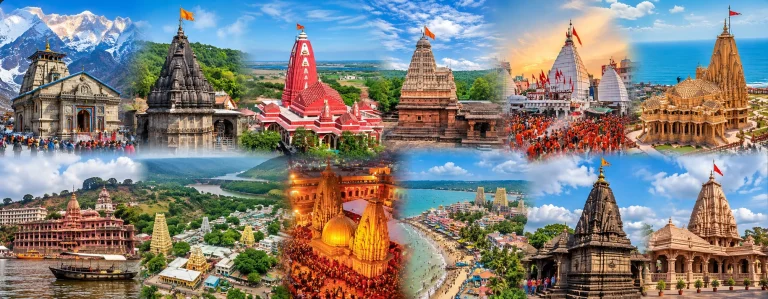
Somnath Temple is one of the most revered shrines of Bhagavan Shiva and is traditionally celebrated as the first among the twelve Jyotirlingas. Situated at Prabhas Patan near Veraval in Gujarat, the temple stands majestically on the shores of the Arabian Sea. For centuries, Prabhas has been regarded as a sacred Tirtha Kshetra, drawing pilgrims to a landscape where mythology, sacred geography, history and devotion converge.
The very name Somnath, meaning “Lord of Soma” or “Lord of the Moon,” recalls the temple’s intimate association with Chandra, the Moon God, whose worship of Bhagavan Shiva is believed to have established the sanctity of this kshetra. Yet Somnath is not remembered only for its ancient legends. Its long and turbulent history of destruction, reconstruction and renewed worship has given it a unique place in the religious and cultural memory of Bharat. The temple that stands today is therefore both an ancient sacred centre and a powerful symbol of continuity and renewal.
02 / STHALA PURANA
Sthala Purana
The sacred origin of Somnath is connected with the story of Chandra, the Moon God. According to the Shiva Purana, Chandra was married to the twenty-seven daughters of Daksha Prajapati, representing the twenty-seven lunar constellations. Of all his wives, however, Chandra showed particular affection towards Rohini. Daksha, angered by this partiality, cursed Chandra to lose his radiance and gradually diminish.
As the curse took effect and his brilliance faded, Chandra sought a means of relief. He approached Bhagavan Brahma, who directed him to Prabhas Tirtha, the sacred region where Somnath stands today. Chandra came to the Triveni Sangam at Prabhas, traditionally identified with the confluence of the Hiran, Kapila and Saraswati rivers. There, beside the sacred waters and under the open sky, he performed severe penance and devotedly recited the Mahamrityunjaya Mantra in worship of Bhagavan Shiva.
Pleased with Chandra’s devotion, Bhagavan Shiva manifested before him as a radiant column of divine light and bestowed His grace upon him. The curse of Daksha could not be completely removed, but Shiva decreed that Chandra would thereafter wax and wane in a regular cycle. Thus, the Moon would periodically lose his radiance only to regain it once again. The waxing and waning of the Moon therefore came to be understood as a visible reminder of Shiva’s boon to Chandra.
In gratitude, Chandra is traditionally said to have built the first temple for Somnath in gold. Bhagavan Shiva came to be worshipped here as Somnath, the Lord of the Moon, while the sacred region came to be known as Prabhasa, the place of splendour, recalling the restoration of Chandra’s radiance.
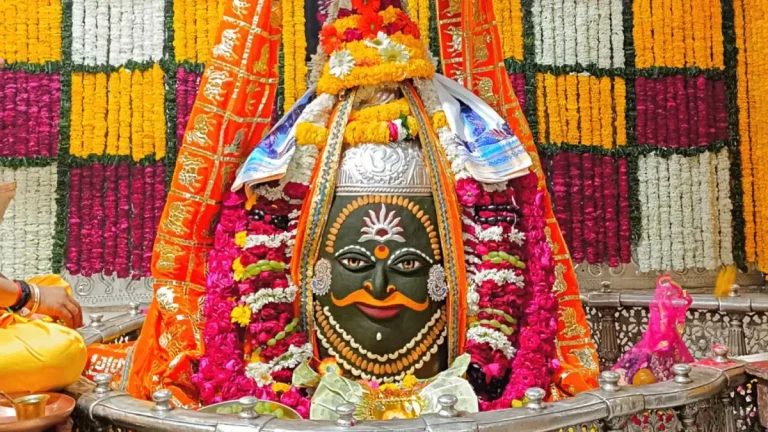
Somnath is traditionally regarded as the Adi Jyotirlinga, the first of the twelve Jyotirlingas, the manifestations of Bhagavan Shiva as divine light. The Skanda Purana and Shiva Purana place Somnath at the beginning of the Jyotirlinga tradition, while the Mahabharata also refers to the sacred region of Prabhasa. The story of Chandra has consequently given Somnath a profound devotional symbolism: just as the Moon regained his lost radiance through the grace of Shiva, devotees come to Somnath seeking the restoration of what may have been lost in their own lives—hope, health, strength, peace or happiness.
03 / HISTORICAL JOURNEY
Historical Journey
The history of Somnath is as remarkable as its sacred origin. Although the precise date of the earliest temple cannot be established with certainty, the antiquity of Prabhasa as a sacred region is reflected in ancient literature, and Somnath had certainly become an important pilgrimage centre by the early medieval period. Over the centuries, the temple was repeatedly attacked and destroyed, yet worship continued and the shrine was rebuilt time and again. This extraordinary cycle of destruction and reconstruction has become inseparable from the identity of Somnath itself.
Traditional accounts describe a succession of temples associated with the sacred site. The first is said to have been built by Chandra in gold, followed by a silver temple attributed to Ravana and a sandalwood temple associated with Bhagavan Krishna. In the historical period, the shrine came to be constructed in stone, with various rulers contributing to its development. The historical temple is often associated with the Maitraka or early Chalukya traditions, while the Solanki king Mularaja is traditionally connected with the construction or renovation of a grand stone temple around the end of the tenth century.
In 1026 CE, Somnath was attacked by Mahmud of Ghazni, whose forces entered Gujarat and plundered the temple. The Shiva lingam was destroyed and considerable wealth was carried away. The raid was recorded in Persian historical traditions and became one of the most remembered episodes in the history of the shrine. Yet the destruction did not bring an end to Somnath. The temple was restored, and the sacred tradition continued.
The pattern was repeated during the centuries that followed. In 1299, the forces of Alauddin Khilji, led by Ulugh Khan, invaded Gujarat and attacked Somnath. The temple was again subjected to destruction and its sacred image was carried away. Later, the Chudasama king Mahipala and his son Khengara undertook the restoration of Somnath and the reinstallation of the lingam. Further attacks followed, including those associated with Zafar Khan in 1395 and Mahmud Begada in 1451. Yet each period of destruction was followed by renewed efforts to restore the shrine and continue worship.
The temple suffered again during the Mughal period. Aurangzeb ordered its destruction in the seventeenth century, and by 1706 the shrine had been razed. Yet the worship of Somnath did not disappear. In 1783, Queen Ahilyabai Holkar of Indore constructed a smaller temple nearby, allowing devotees to continue worshipping the deity even while the original site remained in ruins. The continuation of worship through these difficult centuries became an important part of Somnath’s enduring story.
The modern reconstruction of Somnath began after India’s independence. In November 1947, Sardar Vallabhbhai Patel visited the ruins and resolved to see the ancient shrine restored. With the involvement of leaders such as K. M. Munshi, the reconstruction was undertaken, and traditional Sompura temple architects were engaged to create the new temple in accordance with the architectural traditions of Gujarat. Construction began around 1950, and on 11 May 1951, Dr. Rajendra Prasad, the first President of India, performed the prana pratishtha of the reconstructed Jyotirlinga. Somnath once again stood as a living temple, its reconstruction becoming an important symbol of cultural and civilizational renewal.
04 / TEMPLE ARCHITECTURE
Temple Architecture
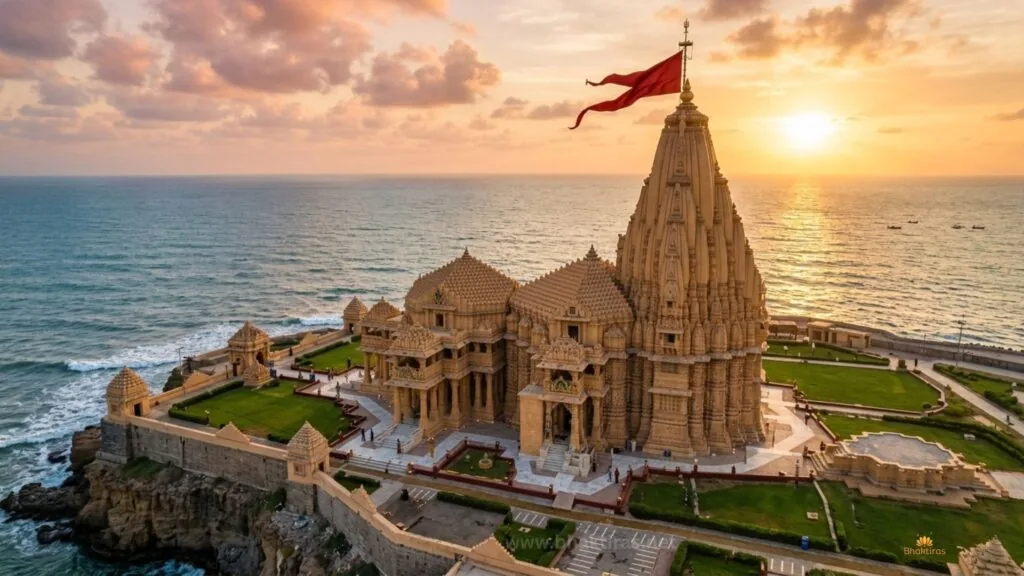
The present Somnath Temple is a striking example of Māru-Gurjara architecture, also associated with the Chalukya or Solanki tradition of western India. Constructed in honey-coloured limestone, the temple draws inspiration from the medieval architectural traditions of Gujarat while representing a modern reconstruction of the sacred shrine. Its design combines monumental scale with intricate craftsmanship and creates a powerful visual relationship between the temple and the Arabian Sea beside it.
The principal shikhara rises dramatically above the temple, reaching approximately fifty metres in height. At its summit is the temple’s flag, which is changed three times each day. The soaring shikhara and the constantly moving flag form one of the most recognisable features of Somnath, particularly when the temple is approached from a distance.
The exterior walls are richly decorated with carvings of Hindu deities, floral motifs, dancers and geometric patterns. Although the present structure is a modern reconstruction, the artisans employed traditional methods of craftsmanship, preserving the character of India’s temple-building traditions. The sculptural detail extends from larger divine figures to delicate latticework and ornamental elements.
One of the distinctive features associated with the temple complex is the Baan-Stambh, or arrow pillar. It marks the celebrated geographical alignment extending southwards from Somnath across the ocean towards Antarctica, with no intervening landmass along that line. The pillar has consequently become an important symbolic feature of the temple complex.
The temple is entered through the Digvijay Dwar, which leads into the spacious temple precinct. The Sabha Mandap provides a gathering space for devotees before the inner sanctum, while deeper within the complex lies the Garbhagriha, where the sacred Jyotirlinga is enshrined. The temple also contains a Nritya Mandap, recalling the traditional place of music and dance within the worship of the deity. The overall arrangement guides the devotee progressively from the outer world towards the sanctum at the heart of the temple.
The setting of Somnath is itself an integral part of its architectural and spiritual character. Standing beside the Arabian Sea, the temple commands a dramatic coastal landscape, while the nearby Triveni Sangam adds another sacred dimension to the pilgrimage. The gardens, pathways and open surroundings create a sense of spaciousness around the temple.
05 / SACRED LEGENDS
Sacred Legends
The story of Chandra remains the central sacred narrative of Somnath, but the wider sacred landscape of Prabhas is associated with several other important traditions. The region is intimately connected with Bhagavan Krishna, whose earthly journey is traditionally said to have reached its conclusion at Prabhas. This association adds another dimension to the sanctity of the region and places Somnath within a broader sacred landscape that extends beyond the immediate shrine of Bhagavan Shiva.
The traditions of Prabhas therefore bring together different strands of Hindu sacred memory. The manifestation of Shiva as Somnath, the penance of Chandra, the sacred waters of the Triveni Sangam and the association of the region with Bhagavan Krishna collectively contribute to the unique spiritual character of the kshetra.
06 / SAINTS, LITERATURE & SCRIPTURE
Saints, Literature & Scripture
The sanctity of Somnath is preserved not only through living tradition but also through its place in Hindu sacred literature. The Shiva Purana records the story of Chandra’s penance and the manifestation of Bhagavan Shiva at Prabhas, while the Skanda Purana, particularly its Prabhasa Khanda, contains important traditions concerning the sacred region and the spiritual benefits associated with pilgrimage and worship there. The Mahabharata too preserves the antiquity of Prabhasa as a sacred place.
The Skanda Purana tradition also preserves the account of Kubera’s worship of Bhagavan Shiva at this sacred kshetra. According to the cited passage, Shiva granted Kubera several boons, including friendship with Shiva, lordship over wealth and the position of a guardian of the northern direction. Such traditions reinforce the conception of Somnath not merely as a historical temple, but as a sacred field in which devotion to Shiva brings divine grace.
07 / SPIRITUAL SIGNIFICANCE
Spiritual Significance
Somnath occupies a special place in the spiritual imagination of devotees because of its association with the Jyotirlinga, the divine light of Bhagavan Shiva. The temple is traditionally regarded as a powerful centre of worship, pilgrimage and spiritual purification. Ancient scriptural traditions associate worship at Somnath with freedom from sins and karmic debts, while bathing in the sacred waters of the Triveni Sangam before worship is regarded as an act of purification.
The temple is also revered as a place associated with spiritual upliftment and moksha. The symbolism of the Jyotirlinga as divine light lends particular significance to the pilgrimage: the devotee approaches the light of Shiva not merely as an external object of worship but as a reminder of the divine presence within. The association of Prabhas with the final earthly journey of Bhagavan Krishna further enhances the spiritual importance of the region.
The story of Chandra’s restoration has also shaped popular devotional beliefs surrounding Somnath. Just as the Moon regained his lost radiance through Shiva’s grace, devotees come to the temple seeking restoration in their own lives. Health, prosperity, relief from difficulties and the removal of obstacles are among the aspirations associated with worship at Somnath. Rudrabhisheka is mentioned as one form of worship undertaken by devotees seeking Shiva’s blessings.
The connection with Chandra also gives Somnath a special place in traditions of astrological worship. Devotees who associate difficulties in their lives with adverse lunar influences or Chandra Dosha may undertake worship at Somnath, particularly on Mondays or during significant lunar occasions. Special prayers are associated with lunar eclipses, when devotees consider worship and meditation at this sacred shrine particularly auspicious.
08 / WORSHIP, RITUALS & FESTIVALS
Worship, Rituals & Festivals
The rhythm of worship at Somnath continues throughout the day. The source material describes the temple as open from the early morning until late evening, with darshan available during the principal visiting hours. Three daily aartis are traditionally mentioned at 7:00 in the morning, noon and 7:00 in the evening. For pilgrims, the evening worship provides a particularly evocative experience, as the temple and the surrounding seashore are illuminated after sunset.
The connection of Somnath with Chandra also gives lunar occasions a special place in its devotional calendar. During Chandra Grahana, special prayers are held at the temple, and devotees consider the period particularly suitable for prayer, meditation and worship associated with the Moon and Bhagavan Shiva.
The temple also presents a nightly sound-and-light programme narrating the history and legends of Somnath. Set against the illuminated temple, the presentation brings together the sacred traditions and historical journey of the shrine for pilgrims and visitors.
09 / WHAT MAKES SOMNATH UNIQUE
What Makes Somnath Unique
What makes Somnath distinctive is the remarkable convergence of sacred mythology, ancient pilgrimage tradition, dramatic history and modern reconstruction. It is traditionally regarded as the first of the twelve Jyotirlingas and is inseparably associated with the story of Chandra’s restoration by Bhagavan Shiva. Its location beside the Arabian Sea gives the temple an extraordinary physical setting, while the Baan-Stambh has become one of its most recognisable features.
Yet perhaps the most distinctive feature of Somnath is the story of its repeated destruction and rebuilding. Across centuries of political upheaval, the temple was attacked and damaged repeatedly, but worship was restored again and again. The reconstruction undertaken after Indian independence added another chapter to this long story, allowing Somnath once more to stand as a living centre of pilgrimage.
Its location on the coast, its association with the Triveni Sangam, its architectural grandeur and its continuing ritual life all contribute to an experience that is very different from that of an ordinary historic monument. Somnath is not merely something to be viewed; it remains a place of worship and pilgrimage.
10 / PILGRIMAGE GUIDE
Pilgrimage Guide
Somnath Temple is situated at Prabhas Patan, adjacent to Veraval in the Saurashtra region of Gujarat. Its position on the Arabian Sea makes the journey to the temple visually striking, particularly as one approaches the coastal landscape. The temple is approximately 400 kilometres southwest of Ahmedabad.
For pilgrims arriving by air, Diu Airport is approximately 85–90 kilometres away, while Keshod Airport is approximately 55 kilometres from Somnath. Rajkot and Ahmedabad offer additional air connections for travellers coming from other parts of India, after which the journey can be continued by road or rail.
Somnath has its own railway station, located approximately 1.5–2 kilometres from the temple. Veraval Junction, around seven kilometres away, is the larger railway station and has connections with several major cities. From Veraval, pilgrims can reach the temple by taxi, auto-rickshaw or bus.
The temple is also accessible by road from Rajkot, Porbandar, Bhavnagar, Ahmedabad and other major centres of Gujarat. State transport buses, private buses, taxis and private vehicles provide convenient options for reaching Prabhas Patan.
The source material describes the temple as being open from approximately 6:00 AM to 9:00 PM, with brief afternoon closures. Pilgrims planning their visit may wish to experience the evening aarti and the subsequent sound-and-light presentation. Mobile phones, cameras and leather articles are stated to be prohibited inside the temple and must be deposited outside.
As a major pilgrimage centre, Somnath offers accommodation ranging from pilgrim guesthouses and dharamshalas to hotels of different categories.
11 / SOURCES & REFERENCES
Sources & References
The principal sacred sources referred to in this chapter are the Shiva Purana, the Skanda Purana, particularly the Prabhasa Khanda, and the Mahabharata, alongside the traditional accounts associated with the Sthala Purana of Somnath. Historical material concerning the temple’s medieval destruction and reconstruction, as well as its reconstruction in the modern period, forms the historical basis for understanding Somnath’s remarkable journey through time.
12 / PHOTOGRAPHS
From the whole to the detail.
Select a photograph to explore it at a larger scale.
13 / LOCATION & MAP
Place the story on the map.
PLACE THIS STORY ON THE MAP
Prabhas Patan, near Veraval, Gujarat
Gujarat, India
ABOUT THIS FIELD ENTRY
Rooted in the Bharat Ke Wow archive.
This page is part of the Bharat Ke Wow series on the Dvādaśa Jyotirlingas. Sacred narratives are presented as temple tradition.
Read the original entry ↗