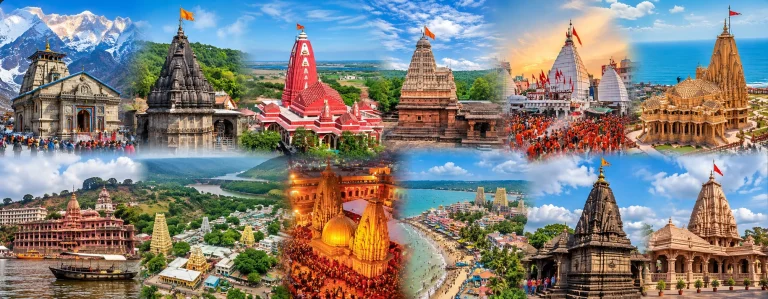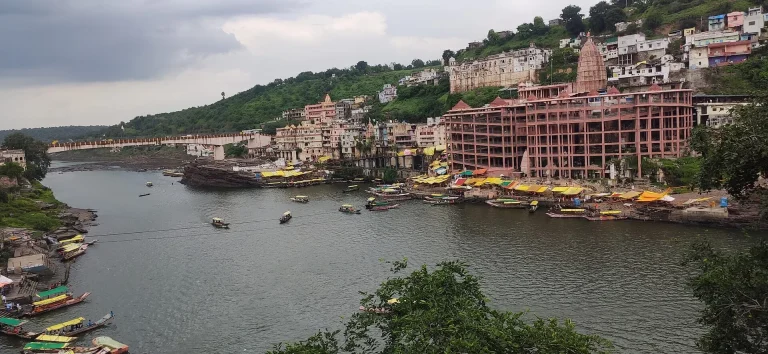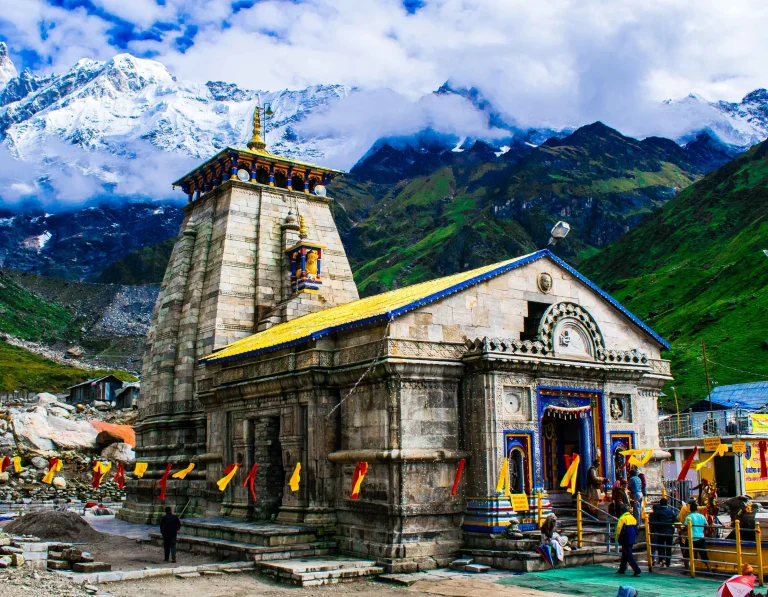



01 / INTRODUCTION
Mahakaleshwar Jyotirlinga, Ujjain
The Sovereign of Time
avantyāṁ ca mahākālo liṅgatrayam idaṁ śubham |
tasya darśanamātreṇa naro mucyeta bandhanāt ||
In Avantika, Ujjain, resides Mahākāla, the auspicious Linga. By the mere sight of Him, a person becomes freed from bondage.
— Shiva Purana, Kotirudra Samhita
On the sacred banks of the Shipra River in Madhya Pradesh stands the ancient city of Ujjain, known in earlier times as Avantika, and at its heart rises the revered Mahakaleshwar Jyotirlinga. One of the twelve most sacred abodes of Bhagavan Shiva, Mahakaleshwar occupies a unique place in the spiritual imagination of Bharat. Here Shiva is worshipped as Mahakal — the Lord of Time, the One who stands beyond the cycles of creation, preservation and dissolution.
The presiding Jyotirlinga is traditionally regarded as Swayambhu, self-manifested rather than established through ritual consecration. This inherent presence gives the shrine a distinctive spiritual character. Mahakaleshwar is not simply worshipped as a deity who governs time; He is understood as the Divine Principle that transcends time itself. In the presence of Mahakal, the fear of death, the limitations of worldly existence and the passage of time are contemplated from a deeper spiritual perspective.
The sacred identity of Mahakaleshwar is inseparable from that of Ujjain. For centuries, the city has been associated with astronomy, mathematics, literature, pilgrimage and the measurement of time. Ancient Indian astronomical traditions placed Ujjain at a position of extraordinary importance, and the city came to be regarded as the Nabhi-desha, or navel of the earth. Its connection with the Prime Meridian and the Tropic of Cancer further strengthened the association between Ujjain and the measurement of cosmic time.
This extraordinary meeting of sacred geography, astronomy and Shaiva philosophy gives Mahakaleshwar its distinctive character. Ujjain was a city where time was calculated, the heavens were studied and the movements of the planets were observed, while at its centre stood Mahakal, the Lord who is believed to govern time itself. Even today, the spiritual identity of Ujjain is inseparable from this ancient relationship between Kaal and Mahakal.
02 / SACRED ORIGIN / STHALA PURANA
Sacred Origin / Sthala Purana
The sacred origin of Mahakaleshwar is deeply rooted in the Puranic traditions of the Shiva Purana and Skanda Purana. The temple’s antiquity is traditionally taken back to the earliest epochs of creation, with accounts attributing its original establishment to Prajapita Brahma. Yet the central legend of Mahakaleshwar concerns the manifestation of Bhagavan Shiva as Mahakala to protect the devotees of Ujjain from forces of destruction.
In the ancient city of Avanti, which had become a renowned centre of Vedic learning, a righteous king named Chandrasena ruled over the kingdom. Chandrasena was an ardent devotee of Bhagavan Shiva, and his devotion inspired a young farmer’s boy named Shrikhar. The boy longed to worship Shiva alongside the king, but palace guards prevented him from approaching the royal worship. Undeterred, Shrikhar began worshipping Shiva on his own, using a simple stone near the banks of the Shipra River as the object of his devotion.
At this time, Ujjain was threatened by rival rulers, King Ripudamana and King Singhaditya, who sought to seize the city’s wealth with the assistance of a powerful demon named Dushana. Dushana had received a boon from Brahma that made him almost invincible, and as the invading forces descended upon Avanti, the city’s inhabitants and devotees of Shiva were placed in great danger.
Shrikhar, together with the priest Vridhi, also known in some traditions as Veda Priya, turned to intense prayer. Their devotion became a collective cry for divine protection. In response to the prayers of His devotees, Bhagavan Shiva manifested in His most formidable form as Mahakala. With a single terrible Humkara, the Lord destroyed Dushana and his forces and brought the threat against Ujjain to an end.
The devotees then prayed to Shiva to remain permanently in Ujjain. Moved by their devotion, the Lord agreed and manifested as a radiant, self-manifested Linga. From that moment, Mahakaleshwar became the eternal guardian and patron deity of Ujjain. He was not merely the deity worshipped within the city; in the sacred imagination of its people, He became its true sovereign.
The tradition therefore gives Mahakaleshwar a distinctive relationship with the city. Ujjain is understood to exist under the protection of its divine king, while Mahakal remains the sovereign who transcends the ordinary limitations of earthly rulers and worldly time.
03 / HISTORICAL JOURNEY
Historical Journey
The physical history of Mahakaleshwar is a story of destruction, survival and renewal. The temple stood for centuries as an important centre of pilgrimage, particularly during the period of the Paramara dynasty, when Ujjain flourished as an important political, cultural and religious centre. The prosperity of the city and the importance of Mahakaleshwar were reflected in the literature and traditions of the period.
The medieval period, however, brought severe upheavals. In 1234–35 CE, Sultan Iltutmish of the Slave Dynasty led a raid on Ujjain and demolished the Mahakaleshwar temple. According to the historical tradition preserved in the source, the Jyotirlinga was dismantled and thrown into the nearby Kotiteerth Kunda, while the silver Jaladhari and other valuable objects were looted. For several centuries the grand temple structure remained absent, yet the sanctity of the site did not disappear. Devotees continued to regard the place as sacred and maintained worship at the location associated with Mahakal.
Further attacks associated with Jalaluddin Khalji and Alauddin Khalji added to the destruction suffered by the city. Yet the sacred identity of Mahakal remained alive. The tradition of the Mahakal Van, the forest of Mahakal, continued to preserve the memory of the deity even during periods when the monumental temple itself no longer stood in its earlier form.
The revival of the temple came during the rise of the Maratha Empire in the eighteenth century. As Maratha power expanded across Malwa, a wider religious and cultural revival took place. In the 1730s, Maratha General Ranoji Shinde, serving under Peshwa Bajirao I, initiated the reconstruction of the Mahakaleshwar Temple. His Diwan, Ramchandra Sukthankar, also known as Ramchandra Baba Shenvi, used his personal wealth in the rebuilding of the shrine. The reconstructed temple combined traditional architectural elements with the architectural sensibilities of the Maratha period.
The Scindias of Gwalior subsequently continued to patronise the temple, contributing to its maintenance and restoration, including the marble walkways around the shrine. After Indian independence, the administration of the temple came under the Collectorate, while recent decades have seen major expansion of the surrounding pilgrimage infrastructure. The development of Mahakal Lok has added a new chapter to the long history of the shrine.
Thus, the history of Mahakaleshwar mirrors the very idea represented by its presiding deity. Structures may fall, kingdoms may change and political powers may disappear, but the sacred presence of Mahakal continues.
04 / TEMPLE ARCHITECTURE
Temple Architecture
The Mahakaleshwar Temple presents a distinctive synthesis of architectural influences, including Bhumija, Maratha and Chalukyan traditions. Unlike many temples that spread horizontally around a central sanctum, Mahakaleshwar possesses a striking vertical organisation, creating a five-tiered sacred structure in which different manifestations of Shiva occupy different levels. One of these levels lies below ground and houses the principal Jyotirlinga.
The towering shikhara is among the most striking features of the temple. It follows the Bhumija Nagara tradition, characterised by a carefully organised superstructure of projections and miniature spires. These smaller kutastambhasrise in vertical and horizontal rows and gradually taper towards the summit. The sculptural richness of the shikhara gives it the appearance of enormous strings of stone ornaments rising towards the sky.
The temple’s vertical arrangement creates what may be described as a sacred ascent through successive manifestations of Shiva. Deep within the underground Garbhagriha is the Mahakaleshwar Jyotirlinga, whose distinctive south-facing orientation makes it particularly significant. Above it is the shrine of Omkareshwar Mahadev, while the third level contains the shrine of Nagchandreshwar. The latter houses the unusual image of Shiva and Parvati seated upon a ten-hooded serpent and is opened for public darshan only once a year, on Nag Panchami.
Within the sanctum, silver-plated architectural elements and the silver Naag Jaladhari surrounding the massive Linga add to the visual richness of the shrine. Sacred mantras, hymns and classical eulogies adorn the temple walls, while an Akhand Deep, an eternal lamp, continues to burn as a symbol of the uninterrupted presence of the Divine.
The most important architectural and theological feature of Mahakaleshwar is the orientation of the Jyotirlinga itself. Mahakal faces south and is therefore worshipped as Dakshinamurti, the Lord facing the southern direction. In Hindu sacred symbolism, the south is associated with Yama, the deity of death. Mahakal’s southward orientation therefore represents Shiva’s mastery over death and time.
The source further associates this distinctive orientation with the tantric Shivnetra tradition and describes Mahakaleshwar as the only Jyotirlinga maintained strictly according to tantric principles. Devotees approach the south-facing Mahakal seeking protection from Akaal Mrityu, untimely death, and ultimately the freedom of moksha. The orientation is therefore not simply an architectural detail; it expresses the central theological identity of the temple.
05 / SACRED LEGENDS
Sacred Legends
The central legend of Mahakaleshwar is the manifestation of Shiva to protect Chandrasena, Shrikhar, Vridhi and the devotees of Ujjain from the demon Dushana. This story explains not only the origin of the Jyotirlinga but also the identity of Mahakal as the eternal guardian of the city.
The sacred traditions surrounding Ujjain, however, extend beyond the immediate story of the temple. The city itself has long been regarded as a place where the earthly and celestial worlds intersect. Its association with astronomical observation, the movement of the planets and the calculation of time has become inseparable from the spiritual conception of Mahakal as the Lord of Time.
The city is also traditionally associated with the legendary King Vikramaditya, whose court is remembered as a great centre of learning and whose name survives in the Vikram Samvat calendar. The traditions surrounding Vikramaditya, Kalidasa and the intellectual life of Ujjain contribute to the wider sacred identity of the city in which Mahakal reigns.
The idea that Ujjain has only one true king—Mahakal—also survives as a powerful local tradition. This belief reinforces the conception of the deity not simply as the patron of the city but as its eternal sovereign.
06 / SAINTS, LITERATURE & SCRIPTURE
Saints, Literature & Scripture
Mahakaleshwar’s place in sacred literature is reflected most directly in the Shiva Purana and Skanda Purana traditions associated with Ujjain and the Jyotirlinga. The Shiva Purana, Kotirudra Samhita describes Mahakaleshwar as the Lord of Avantika and associates His darshan with freedom from bondage. Another verse describes Mahakal as the Lord who manifested for the protection of His devotees and destroyed the forces of evil.
The literary heritage of Ujjain extends far beyond Puranic scripture. The city is prominently associated with Kalidasa, traditionally regarded as one of the greatest Sanskrit poets. In his Meghaduta, Kalidasa describes Mahakala and the evening worship associated with the temple, including the performance of dance and art within the sacred precinct. His account provides a literary glimpse into the antiquity of the temple’s ritual and cultural life.
Ujjain was also remembered as the centre of a remarkable intellectual tradition. The legendary court of Vikramaditya is associated with the Navaratnas, or Nine Gems, among whom tradition places Kalidasa and the astronomer Varahamihira. Alongside them, scholars such as Brahmagupta and Bhaskaracharya are associated with the city’s broader astronomical and mathematical heritage.
Archaeological evidence further supports the antiquity of Shaiva worship in Ujjain. Punch-marked coins from the fourth to third centuries BCE are described in the source as bearing the figure of Shiva, while inscriptions in and around the temple complex record later construction and patronage. Together, the literary and archaeological traditions demonstrate the extraordinary continuity of sacred life in Ujjain.
07 / SPIRITUAL SIGNIFICANCE
Spiritual Significance
The spiritual significance of Mahakaleshwar begins with the meaning of the name itself. Mahakal is the Great Time, the Lord before whom time itself becomes subordinate. In the Sanatana understanding, time is the force through which all created things emerge, endure and ultimately disappear. Shiva, however, remains beyond this process. He is both the master of time and the ultimate consumer of time.
This understanding gives the worship of Mahakal a profound connection with mortality. The devotee who stands before the south-facing Jyotirlinga is reminded that death is not an independent power beyond the Divine. Mahakal faces the direction associated with Yama and symbolically asserts Shiva’s mastery over death. Devotees therefore seek His protection from Akaal Mrityu, while ultimately aspiring towards liberation from the cycle of birth and death.
Ujjain itself is regarded as one of the Sapta Puri, the seven sacred cities associated with moksha. Its ancient association with astronomy and the measurement of time adds another dimension to its spiritual character. The city was traditionally regarded as a centre from which time could be calculated, while Mahakal represented the Divine Principle beyond time. The physical measurement of time and its metaphysical transcendence therefore meet in a remarkable manner at Ujjain.
The temple is also an important centre for devotional and remedial worship. The source associates Ujjain with relief from planetary afflictions and karmic burdens. Devotees undertake Rudrabhisheka for purification, protection and prosperity, while Maha Mrityunjaya Japa is associated with the removal of the fear of death, protection from illness and the aspiration for long life. Other traditions connect the wider Ujjain pilgrimage with worship directed towards Shani, Rahu, Mangal and Kaal Sarp Dosha.
The spiritual message of Mahakaleshwar ultimately returns to the nature of existence itself. Everything that belongs to time is temporary. The body ages, worldly achievements disappear and all created forms eventually dissolve. Yet Mahakal remains beyond this process. The worship of the Lord therefore becomes an invitation to move beyond fear and attachment and to recognise the imperishable reality that exists beyond time.
08 / WORSHIP, RITUALS & FESTIVALS
Worship, Rituals & Festivals
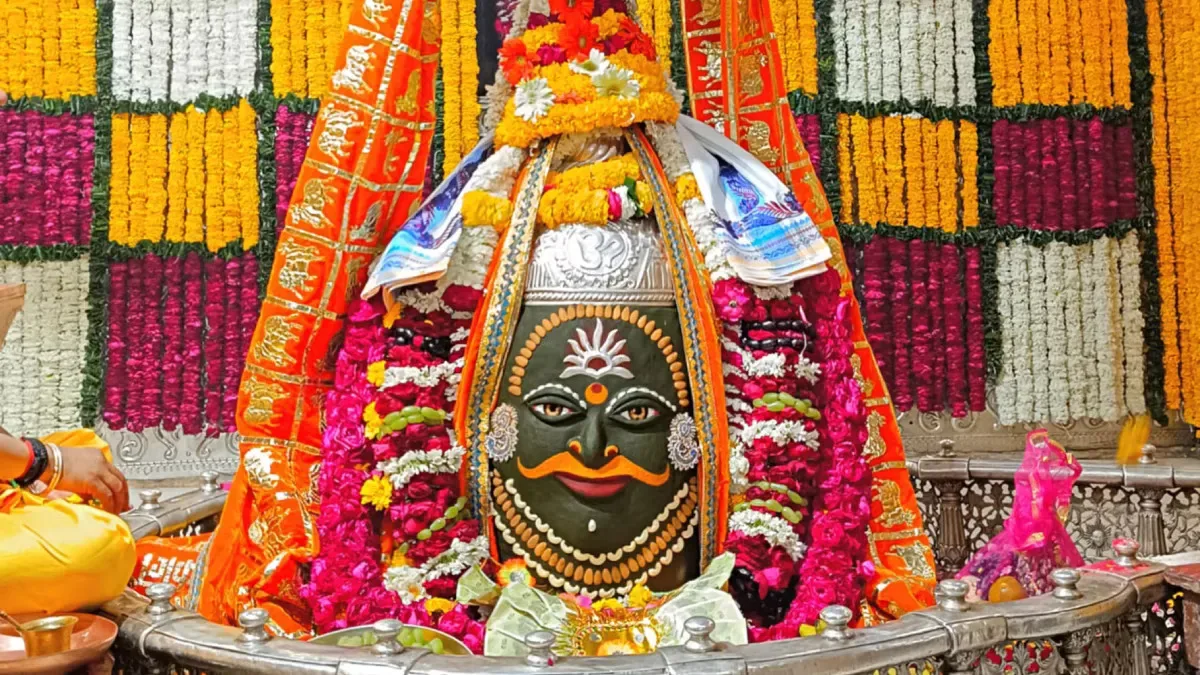
The most celebrated ritual of Mahakaleshwar is the Bhasma Aarti, performed in the early hours of the morning. Beginning around 4:00 AM, the ritual forms the first great worship of the day and has become one of the defining experiences of a pilgrimage to Ujjain. The Jyotirlinga is first bathed in sacred substances including water, milk, curd, honey and ghee. Following the abhisheka, the Linga is adorned before the sacred ash is offered.
The Bhasma Aarti is deeply connected with the identity of Mahakal. Shiva is traditionally associated with cremation grounds and with the ash that remains after the destruction of physical form. In the source’s account, the ash therefore becomes a profound symbol of impermanence. Whatever form matter may once have possessed, it ultimately returns to ash. In this transformation, distinctions disappear and all material existence is revealed as temporary.
The ritual consequently carries a theological message far beyond the physical offering. The sacred ash reminds the devotee that everything governed by time will eventually perish, while Mahakal alone remains eternal. The Bhasma Aarti becomes a meditation upon impermanence, the dissolution of ego, surrender and the possibility of moksha. As the source explains through the Upanishadic tradition, the perishable belongs to Prakriti, while Shiva remains imperishable.
The sounds of Vedic chanting, the conch, drums and cymbals further transform the pre-dawn ritual into an intense spiritual experience. The early hour of the ceremony, traditionally associated with Brahma Muhurta, reinforces the sense that the devotee is witnessing the awakening of the divine presence before the ordinary activity of the day begins.
The annual cycle of worship is marked particularly by the Mahakal Sawari, the grand procession of Mahakaleshwar during the sacred months of Shravan and Bhadrapada. During this period, the Lord leaves His temple in a silver palanquin and travels through the streets of Ujjain as the divine sovereign of the city. The procession is accompanied by elephants, horses, musicians and thousands of devotees chanting “Har Har Mahadev.”
The spiritual heart of the procession is reached at Ramghat on the banks of the Shipra. There the deity is ceremonially bathed in the sacred waters of the river in a Jalabhishek. The grandest procession, the Shahi Sawari, takes place on the final Monday of Shravan and attracts vast numbers of pilgrims. The entire city becomes part of the celebration, reinforcing the ancient belief that Mahakal is not merely housed within Ujjain but reigns over it.
09 / WHAT MAKES MAHAKALESHWAR UNIQUE
What Makes Mahakaleshwar Unique
Mahakaleshwar is distinguished above all by the identity of Shiva as Mahakal, the Lord of Time. Among the twelve Jyotirlingas, the shrine’s south-facing orientation as Dakshinamurti gives it a particularly powerful association with death, dissolution and liberation. The Jyotirlinga is also traditionally regarded as Swayambhu, adding to the sacred significance of its presence.
The temple’s underground sanctum and vertically arranged shrines create an unusual architectural experience. The principal Mahakaleshwar Linga lies below ground, while Omkareshwar and Nagchandreshwar are enshrined on higher levels. The opening of Nagchandreshwar for public darshan only on Nag Panchami adds another distinctive dimension to the temple’s ritual calendar.
The Bhasma Aarti gives Mahakaleshwar another distinction. The offering of sacred ash to the Jyotirlinga at the threshold of dawn transforms the philosophical idea of impermanence into a living ritual. Few temple rituals express so directly the relationship between Shiva, death, time and liberation.
Mahakaleshwar is also unique because of the larger sacred world of Ujjain surrounding it. The city combines the traditions of the Jyotirlinga, the Shakti Peetha of Harsiddhi Mata, the sacred Shipra, the astronomical heritage of Avantika and the intellectual traditions associated with Kalidasa and the great astronomers. Together, these traditions make Ujjain one of the most remarkable sacred cities of Bharat.
10 / PILGRIMAGE GUIDE
Pilgrimage Guide
A pilgrimage to Mahakaleshwar naturally extends beyond the temple itself, for Ujjain is a sacred city whose temples, ghats and ashrams together form a larger pilgrimage circuit. Devotees traditionally undertake a journey through the city’s principal shrines, allowing the experience of Mahakal to unfold within the wider sacred geography of Avantika.
The Shipra River is central to this pilgrimage landscape. Ram Ghat, one of the city’s most ancient bathing ghats, is a traditional place for pilgrims to take a holy dip before worship. The evening aarti on the river, when countless lamps illuminate the water, provides one of the most evocative experiences of Ujjain.
The pilgrimage can then extend to Kal Bhairav, the fierce guardian of Ujjain. Traditionally regarded as the administrator of the city’s spiritual order, Kal Bhairav occupies an important place in the sacred circuit surrounding Mahakal. Devotees often visit the shrine after receiving darshan of Mahakaleshwar.
The nearby Harsiddhi Mata Temple adds the Shakta dimension to the pilgrimage. Traditionally regarded as one of the Shakti Peethas, the temple is associated with the belief that a part of Goddess Sati fell at Ujjain. Harsiddhi Mata is worshipped as a form of Adi Shakti, and her temple stands as the divine feminine counterpart to Mahakaleshwar. The great Deep Stambhas in the courtyard are illuminated with hundreds of oil lamps during Navaratri, creating one of the most striking sights in Ujjain.
Another important site is Sandipani Ashram, traditionally associated with the education of Bhagavan Krishna, Balarama and Sudama under Rishi Sandipani. Its presence reinforces Ujjain’s identity as an ancient centre of learning and Vedic education.
The wider pilgrimage circuit therefore allows a devotee to experience Ujjain through several layers of sacred memory: the river at Ram Ghat, Mahakal as the sovereign deity, Kal Bhairav as the guardian, Harsiddhi Mata as the embodiment of Shakti, and Sandipani Ashram as a reminder of the city’s ancient educational traditions.
For the modern pilgrim, the newly developed Mahakal Lok provides another important part of the experience. Opened in October 2022, the Mahakal Lok Corridor represents a contemporary expansion of the pilgrimage precinct. The project transformed the temple surroundings into a much larger spiritual and cultural complex, extending the precinct from approximately 2.87 hectares to 47 hectares.
Stretching for approximately 900 metres, the corridor has been designed as a journey through the stories and imagery associated with Shiva. Its sandstone pillars carry representations of the Ananda Tandava and Shiva’s various mudras, while murals and monumental sculptures narrate episodes from the Shiva Purana, including the birth of Ganesha, the story of Sati and the creation of the universe. The Nandi Dwar and Pinaki Dwar form monumental gateways, while the rejuvenated Rudra Sagar provides a quieter space for reflection.
Mahakal Lok thus creates a bridge between the ancient sacred identity of Ujjain and the needs of the modern pilgrim. It provides a larger cultural landscape through which visitors can encounter the stories, symbols and artistic traditions associated with Mahakal while preserving the temple at the centre of the pilgrimage.
11 / SOURCES & REFERENCES
Sources & References
The principal scriptural traditions associated with Mahakaleshwar in this chapter are drawn from the Shiva Purana and Skanda Purana, particularly the traditions concerning Mahakala and the sacred city of Avantika. The Shiva Purana, Kotirudra Samhita preserves verses describing Mahakaleshwar as the Lord of Avantika and celebrates the spiritual significance of His darshan.
The astronomical identity of Ujjain is associated in the source with the Surya Siddhanta, while the city’s sacred geography is connected with the tradition of the Nabhi-desha. Its intellectual heritage is further reflected in the traditions surrounding Varahamihira, Brahmagupta, Bhaskaracharya and Kalidasa.
The literary memory of Mahakaleshwar is particularly enriched by Kalidasa’s Meghaduta, which preserves an evocative image of the temple and its evening rituals. Archaeological evidence, including ancient Ujjain coins bearing the figure of Shiva and inscriptions recording later temple construction, further contributes to the historical understanding of the sacred city.
Mahakaleshwar ultimately represents something larger than a monumental temple. It is a living expression of the relationship between time and eternity, mortality and immortality, destruction and renewal. The city of Ujjain was once a centre from which time itself was measured; at its heart stands the Lord who is believed to transcend time.
At dawn, when the Bhasma Aarti begins and sacred ash is offered to the Swayambhu Jyotirlinga, the central message of Mahakal becomes unmistakable. Everything within the realm of time is destined to change and disappear, while the Divine remains beyond decay. When the silver palanquin of Mahakal moves through the streets of Ujjain during the Sawari, the ancient belief that the Lord Himself is the sovereign of the city comes alive once again.
Mahakaleshwar therefore stands not merely as one of the twelve Jyotirlingas, but as a profound meditation upon existence itself. Here, the past, present and future converge in the presence of the Lord of Time. In Ujjain, the city of the Shipra, the city of astronomers and poets, the city of sacred pilgrimage, Mahakal reigns eternally — and before Him, time itself bows.
12 / PHOTOGRAPHS
From the whole to the detail.
Select a photograph to explore it at a larger scale.
13 / LOCATION & MAP
Place the story on the map.
PLACE THIS STORY ON THE MAP
Ujjain, Madhya Pradesh
Madhya Pradesh, India
ABOUT THIS FIELD ENTRY
Rooted in the Bharat Ke Wow archive.
This page is part of the Bharat Ke Wow series on the Dvādaśa Jyotirlingas. Sacred narratives are presented as temple tradition.
Read the original entry ↗