


01 / INTRODUCTION
Omkareshwar–Mamleshwar, Madhya Pradesh
The Fourth Jyotirlinga
ॐकारः परमेशानो धृतः शम्भोः परात्मनः।
अवतारश्चतुर्थो हि भक्ताभीष्टफलप्रदः॥
Omkāra is the Supreme Lord, the highest Self of Śambhu. He is revered as the fourth manifestation, bestowing the cherished fruits of devotion upon His devotees.
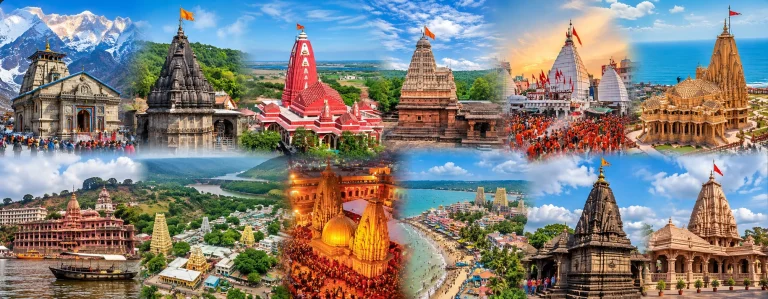
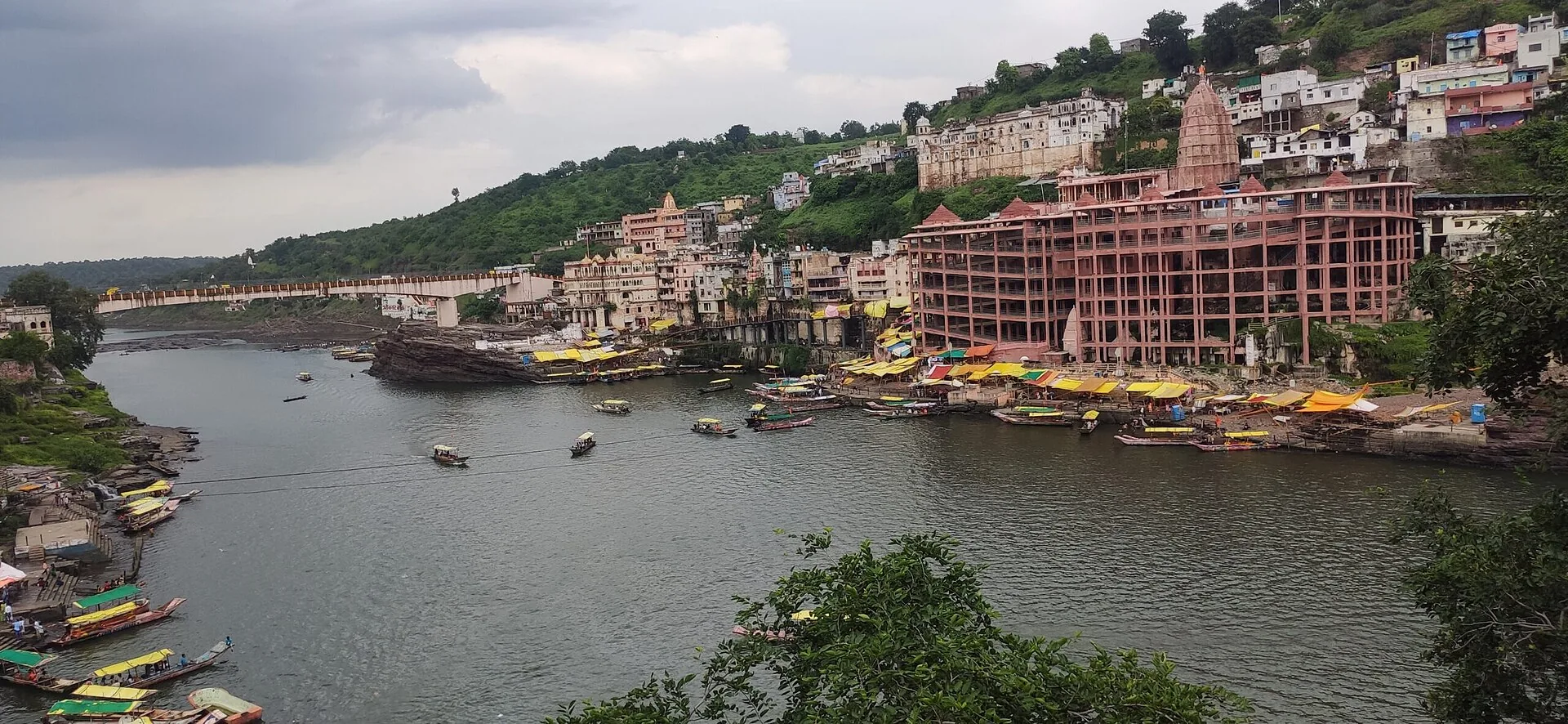
On the sacred Narmada River in Madhya Pradesh lies one of the most distinctive pilgrimage centres associated with Bhagavan Shiva. Omkareshwar–Mamleshwar is revered as the fourth among the twelve Jyotirlingas, yet unlike most Jyotirlinga shrines, its sacred presence is expressed through two closely connected temples. The principal shrine of Omkareshwar stands upon the island of Mandhata, while Mamleshwar, also known as Amreshwar, stands on the southern bank of the Narmada, directly opposite it. The two shrines are traditionally understood as manifestations of the same divine presence.
The island itself is one of the great wonders of the sacred geography of Bharat. As the Narmada divides into two streams around Mandhata, the outline of the island is traditionally understood to resemble the sacred syllable ॐ, the primordial sound from which creation is believed to arise. The mountain at its heart is therefore known as Omkar Parvat, and the presence of the Jyotirlinga upon this naturally formed sacred landscape gives the entire kshetra a profound symbolic unity between nature, sacred sound and divine presence.
The Narmada itself is central to the experience of Omkareshwar. Revered as a sacred river and as the Goddess Narmada, its waters form the setting for ritual bathing, worship and pilgrimage. Devotees descend to the ghats before approaching the temple, carry Narmada water for abhisheka, collect naturally formed Bana Lingas from the river and undertake the traditional circumambulation of Omkar Parvat. The river is therefore not merely the geographical setting of the temple; it is itself an essential part of the sacred experience.
Omkareshwar is consequently a pilgrimage in which the devotee encounters Shiva through several interconnected forms—the Jyotirlinga, the sacred mountain, the river, the two temples and the sacred syllable Om. The experience is one of unity expressed through apparent duality: one sacred presence, two shrines; one river, two streams; one mountain, shaped in the form of Om.
02 / SACRED ORIGIN / STHALA PURANA
Sacred Origin / Sthala Purana
The most important legend of Omkareshwar concerns the Vindhya Mountain and the manifestation of Bhagavan Shiva as the Pranava Linga. According to the Puranic tradition, Vindhya undertook intense penance and worshipped Shiva in the form of a Linga. Pleased with this devotion, Bhagavan Shiva manifested as the Pranava or Om Linga, associating His presence permanently with the sacred sound Om.
The story then explains the unusual relationship between Omkareshwar and Mamleshwar. When the Devas prayed to Shiva, the divine Linga manifested in two forms. One came to be known as Omkareshwar, associated with the sacred syllable Om and the island shrine, while the other became known as Parameshwar or Mamleshwar, the shrine on the southern bank of the Narmada. Thus, although pilgrims encounter two temples, the tradition understands them as two manifestations of one sacred reality.
The Shatarudriya Samhita of the Shiva Purana expresses this idea explicitly. The Omkareshwar Linga is associated with the sacred sound Om, while the second, described as being made of earth, came to be known as Parameshwar. Together, the two forms represent the presence of Shiva as both Omkareshwar and Mamleshwar.
Another important tradition associates the sacred mountain with King Mandhata, a ruler of the Solar or Ikshvaku dynasty and traditionally connected with the lineage of Bhagavan Rama. Mandhata is said to have performed severe austerities upon the island in devotion to Bhagavan Shiva. Pleased by the king’s tapasya, Shiva appeared and blessed him, and the island itself came to be known as Mandhata or Shivpuri in remembrance of this association.
A third Puranic account recalls a time when the Devas were defeated by the Asura forces. Seeking divine protection, they prayed to Bhagavan Shiva, who manifested as Omkareshwar Jyotirlinga and destroyed the demons, restoring cosmic order. The legend therefore presents Omkareshwar not only as a compassionate Lord who fulfils the desires of devotees, but also as the protector of the cosmic order.
These traditions together give Omkareshwar its distinctive sacred identity. The Lord appears as Om, as the fulfilment of Vindhya’s penance, as the object of Mandhata’s devotion and as the protector of the Devas. Above all, the division of the Pranava Linga into Omkareshwar and Mamleshwar teaches that what appears outwardly as two can remain inwardly one.
03 / HISTORICAL JOURNEY
Historical Journey
The historical record of Omkareshwar is not as continuous as the Puranic tradition, yet inscriptions, architectural remains and travellers’ accounts reveal a long history of temple worship and royal patronage. Tradition associates the earliest major temple development with the Paramara rulers of Malwa, particularly around the eleventh century. An inscription at Mamleshwar dated to 1063 CE provides important evidence of activity at the site during this period.
During the twelfth and thirteenth centuries, the Chauhan rulers are said to have maintained the sacred centre. Inscriptions and records from the island refer to royal grants of land and villages associated with the temple priesthood, indicating that Omkareshwar was supported by an established Brahmin community and had developed into an important pilgrimage and religious centre.
The temple’s history also reflects the political upheavals that affected central India. Accounts preserved in the source refer to attacks by invading armies during the medieval period, including an attack associated with Mahmud of Ghazni. Yet unlike many other major temples, Omkareshwar appears to have remained substantially intact. Under Mughal rule, the traditional custodians continued to maintain worship, although the surviving historical record does not indicate major renovations during that period.
The most important phase of the temple’s later history came with the rise of the Maratha Holkars in the eighteenth century. Queen Ahilyabai Holkar, whose devotion transformed many sacred centres of central India, took particular interest in Omkareshwar. She restored damaged portions of the shrine, established new ghats along the Narmada and improved facilities for pilgrims. Much of the present character of the stone temple complex reflects this period of restoration and renewal.
After India’s independence, the preservation of the temple and its associated monuments increasingly came under organised heritage administration. The Archaeological Survey of India assumed responsibility for conservation, particularly at Mamleshwar, which is formally protected as a monument. The Omkareshwar Mandir Trust, with historical roots going back to the Holkar period, continues to play an important role in the administration of the living temple.
The history of Omkareshwar is therefore not simply a record of changing structures. It is a story of continuity. Dynasties changed, political powers came and went, and buildings required restoration, but the Narmada continued to flow around the sacred island and pilgrims continued to approach the Lord of Om.
04 / TEMPLE ARCHITECTURE
Temple Architecture
The principal Omkareshwar Temple rises upon the rocky Omkar Parvat on the northern side of Mandhata island. Its architecture is predominantly Nagara in character, with a soaring curvilinear shikhara rising above the sacred island and the waters of the Narmada. The temple’s stone construction reflects the craftsmanship of several historical periods, with local granite and red sandstone forming much of its architectural character.
The arrangement of the temple reflects its layered history. An older, more compact shrine with its own stone-domed roof stands alongside a later and larger mandapa. Between these structures lies the inner sanctum containing the self-manifested Linga. The slight difference in alignment between the older sanctum and the principal entrance reveals the manner in which the temple developed over time rather than being constructed as one unified architectural project.
The principal mandapa is a remarkable stone pavilion approximately fourteen feet high and supported by sixty substantial pillars. Its vertical arrangement contains five levels of niches and shrines, beginning with Omkareshwar and rising through Mahakaleshwar, Siddhanath and Gupteshwar, with a flag-bearing sculptural element crowning the structure. Elaborate carvings enrich these levels, while surviving fragments of older sculptures scattered across the island testify to the antiquity and turbulent history of the sacred complex.
Before entering the principal temple, pilgrims traditionally encounter the Panchamukhi Ganesh shrine. The five-faced form of Ganesha is associated with the belief that the self-manifested image emerged from the very rock upon which Shiva manifested. Its presence at the entrance therefore carries both the familiar symbolism of Ganesha as remover of obstacles and a specific connection with the sacred origin of Omkareshwar.
Across the Narmada stands Mamleshwar, or Amreshwar, facing the island shrine. Though more compact in form, the temple is architecturally significant. Its sandstone walls contain numerous Sanskrit inscriptions of the Mahamrityunjaya Stotra, dated to 1063 CE. The relatively short shikhara and ornate pillars reflect the architectural character of eleventh-century Malwa. The temple is also closely associated with the Holkar tradition, with hereditary priests connected to the Holkar family continuing the daily worship.
The wider island contains several other important shrines. The Siddhanath Temple, now partly ruined, preserves striking examples of Maha-Gurjara architectural workmanship. Its original high stone base was decorated with carved elephants and elaborate pillars, though only a portion of these survive today. The Gauri Somnath Temple, with its massive black stone Linga and bull image, adds another important Shaiva shrine to the sacred landscape, while the Annapurna shrine and Panchamukhi Ganesha complete the principal group of temples on the island.
The architecture of Omkareshwar cannot, however, be separated from its setting. The temple rises above the Narmada, the sacred river flowing around the island, while the rocky slopes, trees, ghats and surrounding water create a landscape in which the natural form of the island itself becomes part of the sacred design. Here the architect is not only the human craftsman; the river and mountain have themselves shaped the pilgrimage experience.
05 / SACRED LEGENDS
Sacred Legends
The story of Vindhya remains the central legend of Omkareshwar, but the sacred landscape contains several narratives that have shaped the devotional understanding of the kshetra.
The penance of Vindhya presents Shiva as the compassionate Lord who responds to sincere tapasya. The mountain’s worship of the Linga resulted in the manifestation of the Pranava Linga and established the association between Shiva and the sacred sound Om. The subsequent division of the Linga into Omkareshwar and Mamleshwar gives the two temples their intimate theological relationship.
The story of King Mandhata adds the dimension of royal devotion. A ruler of the Solar dynasty, Mandhata is said to have undertaken severe austerities on the island in worship of Shiva. The Lord’s appearance before him sanctified the mountain further and gave the island its traditional names of Mandhata and Shivpuri.
The legend of the Devas and the Asuras presents yet another aspect of Omkareshwar. When the Devas were defeated, they turned to Shiva for protection, and the Lord manifested as Omkareshwar to destroy the demonic forces and restore balance to the cosmos. The story reinforces the understanding of Shiva as the protector who appears whenever righteousness is threatened.
These legends are not merely stories attached to the temple after its construction. They explain the very character of the landscape. Vindhya gives the mountain its penance, Mandhata gives it its royal memory, the Devas give it its role as a place of divine protection, and the Narmada provides the sacred waters through which the pilgrim approaches the Lord.
06 / SAINTS, LITERATURE & SCRIPTURE
Saints, Literature & Scripture
The sacred identity of Omkareshwar is preserved in the Puranic literature of Shaivism, particularly the Shiva Purana, as well as traditions associated with the Skanda and Vayu Puranas. These texts preserve the stories of Vindhya, Mandhata and the Devas and explain the manifestation of Shiva as Omkareshwar.
The Shatarudriya Samhita of the Shiva Purana provides particularly important textual support for the relationship between Omkareshwar and Mamleshwar. It describes Omkaara as the fourth manifestation of Shiva and records that the Lord took two forms when approached by the Devas, blessing devotees with both bhukti—worldly fulfilment—and mukti—liberation.
This dual blessing is an important part of the spiritual identity of the kshetra. Omkareshwar is not represented solely as a place where worldly wishes are fulfilled, nor solely as a place of renunciation and liberation. The scriptural tradition presents Shiva as compassionate towards devotees in both dimensions of life, granting worldly well-being while ultimately leading the seeker towards spiritual freedom.
The inscriptions of Mamleshwar add another literary dimension to the temple. The Mahamrityunjaya Stotra is engraved in Sanskrit upon the sandstone walls and is dated to 1063 CE. These inscriptions are not simply decorative elements; they preserve the devotional language of the community that worshipped here centuries ago.
The wider region also carries the memory of Queen Ahilyabai Holkar, whose patronage of sacred centres across central India left a lasting mark on the architecture and pilgrimage infrastructure of Omkareshwar. Her restoration of the temple and ghats ensured that the sacred traditions of the Narmada and the Jyotirlinga remained accessible to generations of pilgrims.
07 / SPIRITUAL SIGNIFICANCE
Spiritual Significance
The spiritual significance of Omkareshwar begins with the sacred syllable Om. The island’s natural resemblance to ॐ provides an extraordinary meeting between geography and spiritual symbolism. The very landscape appears to embody the primordial sound associated with creation, while upon that landscape stands the Jyotirlinga of Omkareshwar.
The relationship between Omkareshwar and Mamleshwar deepens this symbolism. The single Pranava Linga appearing in two forms expresses the fundamental idea that unity may manifest through apparent multiplicity. The pilgrim crosses the Narmada and encounters two shrines, yet both are understood as expressions of the same Shiva. The physical journey between the island and the riverbank thus becomes a quiet meditation upon the unity underlying diversity.
The sacred Narmada further enhances this spiritual experience. Revered as Goddess Narmada, the river is believed to possess exceptional purifying power. Pilgrims traditionally bathe in her waters before approaching the shrine, and the river’s naturally formed stones are revered as Bana Lingas, manifestations of Shiva suitable for worship in homes and temples.
The Shiva Purana tradition associates Omkareshwar with both bhukti and mukti. The devotee may approach the Lord with worldly concerns, seeking fulfilment and protection, while the deeper purpose of pilgrimage remains the movement towards liberation. The two dimensions are not treated as contradictory. Shiva receives the devotee as he or she is and gradually leads the seeker towards a deeper understanding of the Divine.
The sacred geography of Omkareshwar also invites circumambulation. The traditional 7-kilometre Omkar Parvat Parikrama allows the pilgrim to move around the sacred mountain, visiting smaller shrines along the way while carrying Narmada water or bilva leaves. The journey transforms the island from a place that is merely observed into a sacred landscape that is physically experienced step by step.
08 / WORSHIP, RITUALS & FESTIVALS
Worship, Rituals & Festivals
The daily rhythm of Omkareshwar is closely connected with the Narmada. From the early hours of the morning, pilgrims gather at the ghats to bathe in the sacred river before proceeding towards the temple. The waters provide the first act of purification, after which the devotee enters the temple precinct carrying the remembrance and sanctity of the Narmada with them.
Three principal aartis mark the rhythm of worship during the day. The early morning Mangala Aarti is conducted by temple-appointed priests, followed by midday worship associated with priests of the Holkar tradition and an evening aarti conducted by priests connected with the Scindia tradition. The continuity of these different priestly traditions reflects the long history of royal patronage at Omkareshwar.
Mondays hold a special place in the worship of Shiva. On Somvar, the Somwar Sawari brings Omkareshwar into the streets of the sacred town. A golden palanquin carrying a three-faced image of the Lord moves from the Narmada ghats through the surrounding streets, accompanied by drums, chanting and the prayers of devotees. During Shravan, the procession takes on an especially vibrant character as large numbers of pilgrims gather to participate in the celebration.
The nightly Shayan Aarti provides a striking contrast to the energy of the daytime worship. According to tradition, Shiva comes to Omkareshwar each night to rest. Around eight in the evening, priests perform the Shayan ritual, ceremonially preparing the Linga for rest while hymns and lullabies are offered. A related Shayan Puja is performed at Kotitirtha Ghat for Maa Narmada, reinforcing the sacred relationship between the Lord and the river that embraces His island.
The most important annual festival is Maha Shivaratri, when the temple remains immersed in prayer and worship through the night. Special abhishekams are performed, and devotees maintain vigil in honour of Bhagavan Shiva. The sacred calendar also includes additional worship during Sankashti Chaturthi, Shravan Purnima and the monthly Somavara observances, while Navaratri, Diwali and other major Hindu festivals are celebrated with special offerings.
Kartik Purnima brings another major gathering to Omkareshwar. A large fair develops along the Narmada ghats, with pilgrims arriving from distant parts of the region to bathe in the sacred river and participate in the festivities. The ghats become filled with temporary stalls and the movement of pilgrims, transforming the riverside into a vibrant expression of the living tradition of the kshetra.
09 / WHAT MAKES OMKARESHWAR UNIQUE
What Makes Omkareshwar Unique
Omkareshwar is perhaps most distinctive for the way in which its sacred identity is divided and yet remains united. The fourth Jyotirlinga is represented through Omkareshwar on the island and Mamleshwar on the riverbank, two shrines separated by the Narmada but traditionally understood as two forms of the same sacred Linga. This is one of the most unusual features of the Jyotirlinga tradition.
The natural form of Mandhata island adds another extraordinary dimension. The Narmada flows around the island in two branches, creating an outline traditionally understood to resemble the sacred syllable Om. Thus, the name of the deity, the form of the island and the symbolism of the primordial sound all come together in one landscape.
The Narmada itself makes Omkareshwar distinctive. Few great Shiva temples are so completely integrated with a sacred river. Here the river is a place of bathing, worship, pilgrimage, ritual offering and meditation. Its Bana Lingas are carried into homes, while the traditional parikrama of the river represents an even greater sacred journey.
The presence of Mamleshwar, the ancient inscriptions, the Siddhanath and Gauri Somnath temples, the Omkar Parvat Parikrama and the continuing traditions associated with the Holkars further transform Omkareshwar into a complete sacred landscape rather than a single temple complex.
10 / PILGRIMAGE GUIDE
Pilgrimage Guide
A pilgrimage to Omkareshwar traditionally begins at the sacred Narmada. Devotees arriving at Kotitirtha or Bhrungaranya Ghats first bathe in the river, regarding the ritual immersion as an act of purification. Many pilgrims carry vessels to collect Narmada water, which is later offered to Bhagavan Shiva. Dawn is considered particularly beautiful at the ghats, when the first sunlight falls upon the river and the temple bells begin to sound.
After the river bath, pilgrims traditionally visit Panchamukhi Ganesh before proceeding to Mamleshwar. At the shore temple, devotees offer bilva leaves, incense and prayers to Shiva before crossing towards Mandhata island. The Mamleshwar Bridge provides the principal connection between the riverbank and the island, while boats are also used during periods of high pilgrimage activity.
At Omkareshwar, devotees proceed towards the shrine for darshan of the Jyotirlinga. Many undertake Panchamrita Abhisheka, offering milk, honey, yoghurt, ghee and water to the Lord. The experience of darshan is naturally complemented by the sounds of chanting, the fragrance of incense and the constant presence of the Narmada flowing below the temple.
One of the distinctive practices associated with the Narmada is the collection and worship of Bana Lingas. These smooth stones, naturally shaped by the movement of the river, are traditionally revered as forms of Shiva. Devotees may carry them home for personal worship, treating them with the same reverence accorded to a Shiva icon.
The pilgrimage can then continue with the Omkar Parvat Parikrama, a traditional circumambulation of approximately seven kilometres. The route passes through several smaller shrines, including Rna Mukteshwar, Gauri Somnath, Siddhanath and Aashapuri Devi. The parikrama allows the devotee to experience the sacred island as a living mandala, moving through its temples, rocky paths and natural surroundings rather than remaining only within the principal shrine.
Omkareshwar is accessible by air, rail and road. The nearest major airport is Indore, approximately 77 kilometres away by road. Khandwa Junction, around 72 kilometres away, provides a major railway connection, while Sanawad, approximately 12 kilometres away, serves as another railhead for local connections. Mortakka Bus Stand, around 12 kilometres from Omkareshwar, connects the pilgrimage town with Indore, Ujjain, Khandwa and Khargone, while taxis and private vehicles are readily used for the final journey.
The source recommends October to March as a comfortable period for visiting, particularly because of the cooler weather. The temple is described as being open for darshan from approximately 5:00 AM to 9:30 PM. Accommodation is available in guesthouses, dharamshalas and homestays around Mandhata and the riverbanks, while the Omkareshwar Vishramalaya Trust provides basic rooms for pilgrims.
For a fuller experience of the kshetra, the evening Narmada Aarti at Kotitirtha Ghat should be part of the pilgrimage. As lamps illuminate the river and the surrounding temple architecture, the sacred landscape takes on another character. The sound of bells, the fragrance of sandalwood and incense, the coolness of the river and the sight of the island rising above the water combine to create an experience that cannot be separated from the physical landscape of Omkareshwar.
Before departing, pilgrims often carry home a Narmada Bana Linga as a sacred reminder of the journey. Local handicrafts and handwoven shawls are also available, while temple prasada provides a final connection to the traditional hospitality of the kshetra.
11 / SOURCES & REFERENCES
Sources & References
The principal sacred traditions associated with Omkareshwar arise from the Shiva Purana, particularly the Shatarudriya Samhita, along with traditions preserved in the Skanda and Vayu Puranas. These sources provide the narratives of Vindhya’s penance, the manifestation of the Pranava Linga, the division into Omkareshwar and Mamleshwar, the devotion of King Mandhata and Shiva’s protection of the Devas.
The textual tradition is especially significant because it explains the theological relationship between the two shrines. Omkareshwar and Mamleshwar are not merely two neighbouring temples; they are understood as two manifestations of one divine presence, one associated with Om and the other with Parameshwar. The scriptural tradition therefore provides the spiritual foundation for the physical journey between the island and the riverbank.
Historical understanding of the kshetra is supplemented by the 1063 CE inscription at Mamleshwar, the architectural remains associated with the Paramara period, later records concerning the Chauhan rulers, and the extensive restoration work undertaken during the Holkar period. The continuing role of the Omkareshwar Mandir Trust, the Ahilyabai Khansgi Trust and the Archaeological Survey of India reflects the effort to preserve both the living traditions and the architectural heritage of the sacred site.
Omkareshwar–Mamleshwar ultimately embodies a profound idea: the One can manifest as two without ceasing to be One. The sacred Om-shaped island, the two temples, the two branches of the Narmada and the single divine presence of Shiva come together to create a pilgrimage of extraordinary symbolic richness.
Here, the devotee crosses water to reach the Lord, walks around the sacred mountain, carries the river’s stones home and returns again to the ghats at sunset. The Narmada flows endlessly around Mandhata, while the Jyotirlinga remains at the heart of the island. The river, mountain and temple together transform the landscape into a living expression of Om.
Omkareshwar is therefore more than the fourth Jyotirlinga. It is a sacred meeting of sound and silence, river and mountain, nature and divinity, bhukti and mukti, and above all, unity appearing through two sacred forms. In the timeless flow of the Narmada, the ancient presence of Shiva continues to draw pilgrims towards the sacred Om.
12 / PHOTOGRAPHS
From the whole to the detail.
Select a photograph to explore it at a larger scale.
13 / LOCATION & MAP
Place the story on the map.
PLACE THIS STORY ON THE MAP
Mandhata island, Omkareshwar, Madhya Pradesh
Madhya Pradesh, India
ABOUT THIS FIELD ENTRY
Rooted in the Bharat Ke Wow archive.
This page is part of the Bharat Ke Wow series on the Dvādaśa Jyotirlingas. Sacred narratives are presented as temple tradition.
Read the original entry ↗