


01 / INTRODUCTION
Karpaka Vinayakar Temple,
Pillayarpatti
Nestled in the historic village of Pillayarpatti in Sivaganga district, Tamil Nadu, the Karpaka Vinayakar Temple, popularly known as the Pillayarpatti Pillaiyar Temple, is one of the most remarkable rock-cut shrines dedicated to Lord Ganesha in South India. Renowned for its ancient sculptural traditions, distinctive iconography and enduring religious significance, the temple represents an important chapter in the history of Tamil temple architecture.
Unlike many later temples where the principal deity is fashioned as a freestanding image, the presiding deity here is carved directly into the natural rock of a hillock. The temple’s core shrine is generally dated to the 7th century CE, although certain inscriptions and palaeographic features have prompted scholars to consider the possibility of earlier origins for parts of the complex.
Dedicated to Karpaka Vinayakar, the wish-fulfilling form of Lord Ganesha, the temple remains an important centre of worship and pilgrimage, particularly during the annual Vinayaka Chaturthi celebrations.
02 / LOCATION AND ACCESSIBILITY
Location and Accessibility
The Karpaka Vinayakar Temple is situated at Pillayarpatti, in Tiruppattur taluk of Sivaganga district, Tamil Nadu. It lies approximately 12 kilometres from Karaikudi and is accessible by road through the regional highway network.
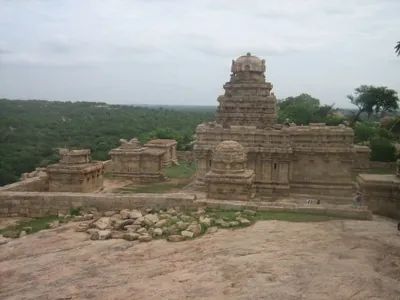
The temple occupies the eastern edge of a rocky hillock, where the natural geological formation has been transformed into a sacred architectural space. The surrounding landscape, the rock-cut sanctuaries and the later structural additions together create a distinctive temple complex that reflects the evolution of religious architecture over several centuries.
03 / HISTORICAL BACKGROUND
Historical Background
The earliest securely datable phase of the temple is generally attributed to the 7th century CE. Its rock-cut architecture and sculptural programme provide valuable evidence for the development of early medieval Hindu art in southern Tamil Nadu.
The region was historically associated with the Pandyas, whose patronage contributed significantly to the growth of religious institutions, literature and the visual arts. The architectural and epigraphical evidence at Pillayarpatti reflects the artistic and religious environment of this period.
Some accounts associate the cave’s excavation with the Pallava ruler Narasimhavarman I, who reigned during the 7th century. However, the attribution and precise chronology of individual elements require careful consideration of the inscriptions, stylistic evidence and regional political history. The temple’s location in the southern Tamil region and its relationship to early Pandya-period artistic traditions make it particularly important for the study of regional rock-cut architecture.
The temple developed gradually, with mandapams, additional shrines, sculptural panels and other architectural features added over subsequent centuries. Inscriptions found within the rock-cut sanctuaries and on the walls and mandapams document different phases of the temple’s history.
During restoration and repair work in the late 19th century, a collection of panchaloha images was reportedly discovered. These metal images are generally dated to the 11th century CE and provide further evidence of the temple’s long-standing ritual traditions.
04 / THE ROCK-CUT CAVE TEMPLE
The Rock-Cut Cave Temple
The most distinctive feature of the complex is its ancient cave shrine, excavated into the natural rock of the hillock. Rather than relying entirely on constructed masonry, the early artisans shaped the living rock into sacred architectural and sculptural forms.
The cave contains images of Lord Ganesha, a Shiva lingam and other unusual sculptural representations. Their forms and iconographic characteristics offer important insights into the evolution of Hindu imagery during the early medieval period.
The primary sanctum is dedicated to Karpaka Vinayakar. A notable feature of the rock-cut arrangement is the absence of a conventional circumambulatory passage around the principal deity, a consequence of the cave’s natural rock formation.
The temple’s rock-cut character also distinguishes it from the later structural additions, allowing visitors to observe different stages in the development of the sacred complex.
05 / KARPAKA VINAYAKAR: THE UNIQUE FORM OF GANESHA
Karpaka Vinayakar: The Unique Form of Ganesha
The principal attraction of Pillayarpatti is its monumental rock-cut image of Karpaka Vinayakar. Carved in relief on the southern face of the rock, the image measures approximately six feet in height and faces north.
The deity is especially remarkable for its distinctive iconography. Unlike the more familiar later representations of Ganesha, which commonly feature four arms, the Pillayarpatti image has only two.
The right hand holds a sweet, while the trunk curves towards the right. This unusual configuration has earned the deity the popular name Valampuri Vinayagar, referring to the right-curving trunk.
The image’s broken left tusk is another notable feature. Together, the two-armed form, the position of the trunk and the sculptural treatment distinguish this image within the broader history of Ganesha iconography.
An inscription near the deity refers to the image as “Desi Vinayagar”. This epigraphical reference is an important element in the study of the shrine’s historical identity and chronology.
The name Karpaka Vinayakar evokes the divine wish-fulfilling tree, Karpaka Vriksha. In devotional understanding, the deity is worshipped as a benevolent bestower of prosperity, wisdom and the fulfilment of sincere prayers.
06 / THE SHIVA SHRINE AND THE ROCK-CUT LINGAM
The Shiva Shrine and the Rock-Cut Lingam
The cave complex also contains a shrine dedicated to Lord Shiva, whose lingam is carved within a sanctuary on the western face of the rock. The shrine follows a distinctive excavated arrangement, with an architectural form often described as resembling the back of an elephant.
The Shiva lingam is an important element in understanding the temple’s Shaiva identity. Although Karpaka Vinayakar is the principal deity and the focus of popular worship, the presence of Shiva within the same rock-cut complex establishes a close relationship between Ganesha worship and the broader Shaiva tradition.
An inscription within this shrine records the name or names associated with its excavation. Its script exhibits archaic characteristics that have attracted the attention of epigraphists and historians. Comparisons with Tamil Brahmi and early Vatteluttu have contributed to scholarly discussions about the chronology of the cave and the development of Tamil writing.
Such inscriptions are especially valuable because they provide evidence beyond stylistic comparisons alone, helping researchers investigate the patronage, chronology and religious history of early medieval temples.
07 / THE ENIGMATIC SCULPTURES: ARDHANARISHVARA, HARIHARA OR A ROYAL FIGURE?
The Enigmatic Sculptures: Ardhanarishvara, Harihara or a Royal Figure?
Among the most intriguing sculptures at Pillayarpatti is a standing two-armed figure accompanied by two attendants. Located between the rock-cut images associated with Ganesha and Shiva, the sculpture has generated several interpretations.
One interpretation identifies the figure as Ardhanarishvara, the composite form of Shiva and Parvati, representing the inseparable relationship between the masculine and feminine principles.
Another interpretation identifies the image as Harihara, the combined form of Shiva and Vishnu. This interpretation draws attention to the apparent differences between the two sides of the figure and the treatment of the crown.
A third proposal suggests that the figure may represent a royal personage accompanied by attendants.
The absence of certain clearly identifiable attributes makes the sculpture difficult to classify conclusively. Its unusual form is precisely what makes it significant for the study of early Hindu iconography. Rather than fitting neatly into later standardised representations, the image preserves an artistic vocabulary that invites continued scholarly examination.
Another unusual relief in the cave has been interpreted by the epigraphist and art historian R. Nagaswamy as a possible representation of Lingodbhava, the manifestation of Shiva as an infinite pillar of light.
These sculptures demonstrate that early temple art could employ forms and visual conventions that do not always correspond to the more familiar iconographic arrangements of later centuries.
08 / ARCHITECTURAL DEVELOPMENT AND LATER ADDITIONS
Architectural Development and Later Additions
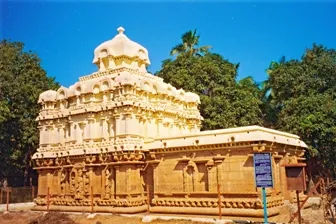
Although the rock-cut cave forms the historical core of the complex, the present-day temple reflects many centuries of architectural development.
The complex includes several mandapams, additional Shiva shrines, a Nataraja shrine, a Chandeshvara shrine and a shrine dedicated to Sivakami Amman. Other sacred spaces are associated with Bhairava, Somaskanda, Kartikeya and his consorts Valli and Devasena, Pasupatheeswarar and the Navagrahas.
A sculptural panel of the Saptamatrikas, the Seven Divine Mothers, is another important component of the temple’s artistic programme.
The temple also features prominent gopurams, including those on the eastern and northern sides, along with a large temple tank to the north. The mandapams are decorated with paintings and other ornamental elements, while designated spaces support devotional singing, ritual activities and traditional performance practices.
The temple kitchen, well and other facilities reflect the practical requirements of a major religious institution serving pilgrims and the local community.
Together, these additions illustrate how an early rock-cut shrine gradually developed into a larger temple complex with multiple ritual, architectural and social functions.
09 / INSCRIPTIONS AND EPIGRAPHICAL SIGNIFICANCE
Inscriptions and Epigraphical Significance
The inscriptions of Pillayarpatti are among its most valuable historical resources. They occur within the rock-cut shrines and on the walls and mandapams added during later phases of construction.
The inscription referring to “Desi Vinayagar” is particularly important for the history of the principal deity. Other inscriptions preserve names associated with the excavation of the Shiva shrine and provide evidence of the temple’s changing institutional and religious landscape.
The palaeographic characteristics of certain records have encouraged scholars to investigate whether some portions of the complex could predate the generally accepted 7th-century phase.
Inscriptions from the 11th to 13th centuries also document the temple’s continued development during the medieval period.
For historians, these records are not merely supplementary details. They help establish chronology, identify patrons, trace the development of religious institutions and connect the temple’s surviving architecture with the wider history of Tamil society.
10 / RELIGIOUS SIGNIFICANCE AND THE NAGARATHAR TRADITION
Religious Significance and the Nagarathar Tradition
Pillayarpatti occupies a special place in the religious and cultural traditions of the Nagarathars, also known as Nattukottai Chettiars. It is recognised as one of their nine ancestral temples, which hold an important position in their community’s religious organisation and heritage.
The Nagarathars have played a significant role in maintaining and supporting the temple. Their traditions associate the establishment of their relationship with the shrine with the early medieval period, commonly citing a date around 714 CE.
The temple is principally associated with the Shaiva tradition, as evidenced by the presence of the Shiva lingam and other Shaiva deities. At the same time, the prominence of Karpaka Vinayakar reflects the central role of Ganesha worship in Tamil religious life.
The temple therefore represents more than a place of individual devotion. It is also a centre of community identity, inherited religious practice and the preservation of a regional sacred tradition.
11 / VINAYAKA CHATURTHI: THE GRAND ANNUAL FESTIVAL
Vinayaka Chaturthi: The Grand Annual Festival
The annual Vinayaka Chaturthi festival is one of the most important events at Pillayarpatti. Celebrated over ten days, it draws devotees from across Tamil Nadu and other regions.
The festival combines worship, processions, music, ritual observances and community participation. Its ninth day is particularly significant for the chariot procession, during which the festival deity is taken through the streets.
The processional image of Ganesha, adorned with gold plating, is carried on a mouse-shaped vahana. The procession also features images associated with Nataraja and Sivakami.
Another distinctive ritual is the Chandana Kaappu, in which sandalwood paste is applied to the deity as part of the festival observances. Decorative floor designs, exhibitions and cultural performances contribute to the festive atmosphere.
The celebration is an important expression of collective devotion, bringing together local residents, Nagarathar families and pilgrims. It also sustains traditional practices associated with temple festivals in the Chettinad region.
12 / DAILY WORSHIP AND TEMPLE ADMINISTRATION
Daily Worship and Temple Administration
The Karpaka Vinayakar Temple is an active place of worship, with daily rituals and regular offerings to the presiding deity and other deities within the complex.
The temple is traditionally administered and maintained by the Nagarathar community through its institutional arrangements.
The published visiting hours are generally:
- Morning: 6:00 AM to 1:00 PM
- Evening: 4:00 PM to 8:30 PM
Visitors are advised to confirm the current timings with the temple before travelling, particularly during festivals and special observances.
A Kumbhabhishekam, the ceremonial consecration and ritual renewal of a temple, was performed here on 1 May 2017.
13 / WHY VISIT KARPAKA VINAYAKAR TEMPLE?
Why Visit Karpaka Vinayakar Temple?
Pillayarpatti offers a distinctive experience for devotees, historians, architecture enthusiasts and travellers interested in the cultural heritage of Tamil Nadu.
Its significance rests on several interconnected features:
- Ancient rock-cut architecture: The cave shrine preserves an important early phase of South Indian temple development.
- Distinctive Ganesha iconography: The two-armed, right-trunked image of Karpaka Vinayakar is especially noteworthy.
- Unusual sculptural representations: The debated figures associated with Ardhanarishvara, Harihara and Lingodbhava offer opportunities for deeper study.
- Epigraphical heritage: The inscriptions provide valuable evidence for understanding the temple’s chronology and historical development.
- Nagarathar cultural traditions: The temple remains an important centre of community identity and religious continuity.
- Living ritual practices: Daily worship and the annual Vinayaka Chaturthi festival connect the ancient shrine with contemporary devotional life.
14 / CONCLUSION
Conclusion
The Karpaka Vinayakar Temple at Pillayarpatti is an outstanding example of the continuity between early rock-cut art and the living religious traditions of Tamil Nadu. Its ancient cave shrine, distinctive Ganesha image, enigmatic sculptures and epigraphical records make it an important site for the study of South Indian art history and temple architecture.
Over the centuries, the original rock-cut sanctuary has evolved into an expansive temple complex without losing the central importance of its ancient sculptural core. The continuing worship of Karpaka Vinayakar, supported by the traditions of the Nagarathar community, demonstrates how historic sacred spaces remain active centres of faith, culture and collective memory.
For anyone seeking to understand the artistic achievements, religious practices and historical depth of Tamil temple culture, Pillayarpatti offers a compelling encounter with a remarkable heritage that continues to thrive.
15 / LOCATION & MAP
Place the story on the map.
PLACE THIS STORY ON THE MAP
Pillayarpatti, Sivaganga district, Tamil Nadu
Tamil Nadu, India
ABOUT THIS FIELD ENTRY
Rooted in the Bharat Ke Wow archive.
Part of the Bharat Ke Wow series on the temples and monuments of Bhārata. Sacred narratives are presented as tradition.
Read the original entry ↗