


01 / INTRODUCTION
Koranganatha Temple,
Srinivasanallur
Srinivasanallur is a village situated in Tiruchirappalli district of Tamil Nadu. It is located about 50 km from the district headquarters. The region is referred as Mahendra-mangalam in its inscriptions suggesting that it was once part of the Pallava territory sometime during the reign of the Pallava king Mahendravarman I (600-630 CE).
Monuments – There are many temples of interest at the village however, this article is focused only on the Koranganatha temple which is under protection of the Archaeological Survey of India.
02 / KORANGANATHA TEMPLE
Koranganatha Temple
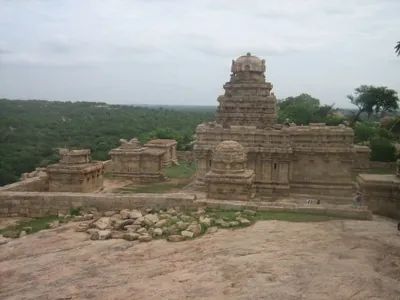
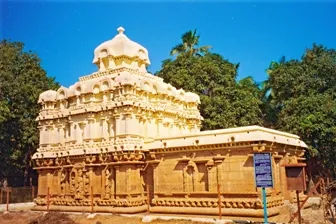
This small but majestic temple is considered as one of the finest specimen of the early Chola period art. However, as there is no foundation inscription found, the construction and its royal association to the Cholas cannot be determined with certainty. The earliest inscriptions on the temple refer to the early Chola kings, therefore it may be surmised that it was constructed during the final decades of the ninth century CE. There are two legends associated with the temple. First mentions that the temple was built by a sanyasi and at the time of consecration, a monkey was found at the top of the temple. Seeing a monkey was taken as a bad omen and the temple was left deserted. Another legend states that first it was a temple for Hanuman worshipped by Madhavas, then Hanuman was replaced with Ganesha by religious opponents and finally Madhavas turned out Ganesha. The temple is referred as Tirukkurakkutturai-Perumanadigal in its inscriptions.
The temple faces east and is built as a dvitala (double storey) vimana structure. It consists of a garbha-grha (sanctum) followed by an antarala and an ardha-mandapa. The antarala made this temple unique as this feature is absent in contemporary temples usually attributed to the early Chola period; Panangudi, Visalur, Kaliyapatti, Kodumbalur, Tirukattalai etc. Adhishthana is of vaprabandha type, composed of upana, jagati, vrtta-kumuda sandwiched within two lotus cusps (adhah- and udrhva-padma), kantha as prati-mukha with vyala-vari and sandwiched within two kampa courses and pattika or prati-vajana. Above the adhisthana rises a vedi or wall-kantha. Vyalas over the kantha are taken amongst the best such specimens produced during this period. At the corners are placed makaras with open mouth and a rider or animals inside. This vaprabandha adhishthana and its decoration scheme is taken as an original Chola style by Barrett.
Bhitti (wall) rises above adhisthana and is fashioned in pancha-ratha mode consisting of a central bhadra niche, corner karna and intermediate prati-karna niches. The style may also be termed as tri-ratha as the two intermediate niches are provided in the recess sections between bhadra and karna, for this article we will take it as pancha-ratha having five niches. Usage of different forms of pilasters over the bhitti is of special interest. Bhadra and prati-karna niches have rudra-kantha (round section) pilasters while karna niche has brahma-kantha (square section) pilaster. Bhadra-niche is given special attention, provided with a makara–torana above its rudra-kantha pilasters and the whole niche is encased within two vishnu-kantha (octagonal section) pilasters. All the niches, except karna, penetrate the wall-kantha (vedi) above the adhishthana. Bhadra-niche or deva-koshtha has Shiva-Dakshinamurti in the south, Brahma in the north and the western deva-koshtha is empty.
Iconography of the Dakshinamurti icon is of great artistic acumen. He is shown seated under a vata (banyan) tree with one of his leg resting over apsamara demon. It is also suggested that the tree depicted in this sculpture may be Ailanthus altissima or Tree of Heaven. However, the iconography of Dakshinamurti associates him sitting under a banyan tree. Presence of a deer near his feat suggests the environment of a forest. His hairdo is very elaborate and exquisitely conceptualized with decorations of flowers. An owl and a squirrel is found over the vata(banyan) tree. A kamaldalu, a rosary and a cloth is also hanging on the vata tree. The makara-torana above the pilasters shows dancing Kali. The whole deva-koshtha is enclosed within two vishnu-kantha pilasters allowing recess space on both sides. Within this recess are carved sculptures in three different registers placed vertically. On the bottom register are shown disciples, above it are shown animals and on the top-most register are shown demi-gods, yakshas/gandharvas and kinnaras. On the eastern karna-niche of the southern wall is found Shiva as Bhikhshatanamurti. He is shown wearing heavy sandals and is accompanied with a gana. In other karna-niches on different walls are placed images of male attendants or female damsels.
Western deva-kostha is empty however presence of Varaha on the makara-torana suggests that it probably houses an image of Vishnu. However, another possibility is that it might have an image of a goddess as both its prati-karna-niches have female attendants. Dhakymentions this makara-torana as the finest makara-torana in South India. The apsaras in the recess niches can be compared with the similar images found in the Nageswaraswami Temple in Kumbakonam.
Bhadra niche on the north has an image of Brahma. Prati-karna niches in the recess have adoring amaras. Decoration over pilasters has some intesring icons. A marvelous depiction of Nataraja is found among these. Shiva is shown in company of musicians and the karana displayed here is urdhva-janu, where the right leg is lifted up with knee going till the chest level and hands can be in any desired mudras. Another interesting sculpture is the depiction of Shiva as Gajasamharamurti, Shiva shown slaying the elephant demon.
As the shikhara of the temple is built in brick and if of late origin, we may skip the discussion of the same. Ardha-mandapa has niches on its south and north walls. Niche on the south is empty while the one in the north has an image of Dakshinamurti. The mandapa from inside is supported on four pillars placed in the middle.
Dating of the temple is somewhat controversial as its assignment is suggested to the reign of the Chola king Aditya I (870-907 CE) and Parantaka I (907-955 CE). S R Balasubrahmanyam is of opinion that the presence of an inscription assignable to Aditya I suggests that the temple existed during his reign therefore it was constructed during his time as the inscription refers to his 24th regnal year. Barrett is of opinion that the inscription of Aditya I is engraved alongside and below two inscriptions of Parantaka I on the same stone, where there is no shortage of clean wall space, suggesting that all three inscriptions were engraved at the same time, in about 20th regnal year of Parantaka I. He assigns this temple to the period of Parantaka I believing that the fabric of the temple supports this later date of 927 CE.
Gary J Schwindler compares the sculptures at Kodumbalur and Brahma sculpture of this temple stating that it is useful for helping to establish the date of the Koranganatha temple. When their carvings are compared, their stylistic affinities are so apparent that an earlier dating of around 895 CE for both the temple and sculptures seems preferable. Dhaky goes with Barrett suggesting that looking at the sculptures and their arrangement it become apparent that these sculptures seem to reflect the serenity typical of Parantaka’s period and therefore are later than Aditya’s period. He suggests that the temple was rebuilt during Parantaka’s time and the inscription of Aditya I is reengraved.
03 / LOCATION & MAP
Place the story on the map.
PLACE THIS STORY ON THE MAP
Srinivasanallur, Tiruchirappalli district, Tamil Nadu
Tamil Nadu, India
ABOUT THIS FIELD ENTRY
From the Puratattva archive.
This article was first published on Puratattva (puratattva.in) and appears on Bharat Ke Wow with permission. Photographs are credited in their captions.
Read the original entry ↗