
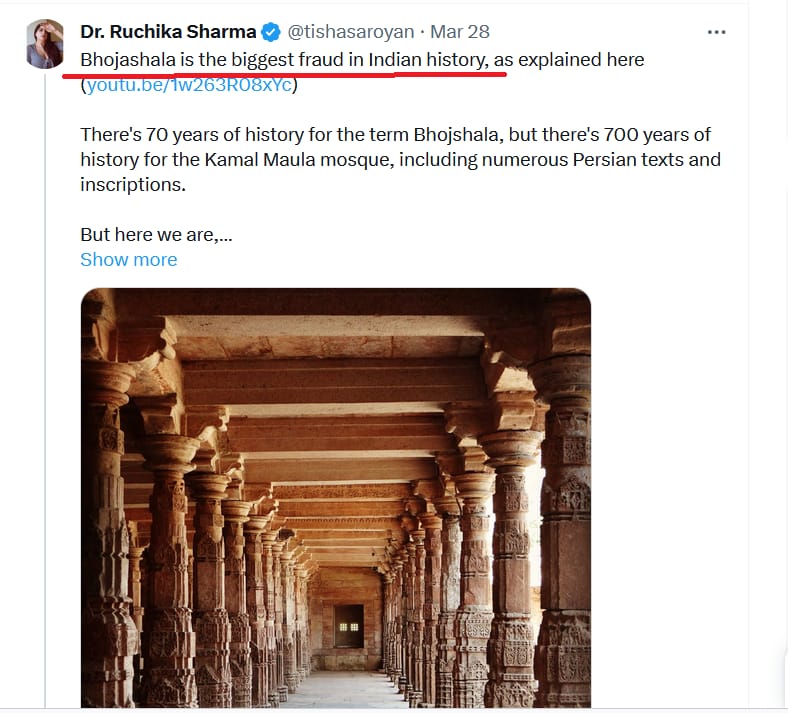
Following the recent court observations on Bhojashala in Dhar, a recurring claim has resurfaced in public discourse: that there are “no historical records” for Bhojashala, while the Kamal Maula Mosque possesses an uninterrupted history of nearly seven centuries. At first glance, this argument may appear persuasive. However, a careful reading of literary sources, inscriptions, archaeological remains, and museum-held evidence presents a far more layered historical picture.
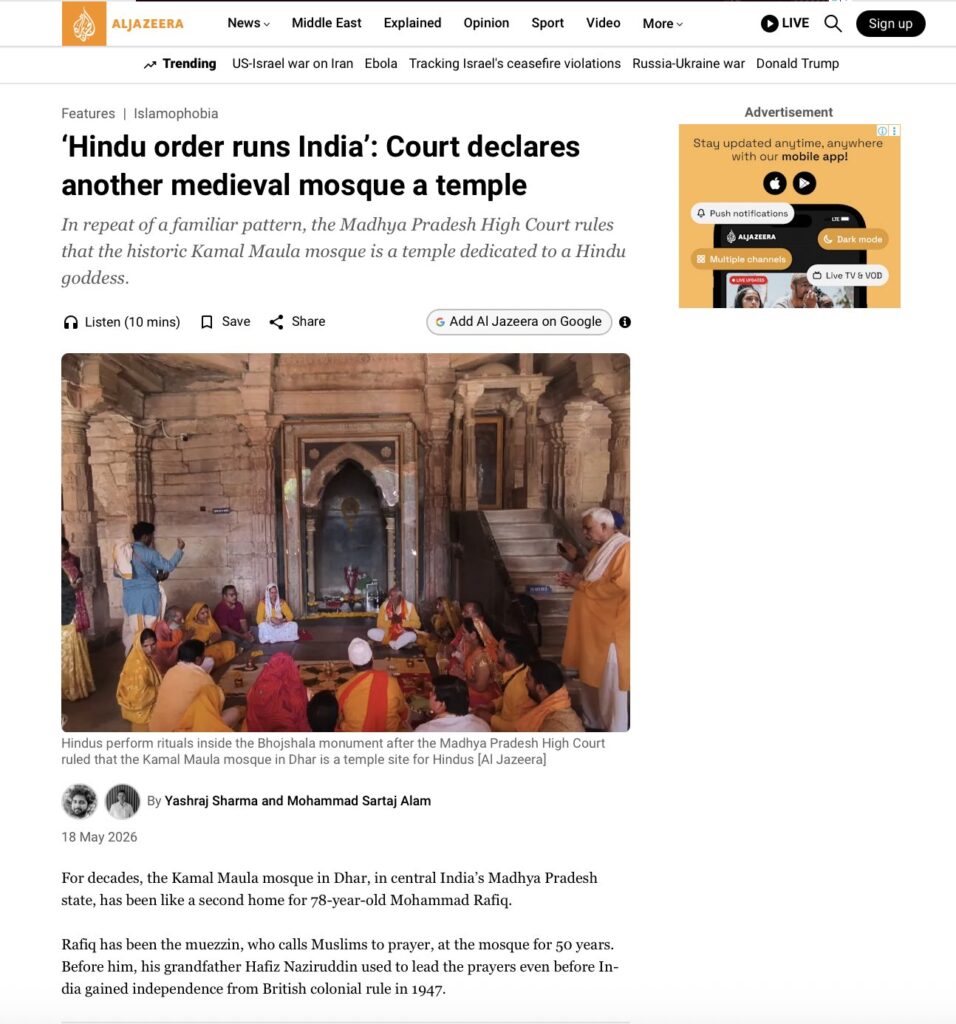
The issue is not whether the structure later functioned as a mosque. That historical phase undeniably existed. The real question is whether credible pre-modern evidence exists for an earlier Sanskritic scholastic and sacred institution associated with Sarasvatī and the intellectual legacy of King Bhoja at Dhar. On that question, the evidence is neither recent nor speculative. It emerges from medieval literary texts, inscriptions discovered within the structure itself, surviving pedagogical carvings, and sculptural evidence associated with Dhar’s intellectual culture.
The Prabhāvakacarita and “Bhoja’s Pāṭhaśālā”
One of the earliest important references appears in the Prabhāvakacarita, composed by Prabhācandra in 1277 CE. The text narrates events placed around 1140 CE during the campaign of the Chalukya ruler Siddharāja Jayasiṃha against Dhāranagara (Dhar). In this account, the ruler encounters students studying in what is explicitly described as “Bhoja’s Pāṭhaśālā” — भोजस्य पाठशाला.
This is significant because the phrase literally means “the school or seat of learning of Bhoja.” Even if the modern popular form “Bhojashala” gained wider usage later, the underlying institution is clearly attested in medieval Sanskrit literature.
The text further states:
तत्र व्याकरणं श्रीमद् भोजराजविनिर्मितम्
“There, the grammar composed by the illustrious King Bhoja was studied.”
This directly connects the institution with Bhoja’s intellectual legacy, particularly his celebrated grammatical treatise Sarasvatīkaṇṭhābharaṇa. The description is not of an ordinary shrine or casual gathering place. It portrays a rigorous scholastic environment where students studied continuously and learned scholars assembled for discussion and instruction.
The reference, therefore, is not merely architectural; it points toward a living centre of Sanskrit learning.
The Pārijāta-Mañjarī Inscription Found Within the Structure
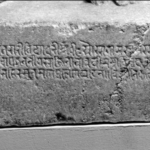
Perhaps the most decisive evidence comes from an inscription discovered inside the present structure known as the Kamal Maula Mosque. Published in Epigraphia Indica (Vol. VIII), the inscription belongs to the reign of the Paramāra ruler Arjunavarman in the early thirteenth century.
The inscription contains a Sanskrit drama titled Pārijāta-Mañjarī. Crucially, the text states that the drama was intended to be performed in the temple of Goddess Śāradā — another name for Sarasvatī or Bhāratī — located at Dhāra.
The inscription describes this Śāradā temple as:
- a jewel-like ornament of the city,
- and the foremost among the temples situated within the eighty-four divisions of Dhar.
This is not the language used for a marginal shrine. It reflects the presence of a major sacred and cultural institution deeply integrated into the intellectual life of the city.
Equally important is the archaeological context of the inscription itself. Reports published at the time record that the inscription was found embedded inside the structure attached to the northern wall of the principal mihrab, with the inscribed surface turned inward. It was not a loose manuscript or an isolated artifact brought from elsewhere. It was physically incorporated into the building itself.
That detail matters enormously. It makes it impossible to dismiss the Sarasvatī-temple association as a modern fabrication or recent ideological invention.
Temples as Centres of Learning and Performance
The content of the inscription also aligns with what is historically known about medieval Indian temple culture. Temples frequently functioned not only as places of worship but also as centres of education, dramatic performance, philosophical discussion, manuscript culture, and public recitation.
If a dramatic Sanskrit inscription associated with Śāradā/Sarasvatī was discovered within the present structure, and if the text itself identifies the performance space as the Sarasvatī temple of Dhar, then the burden of explanation falls upon those who deny any earlier scholastic or temple association with the site.
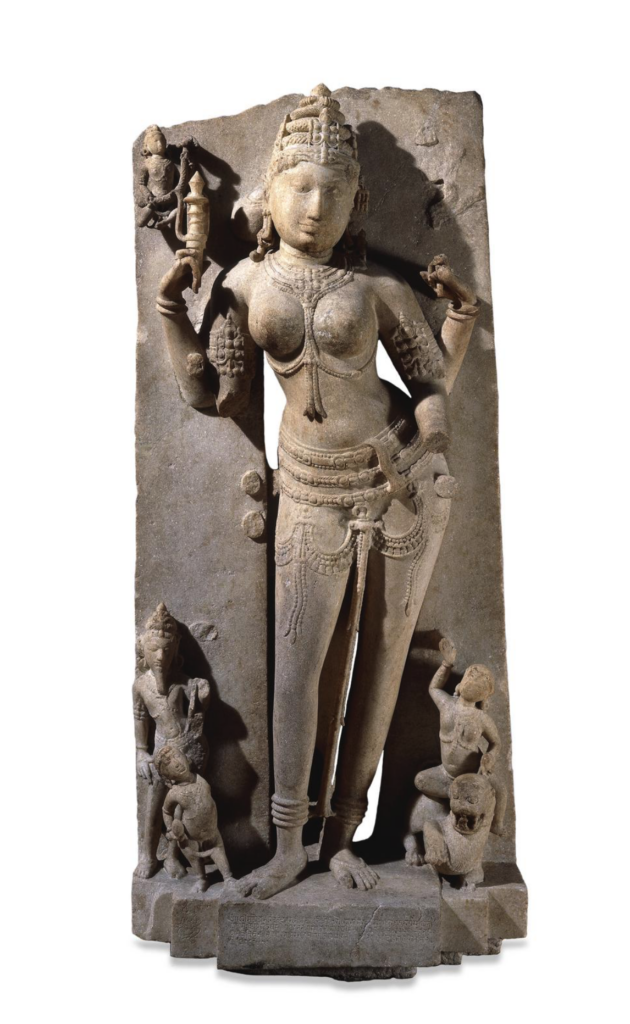
Image Courtesy : https://www.britishmuseum.org/
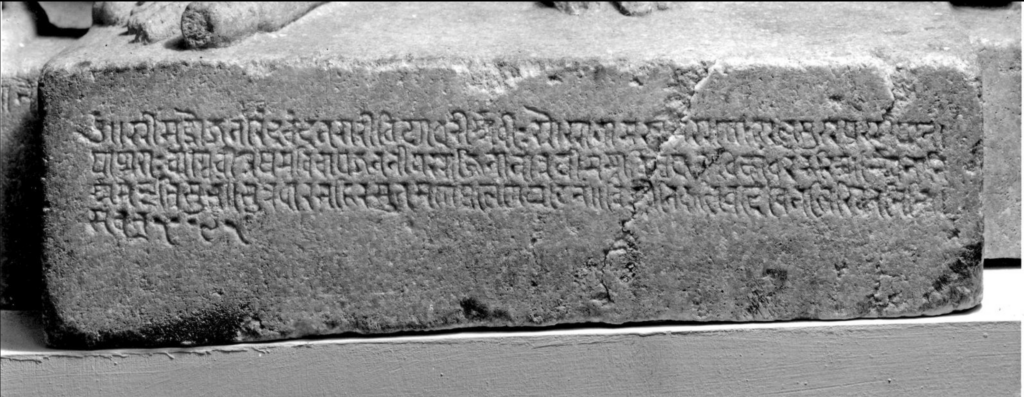
Image Courtesy : https://www.britishmuseum.org/
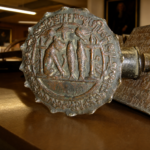
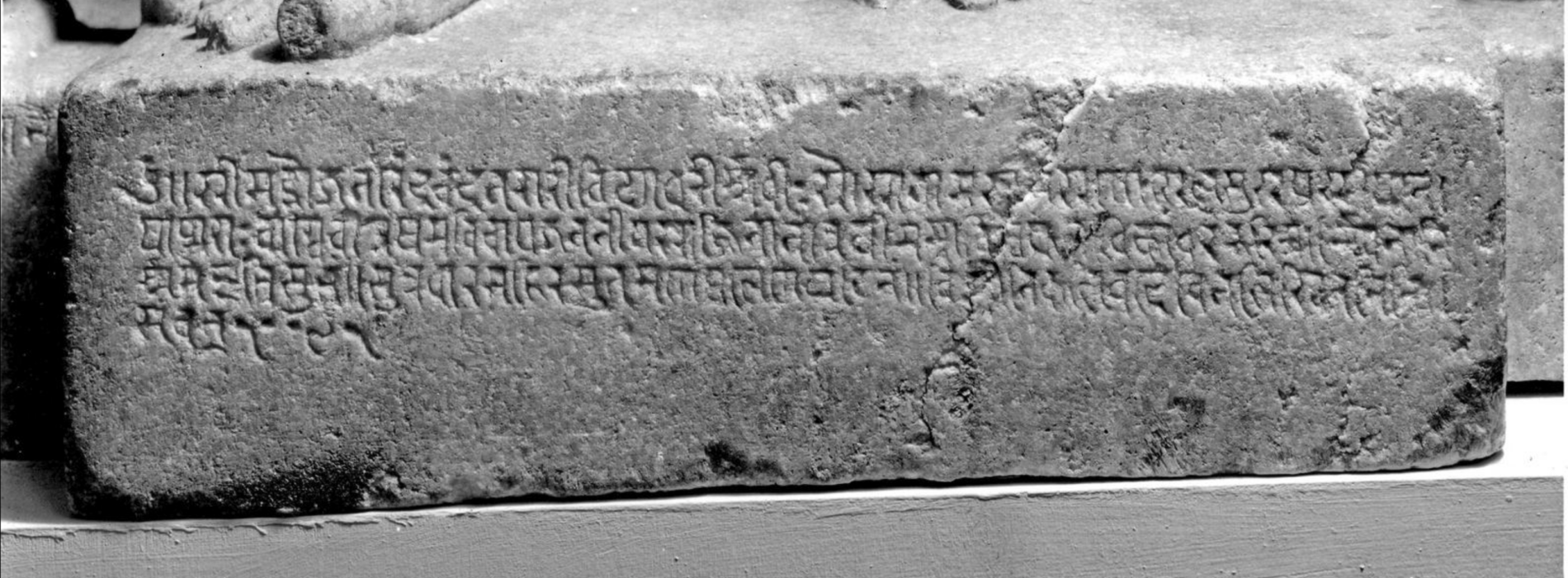
The pedestal inscription associated with the Sarasvatī image further strengthens the intellectual and scholastic associations of Dhar. Written in Sanskrit in Devanāgarī script, the inscription invokes Vāgdevī, the goddess of speech and learning, and records the creation of the image within a learned cultural environment associated with Bhoja’s Dhāra.
Curatorial observations connected with the image further note that the inscription links the sculpture with traditions of learning and with the broader scholastic culture of the Paramāra period.
The Prabandhacintāmaṇi and Sarasvatīkaṇṭhābharaṇa
Another important literary witness is Merutuṅga’s Prabandhacintāmaṇi, composed around 1304 CE. The text refers to a temple named Sarasvatīkaṇṭhābharaṇa.
This is highly significant because the name directly recalls Bhoja’s grammatical treatise of the same title. The connection between Bhoja, Sarasvatī, grammar, and Dhar is therefore not incidental. It reflects a coherent intellectual tradition remembered in medieval literary memory.
A temple associated with Sarasvatī and bearing the title of Bhoja’s grammatical work is precisely what one would expect in a city historically celebrated for scholarship and Sanskrit learning.
The Serpentine Grammatical Inscriptions
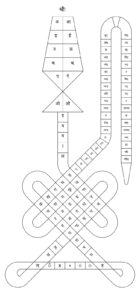
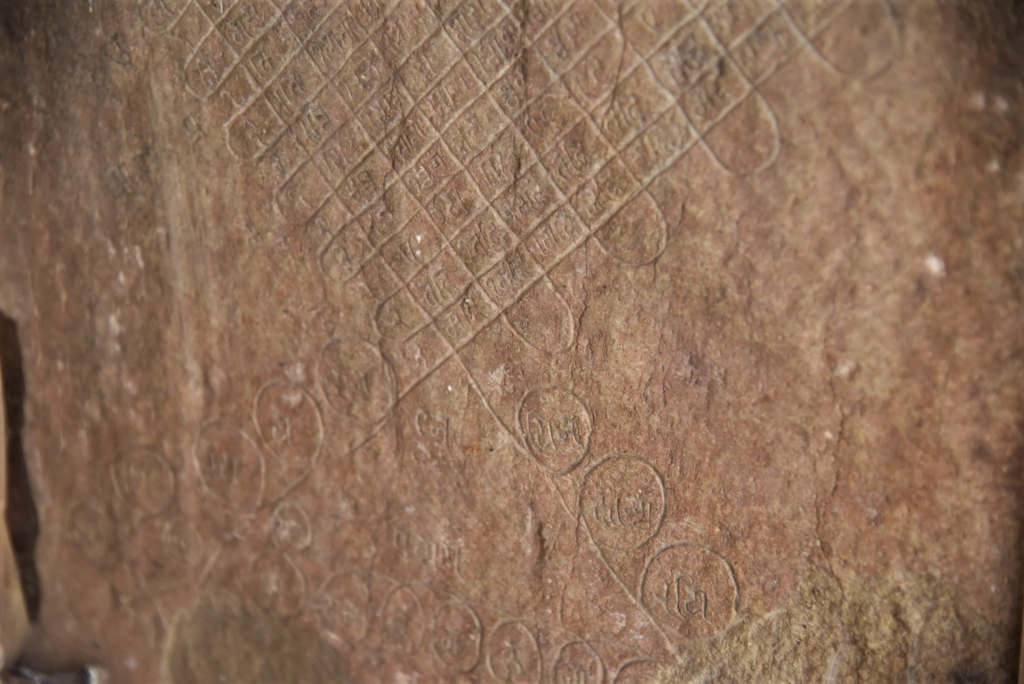
The physical evidence from the complex further strengthens this interpretation. Among the most remarkable finds are the famous serpentine grammatical inscriptions discovered within the structure.
These inscriptions present alphabets and grammatical rules arranged in serpentine patterns, apparently designed as mnemonic teaching devices. Their pedagogical purpose is unmistakable. Such carvings make immediate sense in a Sanskrit educational setting associated with grammar and scholastic instruction.
It is difficult to explain them merely as decorative architectural features unrelated to learning.
Historical Methodology and Layered Monuments
At this point, it is important to clarify a basic principle of historical methodology: the existence of a later religious phase does not erase evidence of an earlier phase.
Across medieval India, monuments frequently underwent reuse, reconstruction, adaptation, and layered occupation over centuries. Temples became mosques, mosques became temples, palaces became forts, and sacred landscapes evolved continuously across political transitions.
Therefore, the existence of the Kamal Maula Mosque for several centuries does not, by itself, invalidate evidence for an earlier Sanskritic and Sarasvatī-centred institution at the same site.
The real historical question is not whether a mosque phase existed. It clearly did. The question is what existed before it and what the embedded literary, epigraphic, and architectural evidence reveals about the earlier life of the structure.
A Coherent Historical Pattern
When the evidence is viewed together, a coherent pattern emerges:
- The Prabhāvakacarita refers to “Bhoja’s Pāṭhaśālā” at Dhar and connects it with Bhoja’s grammatical tradition.
- The Pārijāta-Mañjarī inscription found within the structure explicitly mentions the temple of Śāradā/Sarasvatī at Dhar.
- The Sarasvatī sculpture associated with Dhar preserves inscriptional references to Vāgdevī and learned traditions linked with Bhoja’s intellectual milieu.
- The Prabandhacintāmaṇi remembers a temple named Sarasvatīkaṇṭhābharaṇa, directly linked to Bhoja’s scholastic legacy.
- The serpentine grammatical carvings point toward a pedagogical Sanskritic environment.
- The architectural fabric itself includes reused pillars, sculptural fragments, Sanskrit inscriptions, and elements associated with pre-Islamic sacred architecture.
Therefore, the claim that “there are no records for Bhojashala” is historically unsustainable.
The evidence is not modern mythology or twentieth-century invention. It consists of medieval literary references, inscriptions physically embedded within the structure, museum-preserved epigraphic material, and surviving pedagogical carvings associated with Sanskrit learning.
Conclusion
The Bhojashala debate cannot be reduced to slogans, selective memory, or present-day political binaries. Any serious historical discussion must engage with the actual evidence preserved in texts, inscriptions, sculpture, and the monument itself.
Dhar was remembered not merely as a political centre, but as a seat of grammar, poetry, learning, performance, and Sarasvatī worship associated with the intellectual world of King Bhoja.
The debate, therefore, is not between memory and history.
The historical record itself preserves the memory of Dhar as a centre of Sarasvatī worship, Sanskrit learning, and Bhoja’s intellectual legacy.