
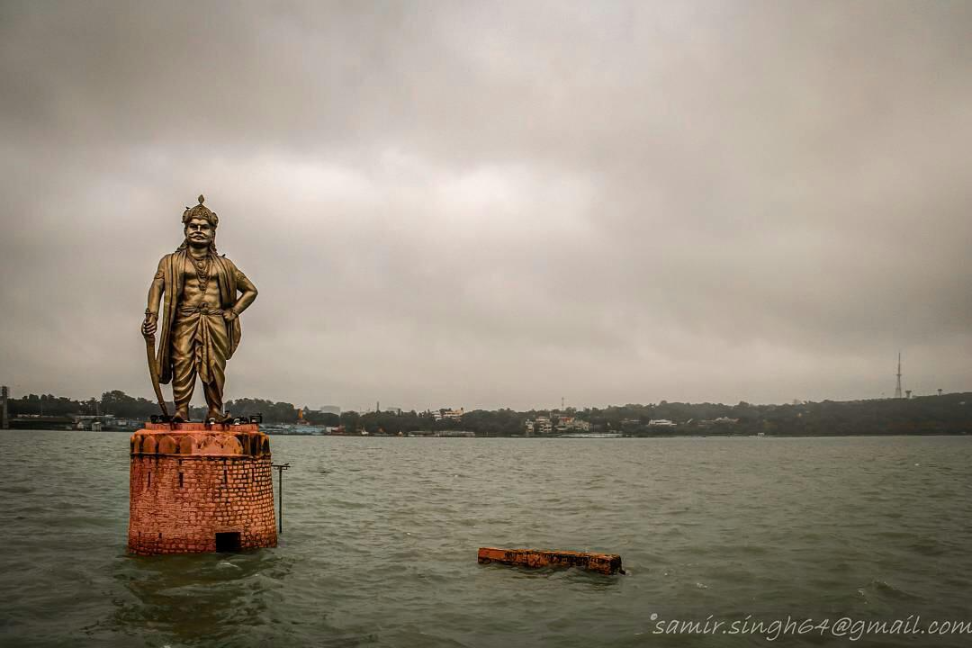
Raja Bhoja History: The Scholar-King Who Built Lakes, Temples, and Bhojashala
- May 15, 2026
- 0 Comment
Adya Dhara sadadhara sadalamba Sarasvati,
Panditah manditah sarve Bhojaraje bhuvam gate.“Dhara remains supported, Sarasvati still has her foundation, and scholars continue to shine because Raja Bhoja once walked upon this earth.”
A king once built a lake so vast that it transformed an entire landscape.
He designed temples, wrote books on architecture and poetry, explored mechanical devices centuries ahead of his time, and transformed his capital into one of India’s greatest centres of learning.
His name became so legendary that generations of rulers wished to be compared to him.
That king was Raja Bhoja.
More than a warrior or patron, Raja Bhoja represented a uniquely Indian ideal: the ruler as philosopher, engineer, poet, strategist, architect, and guardian of civilization itself.
Even today, nearly a thousand years later, the history of Raja Bhoja continues to inspire scholars, architects, historians, and seekers of India’s civilizational knowledge traditions.
Quick Facts About Raja Bhoja
| Detail | Information |
| Full Name | Raja Bhoja |
| Dynasty | Paramara Dynasty |
| Period | 11th Century CE |
| Region | Malwa |
| Capital | Dhara |
| Famous For | Bhojtal, Bhojeshwar Temple, Bhojashala |
| Known As | Scholar-King of India |
| Major Work | Samarangana Sutradhara |
| Fields of Interest | Architecture, Engineering, Sanskrit, Governance, Philosophy |
Who Was Raja Bhoja?
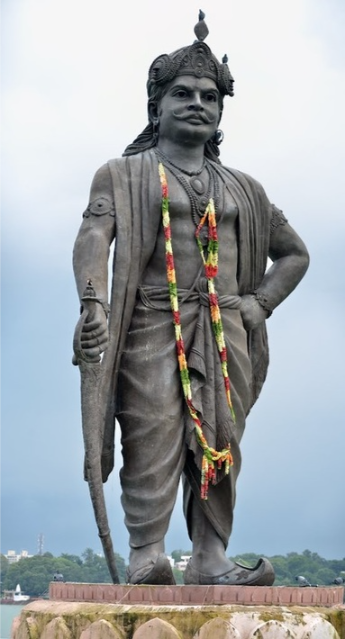
Raja Bhoja was one of the most celebrated rulers of the Paramara dynasty, which rose to prominence in central India after the decline of the Gurjara-Pratiharas.
Believed to have been born between 982 and 989 CE, Raja Bhoja likely ascended the throne around 1000 CE and ruled for more than five decades. Under Raja Bhoja, the Malwa region experienced extraordinary political influence, intellectual flourishing, and architectural development.
But Raja Bhoja was not remembered merely because he ruled.
He was remembered because he embodied a civilizational ideal where knowledge, governance, spirituality, science, literature, engineering, and public welfare were deeply interconnected.
In Raja Bhoja’s world:
- architecture itself was sacred,
- engineering became an act of dharma,
- learning was worthy of worship,
- and kingship required intellectual refinement.
This integrated vision of civilization is what makes Raja Bhoja profoundly relevant even today.
Raja Bhoja and the Rise of a Knowledge Civilization
From childhood, Raja Bhoja was trained as an ideal Kshatriya prince. But his education extended far beyond warfare.
Raja Bhoja mastered:
- statecraft and governance,
- Sanskrit literature,
- grammar,
- poetics,
- philosophy,
- architecture,
- and the famed sixty-four arts.
In Raja Bhoja, the sword and the manuscript belonged to the same hand.
At a time when modern education increasingly separates disciplines into isolated silos, Raja Bhoja’s world imagined knowledge as a continuum. Science, art, spirituality, engineering, aesthetics, governance, and literature were not seen as separate domains.
This multidisciplinary vision became one of the defining features of Raja Bhoja’s reign.
Raja Bhoja the Warrior and Defender
Although remembered today for scholarship and architecture, Raja Bhoja was also a ruler of significant military ability.
Paramara inscriptions describe Raja Bhoja’s victories over regions including:
- Lata,
- Konkana,
- Gujarat,
- Karnataka,
- and Chedi.
Several traditions also associate Raja Bhoja with resistance during the era of Mahmud of Ghazni. While historians debate certain details, Raja Bhoja was consistently remembered as a ruler of formidable strength and influence.
Yet, had Raja Bhoja only been a conqueror, history may have remembered him as one ruler among many.
What truly distinguished Raja Bhoja was the astonishing breadth of his intellect.
Raja Bhoja the Polymath
Raja Bhoja was not merely a patron of scholars.
Raja Bhoja himself became one of the great polymaths of medieval India.
Works attributed to Raja Bhoja span an extraordinary range of subjects:
- architecture,
- engineering,
- astronomy,
- grammar,
- poetics,
- music,
- Ayurveda,
- yoga,
- Vedanta,
- polity,
- and technology.
Among the most famous works associated with Raja Bhoja are:
- Samarangana Sutradhara
- Sringaraprakasha
- Sarasvatikanthabharana
- Rajamartanda
- Yuktikalpataru
These works reveal a mind that moved effortlessly between metaphysics and mechanics, poetry and polity, grammar and city planning.
For readers interested in exploring Raja Bhoja’s intellectual legacy in greater depth, we have also published a curated collection of books and research-based works on Raja Bhoja, Bhojashala, Indian knowledge systems, temple architecture, and Sanskrit traditions.
Explore the Raja Bhoja Collection
Raja Bhoja and Ancient Indian Engineering
One of Raja Bhoja’s most fascinating contributions is the Samarangana Sutradhara, a monumental text on architecture, urban planning, design, and engineering.
The work discusses:
- city layouts,
- temple construction,
- fortifications,
- water systems,
- roads,
- residential planning,
- and mechanical devices.
The text also contains descriptions of:
- automated mechanisms,
- rotating celestial globes,
- and concepts resembling robotics and animatronics.
Whether understood literally or theoretically, Raja Bhoja’s works reveal something extraordinary: medieval India possessed a sophisticated imagination of technology and mechanism.
Long before modern disciplinary boundaries existed, Raja Bhoja’s world explored the intersection of engineering, aesthetics, astronomy, and sacred design.
Raja Bhoja’s Dhara: The Capital of Learning
Dhar, the capital of Raja Bhoja, emerged as one of the great intellectual centres of medieval India.
The city was carefully planned with:
- gateways,
- royal roads,
- drainage systems,
- gardens,
- fountains,
- artificial lakes,
- and fortified structures.
Roads intersected systematically. Water management received careful attention. Public beauty was integrated into civic planning.
In Raja Bhoja’s imagination, a city was not merely a settlement.
It was a living body of civilization.
Bhojtal: The Massive Lake Built by Raja Bhoja
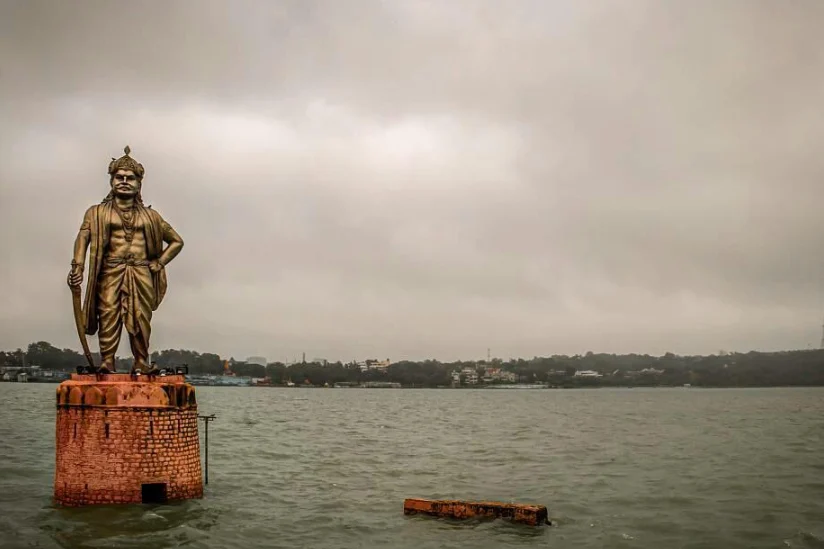
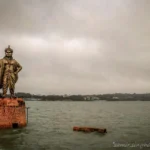
Among Raja Bhoja’s greatest achievements was Bhojtal — one of the most extraordinary hydraulic engineering projects of medieval India.
Spread across the Betwa valley, Bhojtal is believed to have once covered nearly 250 square miles.
According to tradition, Raja Bhoja suffered from a severe skin disease. His guru advised him to construct a massive lake fed by 360 streams and bathe in it at an auspicious moment.
Royal engineers eventually identified a valley surrounded by hills near present-day Bhopal.
To create the reservoir:
- massive dams were constructed,
- enormous stone blocks were fitted without mortar,
- and advanced water retention methods were employed.
The engineering demonstrates remarkable understanding of:
- pressure distribution,
- landscape behaviour,
- stone fitting,
- and long-term water management.
Even today, Bhojtal remains one of the most powerful examples of ancient Indian hydraulic engineering.
More importantly, Raja Bhoja’s lake reflects an older Indian understanding of public works: infrastructure itself could become sacred service.
Bhojeshwar Temple and Raja Bhoja’s Architectural Vision
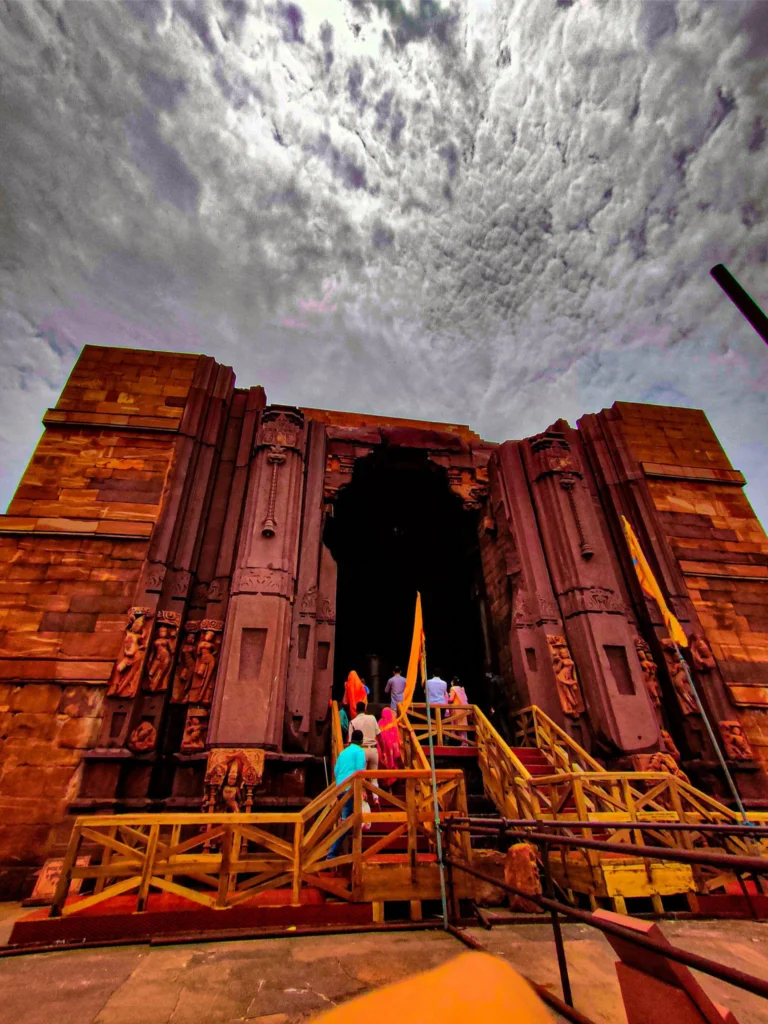
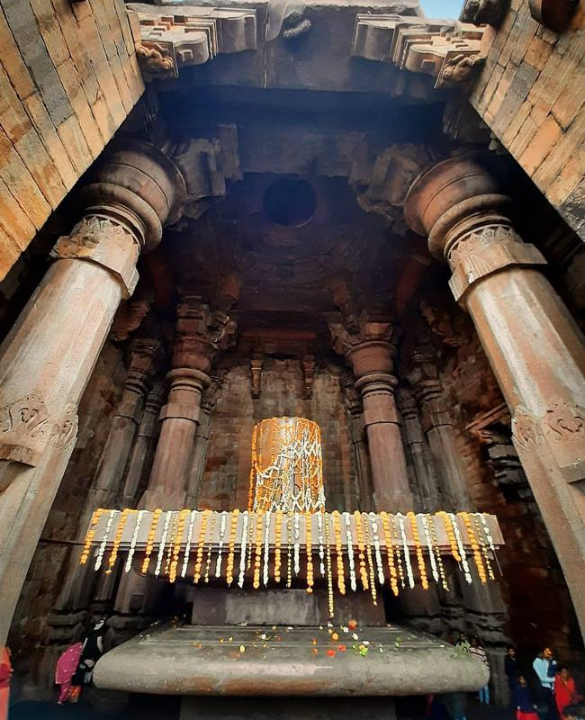
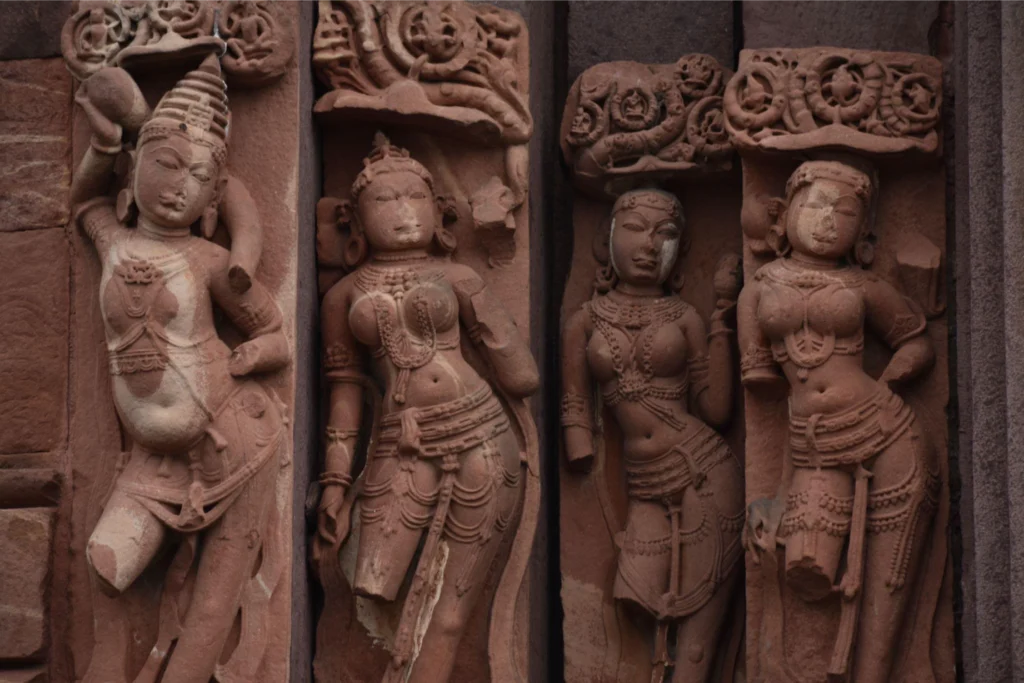
Near Bhopal stands the magnificent Bhojeshwar Temple, traditionally associated with Raja Bhoja’s architectural vision.
The temple is famous for:
- its monumental scale,
- massive pillars,
- unfinished superstructure,
- and colossal Shivalinga.
Yet what makes Bhojeshwar Temple emotionally powerful is its incompleteness.
The unfinished structure feels suspended in time — a reminder of ambition interrupted but never erased.
Even incomplete, Bhojeshwar Temple overwhelms visitors with scale, symmetry, and sacred grandeur.
It is not merely architecture.
It is aspiration carved into stone.
Raja Bhoja, Bhojashala, and the Temple of Knowledge
Perhaps the most evocative part of Raja Bhoja’s legacy is the institution later associated with Bhojashala.
Raja Bhoja was a great devotee of Sarasvati, the goddess of wisdom, learning, music, and speech.
Raja Bhoja established a sacred centre of learning known as:
- Bharati Bhavana,
- Sarasvati Sadana,
- and later, Bhojashala.
This was not simply a temple.
It was a temple-library-university complex where knowledge itself was revered as sacred.
Students and scholars engaged with:
- grammar,
- poetry,
- philosophy,
- debate,
- music,
- and sacred learning traditions.
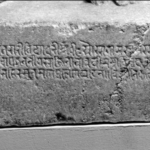
Stone pillars at the site contain Sanskrit grammatical inscriptions and artistic educational diagrams connected to ancient systems of learning.
Imagine walking into a temple where the pillars themselves teach grammar.
That was Raja Bhoja’s vision of education.
You may also enjoy reading our related articles and publications on ancient Indian education systems, Sanskrit traditions, and temple-based learning institutions.
Raja Bhoja and the Sacredness of Learning
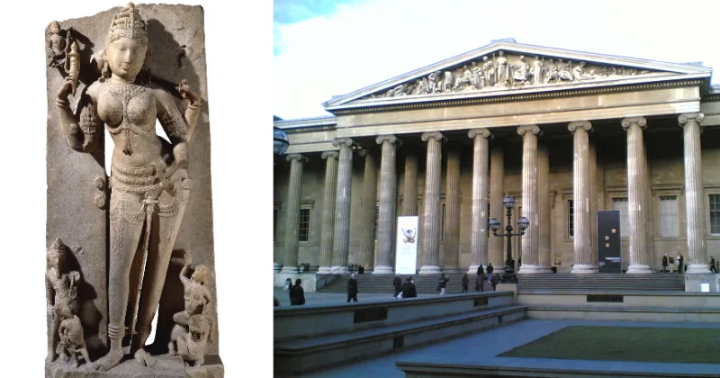
A celebrated image of Vagdevi once associated with Raja Bhoja’s learning centre is regarded as a masterpiece of Paramara-era sculpture.
The sculpture depicts the goddess in serene meditative elegance, adorned with refined ornamentation and symbolic figures.
Today, the image is preserved in the British Museum.
The significance of Raja Bhoja’s Sarasvati tradition extends far beyond art history.
It reflects a profound Indian civilizational idea:
Learning was not merely informational.
It was transformational.
Knowledge demanded discipline, beauty, humility, memory, and reverence.
At a time when information is abundant but intellectual depth is increasingly rare, Raja Bhoja’s vision feels remarkably relevant.
Why Raja Bhoja Still Matters Today
Raja Bhoja matters because he challenges modern assumptions about leadership, knowledge, and civilization.
Raja Bhoja was:
- a warrior without being merely martial,
- a scholar without being detached from governance,
- an engineer without abandoning spirituality,
- and a builder who understood both utility and beauty.
The history of Raja Bhoja offers enduring lessons for the modern world.
1. Knowledge Must Be Integrated
Raja Bhoja’s works show no artificial separation between science, art, governance, philosophy, and spirituality.
2. Public Works Can Be Sacred
Bhojtal demonstrates how infrastructure can embody ecological and ethical responsibility.
3. Education Needs Beauty and Reverence
Bhojashala reminds us that learning spaces should inspire intellectual aspiration.
4. Leadership Requires Intellectual Depth
Raja Bhoja’s example shows that power without learning is incomplete.
5. Civilizations Survive Through Institutions
Temples, libraries, lakes, cities, inscriptions, and texts preserve collective memory across centuries.
FAQs About Raja Bhoja
Raja Bhoja was an 11th-century ruler of the Paramara dynasty in Malwa, remembered for his contributions to architecture, engineering, Sanskrit scholarship, education, and governance.
Raja Bhoja is famous for Bhojtal, Bhojeshwar Temple, Bhojashala, Sanskrit learning traditions, and works such as Samarangana Sutradhara.
Bhojashala is a historic site in Dhar associated with Raja Bhoja’s temple-library and sacred centre of learning dedicated to Sarasvati.
Samarangana Sutradhara is an ancient Sanskrit treatise attributed to Raja Bhoja dealing with architecture, engineering, urban planning, and mechanical devices.
Raja Bhoja is traditionally associated with the construction of Bhojeshwar Temple near Bhojpur in Madhya Pradesh.
Raja Bhoja represents an integrated civilizational vision where knowledge, engineering, governance, spirituality, and public welfare worked together.
Explore Books on Raja Bhoja and Indian Knowledge Traditions
Readers interested in exploring the intellectual and civilizational legacy of Raja Bhoja in greater depth can explore our curated Bhoja Collection — a carefully selected set of works covering Sanskrit scholarship, poetics, aesthetics, architecture, engineering, and ancient Indian knowledge systems.
1. King Bhoja
A concise yet insightful introduction to Raja Bhoja’s life, legacy, and role as a patron of Sanskrit learning, arts, and culture. This work situates Raja Bhoja within the broader intellectual history of India while also preserving Dr. Raghavan’s scholarly perspective.
Focus Areas:
Kingship • Cultural Patronage • Sanskrit Scholarship
2. Bhoja’s Śṛṅgāra Prakāśa
A detailed study of Raja Bhoja’s monumental treatise on poetics and aesthetics, exploring concepts such as rasa, dhvani, alaṅkāra, and nāṭya. This volume examines Raja Bhoja’s literary vision and positions him among the great thinkers of Sanskrit poetics.
Focus Areas:
Sanskrit Poetics • Aesthetics • Literary Theory
3. Bhoja’s Contribution to Technical Literature
A rare exploration of Raja Bhoja’s contributions to scientific and technical knowledge, including architecture, engineering, town planning, and mechanical design. With special focus on works such as Samarangana Sutradhara and Yuktikalpataru, this study highlights the sophistication of India’s traditional knowledge systems.
Focus Areas:
Ancient Indian Science • Architecture • Applied Knowledge
Whether you are a student, researcher, history enthusiast, architect, or seeker of India’s intellectual heritage, these works offer valuable insight into the extraordinary world of Raja Bhoja and the interdisciplinary vision of classical Indian civilization.
Explore the Raja Bhoja Collection
The Legacy of Raja Bhoja
Raja Bhoja did not merely rule a kingdom.
Raja Bhoja imagined civilization itself as an act of knowledge, beauty, responsibility, and sacred purpose.
He built lakes that sustained life, temples that inspired awe, institutions that nurtured learning, and texts that carried knowledge across centuries.
That may be why, nearly a thousand years later, India still remembers the name of Raja Bhoja.