


01 / INTRODUCTION
Kashi Vishwanath, Uttar Pradesh
The Eternal Jyotirlinga
तेजोमयं सगुणनिर्गुणमद्वितीयम् ।
आनन्दकन्दमपराजितमप्रमेयम् ।
नागात्मकं सकलनिष्कलमात्मरूपं ।
वाराणसीपुरपतिं भज विश्वनाथम् ॥
Adore Lord Vishwanatha, the sovereign of Varanasi—the radiant One who shines as pure consciousness, who is at once with form and beyond all form, the inexhaustible source of bliss, and the indivisible Self that pervades all existence.
There are sacred cities in Bharat in which a temple becomes the centre of the city. In Kashi, the city itself becomes the temple. At the heart of this immense sacred landscape stands Kashi Vishwanath, the Lord of the Universe, revered as one of the twelve Jyotirlingas and regarded as the spiritual axis around which the sacred geography of Varanasi unfolds. The temple stands close to the western bank of the Ganga, within the dense lanes of the old city, where pilgrims, priests, ascetics, householders and visitors have moved through the same sacred streets for centuries.
The name Vishwanath itself expresses the greatness attributed to this shrine. Shiva is worshipped here not merely as the Lord of one place or one community, but as the Lord of the Universe. Kashi is traditionally understood as a city in which Shiva’s presence never departs, and this idea gives the shrine its ancient epithet Avimukta—the place that is never forsaken by Shiva. The sacred traditions surrounding the city go further, describing Kashi as a realm of liberation, where the Lord Himself grants the knowledge necessary to cross beyond the cycle of birth and death.
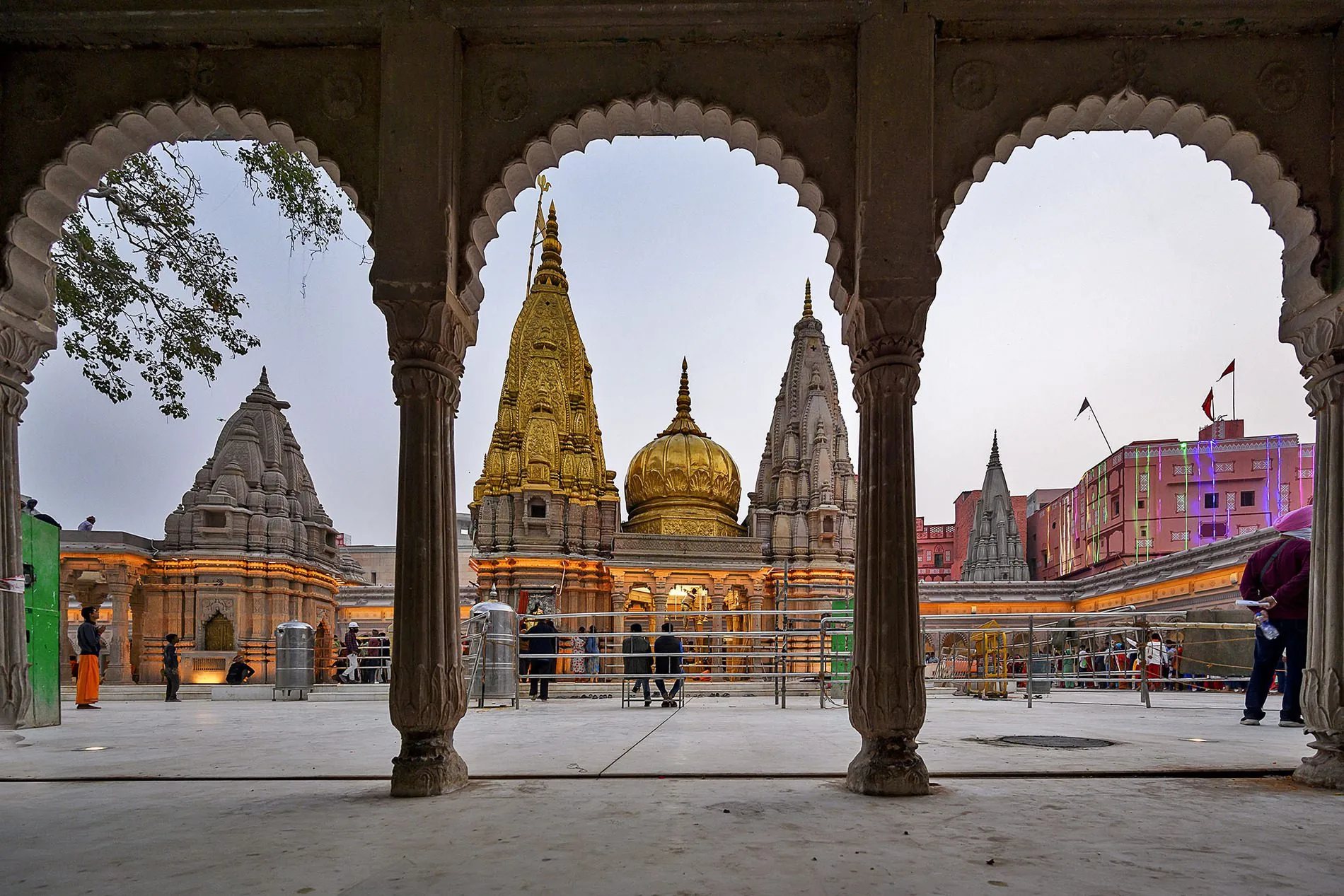
The present temple, with its gilded domes and shikhara, is comparatively modest in footprint but immense in religious significance. Its gold-covered superstructure has given it the popular name Golden Temple of Varanasi, while its narrow approach through Vishwanath Gali connects it intimately with the old city. The temple’s modern surroundings have been transformed by the Kashi Vishwanath Dham corridor, which now creates a grand connection between the shrine and the Ganga. Yet beneath the gold, stone and modern infrastructure lies a sacred tradition far older than the present building.
Kashi Vishwanath is therefore not simply a monument of architecture or a pilgrimage destination. It is a living centre where mythology, scripture, ritual, death, liberation and everyday life meet. A pilgrim may arrive to worship Shiva, bathe in the Ganga, visit the ghats, remember ancestors, witness the evening lamps or simply walk through the ancient lanes. All of these experiences become part of the pilgrimage to Vishwanath.
02 / SACRED ORIGIN / STHALA PURANA
Sacred Origin / Sthala Purana
The most fundamental legend associated with Kashi Vishwanath is the story of the Jyotirlinga, the limitless pillar of divine light. According to the sacred tradition preserved in the Skanda Purana, Brahma and Vishnu once entered into a dispute concerning supremacy. Their disagreement could not be resolved through ordinary means, and Shiva appeared before them as a blazing column of light that pierced both earth and sky.
The two gods attempted to discover the limits of this extraordinary manifestation. Vishnu assumed the form of a boar and travelled downwards in search of its base, while Brahma travelled upwards in search of its summit. Neither could find an end to the pillar. Vishnu returned and acknowledged the immeasurable nature of Shiva. Brahma, however, falsely claimed to have reached the top. His falsehood resulted in a curse, while Vishnu’s humility was honoured.
The tradition associates this primordial manifestation with Kashi, making the city one of the most ancient centres of Shiva worship and giving Vishwanath a unique place among the Jyotirlingas. Here Shiva is not merely a deity who resides in a temple. He is the limitless light beyond measurement, the reality before which even the greatest gods cannot establish superiority through ordinary means.
The sacred identity of Kashi is further expressed through the concept of Avimukta. The city is described as the place that Shiva never abandons. The Avimukteshvara tradition is closely connected with this understanding, and the sacred text declares that beholding the Avimukteshvara Linga in the region of Avimukta frees the devotee from the bondage of karma.
This idea is central to understanding Kashi. The city’s sanctity does not depend solely upon the presence of a single temple. The entire region is treated as a sacred field protected by Shiva. Vishwanath stands at the centre of that field, but the Ganga, the ghats, the wells, the smaller shrines and the ancient lanes all participate in its sacred geography.
03 / SACRED LEGENDS
Sacred Legends
One of the deepest legends associated with Kashi is the story of King Divodasa, preserved in the Kashi Khanda of the Skanda Purana. Unlike stories of demons defeated by Shiva, this is a story about the limitations of even perfect human achievement.
Divodasa was a righteous and disciplined king whose rule was so exemplary that there appeared to be no need for divine intervention. His kingdom was governed through dharma, order and human effort. The gods themselves found it difficult to enter a city in which human excellence appeared complete. Shiva therefore withdrew from Kashi under a cosmic arrangement, allowing Divodasa to govern without divine interference.
For a time, Kashi became a city of extraordinary human accomplishment. Yet something remained incomplete. The gods repeatedly attempted to return, appearing in different forms and approaching the king through various means, but Divodasa’s discipline remained firm. Finally Shiva Himself intervened. Through a series of divine unfoldings, the king came to understand that perfection without surrender is incomplete. Dharma cannot remain confined to human effort; ultimately it must open towards transcendence.
When Divodasa relinquished his hold, Shiva returned to Kashi. The city thereby became whole again—a place where righteousness and liberation could coexist. Kashi became Avimukta, the city never forsaken by Shiva. The legend therefore teaches that human excellence is valuable, but it reaches fulfilment only when it is surrendered to the Divine.
Another of Kashi’s most powerful traditions concerns the moment of death. It is believed that Shiva Himself whispers the Taraka Mantra into the ear of the dying in Kashi, guiding the soul towards liberation. This belief has drawn ascetics, householders and seekers to the city for centuries. Kashi therefore possesses an unusual relationship with death: mortality is not hidden from everyday life but placed directly alongside worship, pilgrimage and the search for moksha.
The sacred city is also traditionally believed to remain protected even during Mahapralaya, the great cosmic dissolution. According to the tradition, Shiva holds Kashi upon His trident while the rest of creation is dissolved. This is the ultimate expression of the name Avimukta: the city is never abandoned, even when the universe itself passes through dissolution.
04 / HISTORICAL JOURNEY
Historical Journey
The historical story of Kashi Vishwanath is one of destruction and renewal. The temple has been repeatedly damaged or destroyed during periods of political upheaval, yet worship of Vishwanath repeatedly re-emerged. The present temple is therefore only the latest physical expression of a sacred tradition that survived through many historical transformations.
By the seventh and eighth centuries CE, the fame of Shiva’s temple in Varanasi was already established. The Chinese pilgrim Xuanzang described a large Shiva temple in the city and referred to the deity as Devadeva, “god of gods.” This account corresponds with the Mahabharata’s association of Shiva with Kashi as Devadeva. Archaeological evidence, including a stone seal dating broadly to the sixth to eighth centuries bearing the name Avimukteshvara, further indicates the antiquity of Shiva worship in the region.
The medieval period brought repeated destruction. In 1034 CE, Varanasi was attacked by the Ghaznavid general Ahmad Niyaltigin. The major upheaval came in 1194 CE, when Qutb al-Din Aibak’s forces destroyed the Adi Vishveshwar temple, then regarded as the principal Vishwanath shrine. The source records that the site later became associated with the construction of an early Gyanvapi mosque.
Yet Shiva worship did not disappear. The sacred centre moved within the city, and new temples arose. A Vishwanath shrine was rebuilt in the late thirteenth century, but later suffered further destruction. The Sharqi rulers of Jaunpur demolished many temples during the fifteenth century, and the destruction associated with Sikandar Lodi in the 1490s brought another severe blow to the sacred landscape of Banaras. Local patrons repeatedly responded by establishing new shrines and restoring worship.
In 1585, a new Vishwanath Linga was consecrated at Avimukteshvara through the patronage of Raghunath Pandit, associated with Todar Mal. This period illustrates the recurring pattern in Kashi’s history: even when one temple was lost, the sacred presence of Vishwanath was not considered lost. The Linga could be re-established, worship could continue and the pilgrimage could be renewed.
The most decisive destruction of the old temple occurred in 1669, when Emperor Aurangzeb ordered its demolition. The Shiva Linga and garbhagriha were destroyed, and the Gyanvapi Mosque was constructed at the site. For more than a century, the great temple remained absent from its former location.
The revival came under Rani Ahilyabai Holkar of Indore, who commissioned a new Kashi Vishwanath Temple in 1777. Built adjacent to the mosque on slightly higher ground, the new temple incorporated surviving elements of the earlier sacred complex. Its consecration on 25 August 1777 marked the rebirth of Vishwanath’s principal shrine.
Other rulers and patrons subsequently contributed to the temple. Maharaja Baiza Bai of Gwalior constructed a pillared colonnade in 1828, while Maharaja Ranjit Singh of Punjab donated approximately one tonne of gold in 1835 to gild the principal dome. The golden superstructure created the temple’s enduring popular identity as the Golden Temple of Varanasi.
In the modern period, administration of the shrine came under a board appointed by the Uttar Pradesh government in 1983. The most significant recent transformation began with the Kashi Vishwanath Corridor Project, launched in 2019 and inaugurated in December 2021. The project created a direct connection between the temple and the Ganga and, during the process, uncovered numerous smaller shrines that had become buried or inaccessible over time. Many were restored as part of the redevelopment.
The history of Kashi Vishwanath is therefore not simply a succession of destructions. It is a story of continuity through renewal. Buildings disappeared, but Vishwanath remained.
05 / TEMPLE ARCHITECTURE
Temple Architecture
The present Kashi Vishwanath Temple is relatively compact compared with the enormous temple complexes of South India, yet its architectural presence is unmistakable. It follows the Nagara tradition, with the garbhagriha beneath a towering shikhara and pillared mandapas surrounding the central sanctuary. The shrine’s relatively modest scale makes the brilliance of its gilded superstructure even more striking.
The central sanctum houses the main Shiva Linga, a black stone form set within a silver altar. Above the sanctum rises the golden dome and shikhara, creating the feature that dominates both the temple complex and the visual identity of the surrounding city. Maharaja Ranjit Singh’s donation of approximately one tonne of gold in 1835 transformed the upper portions of the temple into the gilded form for which it is famous.
The lower portions of the temple employ red sandstone and granite, with arched niches and carved pilasters. Around the principal shrine are smaller shrines dedicated to various deities associated with Shiva and the sacred geography of Kashi, including Avimukteshvara, Ganesha, Vishnu and Kartikeya. The temple therefore functions as a compact sacred constellation rather than an isolated shrine.
The Kashi Khanda records that an earlier form of the Vishwanath temple was known as Moksha Lakshmi Vilas and contained five mandapas surrounding the central sanctum. The Jnana Mandapa stood to the east, the Ranga Mandapa to the west, the Aishvarya Mandapa to the north and the Mukti Mandapa to the south. This arrangement reveals that the temple’s older architectural conception was already organised around the themes of knowledge, prosperity, ritual expression and liberation.
The present building therefore represents only one chapter in a much longer architectural history. The sacred centre has repeatedly changed form, but the central principle has remained the same: Vishwanath at the heart, surrounded by a sacred landscape that points towards liberation.
A particularly intriguing element is the Gyanvapi well, situated beside the temple. Temple tradition holds that during the destruction of 1669, priests concealed the original Jyotirlinga in the well to protect it from desecration. The well is now empty but remains an important part of the sacred geography of the complex. Whether approached as historical memory or sacred tradition, the story reflects the determination of the temple’s custodians to preserve the divine presence even during periods of extreme danger.
06 / SPIRITUAL SIGNIFICANCE
Spiritual Significance
The spiritual significance of Kashi Vishwanath cannot be separated from the spiritual identity of Kashi itself. The city is traditionally regarded as the ultimate city of liberation, and Vishwanath stands at its centre as the Lord who grants the possibility of moksha.
The Kashi Khanda of the Skanda Purana describes Kashi as an eternal city protected by Shiva, remaining untouched even during cosmic dissolution. It presents the city as a place where Shiva grants the Taraka Mantra to those who die there, freeing them from the cycle of birth and death. The Ganga, the ghats, shraddha rituals and the many temples of the city all form part of this larger sacred system.
The idea of the Taraka Mantra gives Kashi a spiritual character unlike almost any other pilgrimage centre. The city is not simply a place where devotees pray for a long life. It is also a place where death itself becomes part of the path to liberation. The belief that Shiva whispers the liberating mantra into the ear of the dying transforms the moment of death from an end into a final encounter with the Divine.
The sacred geography of Kashi is traditionally expressed through a Panchayatana, a constellation of five principal divine presences. Vishwanath represents Shiva as the axis of existence; Annapurna represents nourishment, both material and spiritual; Kalabhairava serves as the fierce guardian of Kashi; Bindumadhava represents Vishnu as the sustaining principle; and Dundhivinayaka represents Ganesha as the remover of obstacles.
This constellation reveals that Kashi’s spiritual vision is not confined to one form of divinity. Shiva stands at the centre, but nourishment, preservation, protection and the removal of obstacles are all necessary dimensions of sacred life. A pilgrimage to Vishwanath is therefore ideally understood as part of a larger pilgrimage through Kashi.
The spiritual tradition further holds that darshan of Vishwanath can cleanse sins and lead towards liberation. Such beliefs explain why devotees continue to endure long journeys and crowded lanes simply for a moment in the presence of the Linga. The value of the darshan lies not in the duration of the encounter but in the intensity of the sacred presence.
Kashi thus becomes a city in which life and death, devotion and renunciation, householders and ascetics, celebration and cremation exist side by side. The burning fires of Manikarnika and the golden domes of Vishwanath are not contradictory. Both belong to the same spiritual landscape—one reminding humanity of impermanence, the other of the eternal.
07 / WORSHIP, RITUALS & FESTIVALS
Worship, Rituals & Festivals
The daily life of Kashi Vishwanath is shaped by continuous worship. Unlike a monument visited only during certain hours, the temple remains a living centre of ritual through the day. Four major aartis mark the principal rhythm of worship: Mangala Aarti before dawn, Bhog Aarti around midday, Saptrishi Aarti in the evening and Shringar Aartiat night.
The pre-dawn Mangala Aarti carries a special atmosphere. Before the city has fully awakened, lamps, bells, conches and Vedic chanting gather around the Jyotirlinga. The ritual symbolically awakens the sacred centre of Kashi for another day. The evening Saptrishi Aarti, meanwhile, is performed with seven large lamps honouring the seven great sages, creating one of the temple’s most distinctive daily rituals.
Throughout the day, the Shiva Linga receives traditional offerings including water, milk, bael leaves, flowers and sacred ash. The continuous cycle of anointing and decoration expresses the intimate relationship between devotee and deity. Vishwanath is not worshipped as a distant philosophical principle alone; He is bathed, adorned, offered food and praised through mantra.
Maha Shivaratri is the greatest festival associated with the temple. Devotees fast, remain awake through the night and participate in special worship celebrating Shiva’s cosmic presence. The temple becomes a centre of intense devotional activity, with the entire city of Kashi participating in the sacred atmosphere.
The month of Shravana is another important period. Mondays are especially sacred to Shiva, and the Vishwanath Linga receives elaborate offerings of flowers and sandalwood. Large crowds gather for darshan, transforming the already busy lanes around the temple into an especially vibrant pilgrimage route.
Yet the festival most closely associated with the visual identity of Varanasi is Dev Deepavali, celebrated on Kartika Purnima. On this night, thousands of earthen lamps illuminate the ghats along the Ganga. The riverfront becomes a vast field of light, with the sacred city appearing almost as though the heavens themselves have descended to the river. Vishwanath and the surrounding ghats participate in this extraordinary celebration of light, devotion and the sacred identity of Kashi.
The rituals of Vishwanath therefore extend naturally into the city. A pilgrim does not experience the temple only inside its walls. The Ganga Aarti, the ghats, the processions, the narrow lanes and the countless smaller shrines all contribute to the rhythm of worship.
08 / WHAT MAKES KASHI VISHWANATH UNIQUE
What Makes Kashi Vishwanath Unique
Kashi Vishwanath’s greatest uniqueness lies in the fact that the temple and the city cannot be separated. At many Jyotirlingas, the temple is the principal destination. At Kashi Vishwanath, the temple is the centre of an enormous sacred geography that includes the Ganga, the ghats, cremation grounds, wells, smaller shrines and ancient pilgrimage routes.
Its identity as the Lord of the Universe gives the shrine an extraordinary theological scope. Vishwanath is not simply Shiva of Kashi; He is Shiva as the universal Lord, while Kashi itself becomes His sacred city.
The belief in the Taraka Mantra further distinguishes Kashi from most pilgrimage centres. Here liberation is connected not merely with ritual performed during life but with the final moment of existence. Shiva is believed to guide the departing soul at death, making Kashi a destination for those seeking not only blessing during life but liberation beyond it.
The city’s Panchayatana structure also makes the pilgrimage unique. Vishwanath exists within a constellation that includes Annapurna, Kalabhairava, Bindumadhava and Dundhivinayaka. The sacred experience therefore moves beyond a single deity towards a complete spiritual geography.
The temple’s history of destruction and reconstruction is another defining feature. Few major temples embody so visibly the idea that a sacred presence can survive even when its physical structure is repeatedly lost. From the medieval destructions to Ahilyabai Holkar’s reconstruction and the modern Dham corridor, Vishwanath has repeatedly taken new architectural form without losing its identity.
Finally, the temple’s relationship with the Ganga is incomparable. The journey from the shrine to the river is not merely a walk between two attractions. It connects Shiva, the sacred city and the river of purification within one continuous sacred landscape.
09 / PILGRIMAGE GUIDE
Pilgrimage Guide
A pilgrimage to Kashi Vishwanath is best understood as a journey through Kashi, rather than as a visit to the temple alone. The shrine lies within the old city, close to the Ganga and surrounded by narrow lanes filled with shops selling puja articles, flowers, religious objects and traditional textiles. The traditional approach is through Vishwanath Gali, where vehicles cannot enter and the final portion of the journey must be undertaken on foot.
Common access points include Godowlia Chowk and Dashashwamedh Ghat, from which the temple can be reached by walking through the old city’s lanes. Varanasi is well connected by air, rail and road. Lal Bahadur Shastri Airport lies approximately 25 kilometres from the city, while Varanasi Junction is roughly 3–4 kilometres from the temple area. Taxis and rickshaws connect the major arrival points with the old city.
For the pilgrim, the most meaningful approach is often to begin with the Ganga. A dawn visit to the river, followed by bathing where appropriate and then proceeding towards Vishwanath, reflects the traditional relationship between the river and the Lord of Kashi. The sacred journey can continue through the ghats, smaller shrines and the lanes surrounding Vishwanath.
Visitors should expect large crowds, particularly during Maha Shivaratri, Shravan and other major festivals. The source recommends planning ahead, especially for special aartis. Footwear is removed before entering the temple precinct and must be deposited at designated counters. Modest dress is expected.
Accommodation in Varanasi ranges from traditional dharamshalas and temple-associated lodgings to guesthouses and modern hotels. Pilgrims wishing to remain close to the old city can stay near Vishwanath Gali and the ghats, while those seeking greater modern convenience may choose areas such as Assi or the Cantonment. During major festivals, accommodation should be arranged well in advance.
A complete pilgrimage should ideally include more than darshan of Vishwanath. Annapurna, Kalabhairava and other important shrines of Kashi form part of the city’s sacred constellation. A visit to the Ganga ghats, participation in the evening Ganga Aarti and a quiet walk through the old city help reveal why Kashi itself is regarded as a tirtha.
10 / MODERN RESTORATION & LIVING HERITAGE
Modern Restoration & Living Heritage
The modern transformation of Kashi Vishwanath is closely associated with the Kashi Vishwanath Dham Corridor, developed during the late 2010s and inaugurated in 2021. The project created a broad connection between the temple and the Ganga, transforming the approach from the traditional maze of narrow lanes into a much larger pilgrimage complex.
One of the most significant consequences of the redevelopment was the discovery of numerous smaller shrines that had become buried or inaccessible beneath later construction. Many of these were restored and incorporated into the renewed sacred environment. The project therefore did not simply create new infrastructure; it also brought portions of the older sacred geography back into public view.
The temple’s administration and rituals have also undergone modernisation. The Kashi Vishwanath Trust oversees the annual ritual calendar, while temple activities and announcements have increasingly been digitised. Even traditional offerings such as flowers have entered modern ecological initiatives, with discarded temple flowers being collected and transformed into incense.
This renewal illustrates an important characteristic of Kashi: the city is ancient, but it is not frozen in the past. New buildings, new pilgrimage routes and new systems of administration continue to develop around an ancient sacred centre. The challenge is to allow modern infrastructure to serve the living tradition without overwhelming it.
The present Vishwanath therefore exists simultaneously in several times. The Jyotirlinga belongs to the timeless mythology of Shiva; the stone temple remembers the eighteenth and nineteenth centuries; the surrounding lanes preserve older patterns of pilgrimage; and the Dham corridor represents the twenty-first century. All of these layers now coexist around the same sacred centre.
11 / SOURCES & REFERENCES
Sources & References
The principal scriptural foundation for the sacred identity of Kashi Vishwanath comes from the Skanda Purana, especially the Kashi Khanda, which glorifies Kashi as the eternal city of Shiva and the supreme field of liberation. It describes the sacred geography of the city, the importance of the Ganga and ghats, the power of pilgrimage and the belief that Shiva grants the Taraka Mantra to those who die in Kashi.
The Jyotirlinga tradition provides the theological foundation for Vishwanath as Shiva’s limitless manifestation of light. The story of Brahma and Vishnu searching unsuccessfully for the beginning and end of the divine pillar expresses the central idea that Shiva is beyond measurement and beyond the limitations of ordinary perception.
The historical record is supplemented by the accounts of Xuanzang, archaeological discoveries associated with Avimukteshvara, records of medieval destruction and reconstruction, and the patronage of rulers and devotees including Rani Ahilyabai Holkar, Maharaja Baiza Bai and Maharaja Ranjit Singh. Together, these sources reveal a temple tradition repeatedly renewed through periods of political and religious upheaval.
The modern history of the temple includes government administration from 1983, the Kashi Vishwanath Dham redevelopment and the restoration of numerous smaller shrines discovered during the corridor project. These developments demonstrate that the sacred landscape of Kashi continues to evolve while retaining its ancient identity.
The source also records the continuing legal and social contestation surrounding the Gyanvapi complex, including the archaeological survey and ongoing court proceedings. Since this remains a sensitive and evolving matter, it is best treated separately from the devotional history of Vishwanath and described according to the status of the relevant legal proceedings at the time of publication.
12 / THE ETERNAL VISHWANATH
The Eternal Vishwanath
Kashi Vishwanath is ultimately not a story about one temple building. The building has changed. Its walls have fallen and risen again. Its sacred centre has moved across the city. Its domes have been rebuilt, gilded and renewed. Even the streets leading to it have changed.
Vishwanath has remained.
That is the deepest meaning of the name Avimukta. Shiva does not abandon Kashi. The sacred tradition expresses this idea through the image of the Lord protecting the city even during cosmic dissolution, through the belief that He grants the Taraka Mantra at the moment of death, and through the continuous return of devotees who cross the Ganga, walk the ancient lanes and enter the sanctum seeking His darshan.
The story of Divodasa reminds the pilgrim that even righteousness must eventually surrender to the Divine. The Jyotirlinga legend reminds the seeker that the highest reality cannot be measured. The history of the temple reminds us that physical destruction does not necessarily destroy sacred memory. The Ganga reminds us that everything flows and changes, while Vishwanath represents that which remains.
Perhaps this is why Kashi feels unlike any other sacred city.
Here, one can hear the bells of Vishwanath while funeral fires burn at Manikarnika. One can see a child beginning life beside a river where another pilgrim has come to prepare for death. Lamps rise before Shiva in the temple while thousands of lamps illuminate the Ganga during Dev Deepavali. The city refuses to separate life from death, celebration from sorrow, or worldly existence from liberation.
Kashi teaches that they are all part of one journey.
And at the centre of that journey stands Vishwanath—the Lord of the Universe, the radiant Jyotirlinga, the Lord whom the city believes never leaves.
In Kashi, the pilgrim does not merely go to Shiva.
The pilgrim enters the city that Shiva Himself is believed never to abandon.
13 / PHOTOGRAPHS
From the whole to the detail.
Select a photograph to explore it at a larger scale.
14 / LOCATION & MAP
Place the story on the map.
PLACE THIS STORY ON THE MAP
Varanasi, Uttar Pradesh
Uttar Pradesh, India
ABOUT THIS FIELD ENTRY
Rooted in the Bharat Ke Wow archive.
This page is part of the Bharat Ke Wow series on the Dvādaśa Jyotirlingas. Sacred narratives are presented as temple tradition.
Read the original entry ↗