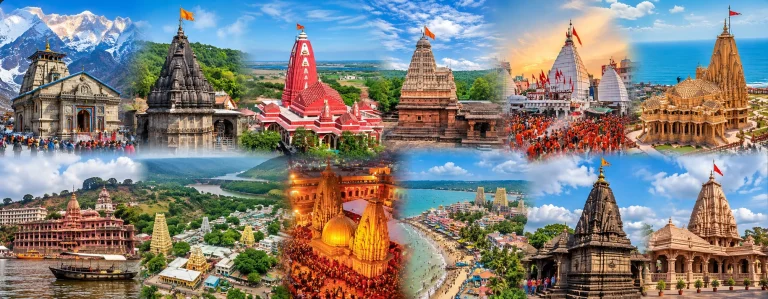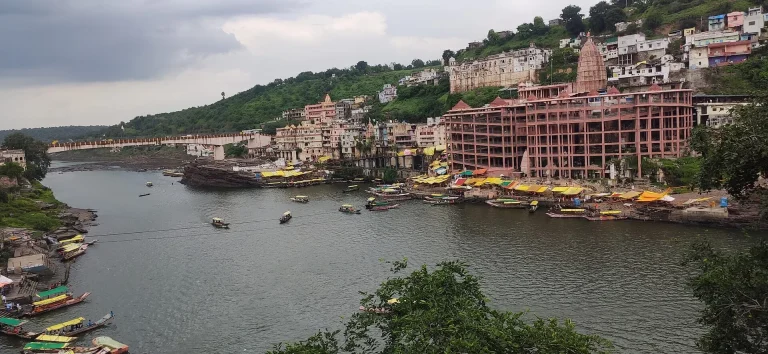



01 / INTRODUCTION
Srishaila Mallikarjuna, Andhra Pradesh
The Second Jyotirlinga
मल्लिकार्जुनसंज्ञश्चावतारश्शंकरस्य वै ।
द्वितीयः श्रीगिरौ तात भक्ताभीष्टफलप्रदः ॥
Mallikarjuna is revered as the second manifestation of Shiva on the holy Srishaila mountain, granting the cherished wishes of His devotees.
Nestled amidst the lush green Nallamala hills of Andhra Pradesh, the Sri Bhramaramba Mallikarjuna Temple at Srisailam is one of the most revered shrines of Bhagavan Shiva and is celebrated as the second of the twelve Jyotirlingas. Known variously as Srishaila, Srisailam and Mallikarjuna Kshetra, the temple stands upon a high plateau overlooking the Krishna River, locally revered as Pātāla Ganga. Dense forests, deep valleys and rugged hills surround the sacred settlement, giving the pilgrimage an atmosphere quite unlike that of a temple situated in an urban landscape.
The journey to Srisailam itself forms part of the experience. The winding roads through the Nallamala hills gradually carry the pilgrim away from the ordinary world and towards the sacred mountain. At the summit, the great gopurams of the temple rise against the sky, marking the presence of Mallikarjuna Swamy and Goddess Bhramarambika. Srisailam has traditionally been revered as a kind of Kailasa on Earth, a sacred mountain where the presence of Shiva is believed to be especially powerful.
The importance of Srisailam extends beyond its identity as a Jyotirlinga. It is one of the rare sacred centres where the traditions of Shaivism and Shaktism converge within the same temple complex. Bhagavan Shiva is worshipped here as Mallikarjuna, while Goddess Parvati is revered as Bhramarambika, a form of the Divine Mother associated with one of the great Shakti Peetha traditions. The two shrines stand together as an expression of the inseparability of Shiva and Shakti.
The sacred atmosphere of Srisailam is further enriched by the natural landscape. The Krishna River flows below the hill, and pilgrims traditionally descend to Pātāla Ganga for a ritual bath before proceeding to the temple. The chanting of Vedic hymns, the fragrance of jasmine flowers and the ringing of temple bells accompany the devotee through the sacred precinct. After the long ascent through the hills, the arrival at Srisailam is experienced not merely as reaching a destination, but as entering a Mahakshetra—a great field of pilgrimage sanctified by centuries of worship.
02 / STHALA PURANA
Sthala Purana
The sacred origin of Mallikarjuna is rooted in the story of the divine family of Shiva and Parvati and their two sons, Kartikeya and Ganesha. According to the Puranic tradition preserved in the Shiva Purana, a question arose as to which of the two brothers should be married first. A contest was proposed: whoever could circumambulate the world and return first would win.
Kartikeya immediately mounted his peacock and set out upon his journey around the world. Ganesha, whose vehicle was the small mouse, approached the challenge differently. Instead of travelling across the earth, he circumambulated his parents, Shiva and Parvati, declaring that they themselves constituted the entire universe. Pleased by the wisdom and devotion of their son, Shiva and Parvati accepted Ganesha’s interpretation and declared him the winner. Ganesha was subsequently married to Siddhi and Riddhi, while Kartikeya was still away.
When Kartikeya returned and discovered that his younger brother had already been married, he was deeply disappointed. Feeling hurt, he left Kailasa and travelled southward upon his peacock. He eventually came to a remote mountain and adopted the life of a brahmachari, choosing solitude and austerity. Different traditions associate his movements with different places, but the Srisailam tradition holds that he eventually came to reside upon the sacred Sri Shaila mountain.
Shiva and Parvati were distressed by their son’s departure and wished to console him. Yet they did not wish to disturb his chosen solitude. Instead, they came to Srisailam and remained near him. Their presence transformed the mountain into a permanent sacred abode. Shiva came to be worshipped here as Mallikarjuna, while Parvati manifested as Bhramarambika. In this way, the divine parents remained near their son, and Srisailam became forever associated with the compassion and love of Shiva and Parvati.
The name Mallikarjuna is itself connected with the sacred traditions of the hill. The Lord is said to have been worshipped with garlands of mallika, or jasmine flowers, by a local princess or devotee, giving rise to the name Mallika-Arjuna. The hill became known as Sri Shaila, the sacred or radiant mountain, and the shrine came to be revered as the abode of Mallikarjuna.
The story gives Srisailam an unusually intimate character. Shiva does not come here merely as a distant cosmic deity; He comes as a father who follows His son out of compassion and chooses to remain near him. For devotees, this has become a powerful expression of the tenderness of the Divine. To visit Mallikarjuna is, in the devotional imagination, to approach Shiva and Parvati in their own sacred home.
03 / HISTORICAL JOURNEY
Historical Journey
The history of Srisailam stretches across many centuries and reflects the devotion of successive dynasties and religious communities. Inscriptions and literary traditions suggest that the sanctity of the hill was recognised at least by the early centuries of the Common Era. An early reference is associated with a second-century inscription of King Pulumavi of the Satavahana dynasty, indicating that Srisailam was already a recognised sacred centre in ancient times. The Satavahanas and later dynasties are believed to have supported the pilgrimage tradition, while the Ikshvakus and Pallavas also contributed to the religious importance of the region.
By the seventh century, Srisailam had become established within the wider landscape of Shaiva devotion. The Tamil Nayanmar saints, including Sambandar, referred to Srisailam in their devotional tradition, demonstrating that the sacredness of the mountain extended well beyond the Telugu-speaking regions surrounding it. Its recognition in Tamil Shaiva literature reflects the wide geographical reach of the temple’s reputation during the early medieval period.
During the medieval period, the temple received further patronage from rulers of the Deccan. The Vishnukundinas and Kakatiyas contributed to the development of the sacred centre, while the Reddy rulers of the fourteenth century undertook important works at Srisailam. Chiefs such as Prolaya Vema Reddy and Anavema Reddy are associated with the construction and improvement of the Veerasiro Mandapam and the long stone steps descending towards Pātāla Ganga. These steps continue to form an important part of the pilgrimage experience, enabling devotees to reach the sacred waters of the Krishna River.
The most extensive architectural development of the temple took place under the Vijayanagara Empire. Harihara Raya I and later rulers, including Krishnadevaraya, recognised the importance of Srisailam and supported major works at the temple. The great enclosing walls, towering gopurams and several of the mandapas associated with the present complex bear the strong imprint of Vijayanagara architectural traditions. The robust granite pillars, sculptures of warriors, dancers and deities, and the axial arrangement of the temple reflect the architectural confidence of that period.
Unlike several major temples elsewhere in the Deccan, Srisailam was not completely destroyed during the periods of political upheaval that affected the region. Its remote location amid the Nallamala forests may have helped preserve the shrine. There were nevertheless periods when the surrounding region came under different political authorities, including the Mughal administration and local Nawabs. Despite these changes, worship at Srisailam continued. By the colonial period, British administrators recorded it as an active pilgrimage centre, and after India’s independence in 1947, the temple came under state administration.
The history of Srisailam can therefore be read not simply through the monuments that survive, but through the continuity of worship that has endured across changing dynasties and political circumstances. The stones of the temple preserve the contributions of many periods, while the living rituals continue to connect the present with that long sacred past.
04 / TEMPLE ARCHITECTURE
Temple Architecture
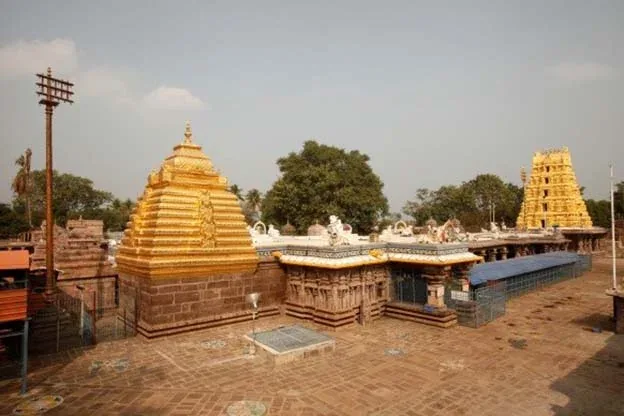
The temple complex at Srisailam is predominantly Dravidian in character, yet its present form reflects the contributions of several historical periods. The entire complex is enclosed within massive fort-like walls measuring approximately 183 by 152 metres, creating a powerful sense of a sacred citadel. Four principal gopurams mark the cardinal directions, with the eastern Rajagopuram serving as the principal entrance. Its towering form, richly decorated with sculptural representations of deities, mythical creatures and floral designs, dominates the approach to the temple.
Upon entering through the eastern gateway, the pilgrim encounters the Nandi Mandapam, where a monumental stone Vrsha, the sacred bull of Shiva, faces the sanctum. Nandi’s unwavering gaze towards Mallikarjuna symbolises absolute devotion, and devotees traditionally whisper their prayers into his ear, entrusting them to the Lord.
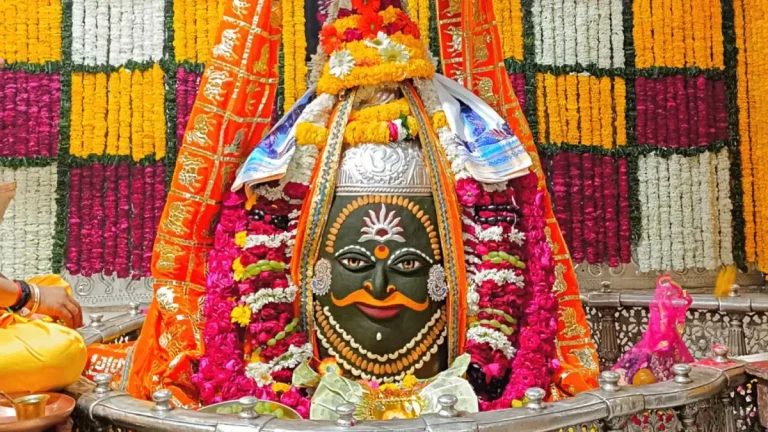
At the heart of the complex lies the Garbhagriha of Mallikarjuna. Above the sanctum rises a gold-plated vimana whose stepped pyramidal form is one of the defining features of the temple. The sanctum itself is relatively small and dark, creating an atmosphere of intimacy and mystery. Within it is the smooth black stone Jyotirlinga of Mallikarjuna. One of the distinctive traditions associated with Srisailam is that devotees may, under the prescribed arrangements, touch the Linga and perform abhisheka, a privilege that is uncommon among major Jyotirlinga shrines. The Linga is traditionally adorned with flowers, bilva leaves and sandalwood, with a silver serpent hood suspended above it.
The Mukha Mandapa before the sanctum is associated with the Vijayanagara period and contains some of the finest sculptural elements of the complex. Its granite pillars depict divine musicians, dancers, scenes from the legends of Shiva and intricate floral motifs. Among the most striking is a representation of Ardhanarishvara, the composite form of Shiva and Parvati, an especially appropriate image in a temple where the unity of Shiva and Shakti is central to its sacred identity. The ceilings are decorated with lotus medallions and mythological scenes, and the hall continues to serve as a gathering place for devotees during worship and festivals.
The temple complex contains numerous other sacred spaces. Adjacent to Mallikarjuna is the shrine of Goddess Bhramarambika, whose presence completes the Shaiva-Shakta character of Srisailam. The complex also contains the remarkable Sahasra Linga, a Linga bearing a thousand miniature lingas, traditionally associated with Bhagavan Rama. Nearby are five ancient lingas believed by tradition to have been installed by the Pandava brothers. The Addala Mandapam, or mirror hall, contains an image of Nataraja reflected repeatedly through its arrangement of mirrors, creating a striking visual representation of Shiva’s infinite nature.
The architectural experience of Srisailam is inseparable from its natural setting. The temple courtyards contain ancient trees that provide shade for pilgrims, while from parts of the complex the Krishna River can be glimpsed far below. The Deepa Stambha in the eastern courtyard is illuminated during festivals, adding another layer of sacred light to the temple after sunset. As evening descends, the surrounding hills, the temple bells, the conch and the fluttering flag create an atmosphere in which architecture and landscape appear to merge into a single sacred experience.
05 / SACRED LEGENDS
Sacred Legends
The principal Sthala Purana of Srisailam is the story of Shiva and Parvati following Kartikeya to the sacred mountain. Around this central tradition has grown a rich body of local legends that give Mallikarjuna a more intimate and multifaceted character.
One such story concerns Princess Chandravati, who is said to have renounced her kingdom and taken refuge on Srisailam. According to the tradition, she observed a cow repeatedly pouring its milk over a particular stone. Discovering a self-manifested Shiva Linga at the spot, she began worshipping it with jasmine flowers. The Lord is said to have appeared before her, and her devotion became associated with the sacred traditions surrounding Mallikarjuna and the mallika flower.
Another deeply rooted tradition connects Mallikarjuna with the indigenous Chenchu community of the Nallamala forests. According to local lore, Shiva once appeared in the form of a hunter and married a maiden of the Chenchu tribe. The community therefore regards Mallikarjuna as one of their own and affectionately calls Him Chenchu Mallayya. The legend expresses a profound idea: that the Lord of the sacred mountain belongs not to one community alone but accepts devotees across social and cultural boundaries.
The goddess Bhramarambika is herself surrounded by a distinctive legend. The name Bhramara means bee, and according to one tradition, Adi Shakti assumed the form of a swarm of bees in order to destroy the demon Arunasura. Having accomplished her task, the Goddess remained upon Srisailam and came to be worshipped as Bhramarambika. Local traditions even associate the occasional presence of bees around the shrine with this ancient story.
Another legend concerns Vrudha Mallikarjuna, the “Old Mallikarjuna.” A devoted princess is said to have followed a mysterious bee to Srisailam, where Shiva appeared before her in the form of an aged ascetic. After testing her devotion, the Lord disappeared, and in her anger she is said to have cursed Him to remain there forever in the form of an aged Linga. The shrine of Vrudha Mallikarjuna preserves this tradition as another expression of the playful and mysterious relationship between the devotee and the Divine.
Together, these legends portray Mallikarjuna in many forms—as a compassionate father, a loving husband, a divine protector, a friend of the forest people and a mysterious granter of grace. The sacred mountain thus becomes not merely the setting of one Puranic story, but a living landscape in which generations of devotees have continued to discover new expressions of the Divine.
06 / SAINTS, LITERATURE & SCRIPTURE
Saints, Literature & Scripture
The sanctity of Srisailam is reflected in a wide range of religious and literary traditions. Its recognition in Tamil Shaiva literature is particularly significant. The Nayanmar saints, including Sambandar, celebrated Srisailam in their devotional tradition, demonstrating the importance of the sacred mountain beyond the geographical boundaries of Andhra Pradesh. The connection with the Tamil Shaiva tradition is an important indication of the pan-Indian character of the shrine.
Srisailam is also closely associated with Adi Shankaracharya, who is traditionally believed to have visited the sacred mountain and composed the devotional work Shivanandalahari here. Tradition further associates him with the establishment or formalisation of certain worship practices for Bhramarambika and with the Sri Chakra in the Goddess’s shrine. A commemorative image of Adi Shankara stands at Srisailam in memory of his association with the kshetra.
The sacred mountain also attracted the great Virashaiva saints Allama Prabhu and Akkamahadevi. Akkamahadevi’s association with the caves around Srisailam has become an important part of the pilgrimage landscape, while the devotional poetry of these saints preserves the intense spiritual atmosphere of Sri Parvata. Their presence adds another layer to the history of Srisailam as a centre not merely of temple worship but of intense personal spiritual experience.
The literary traditions of the kshetra also preserve verses celebrating its sacred geography and the numerous shrines associated with the mountain. These traditions reinforce the conception of Srisailam as an entire sacred landscape rather than merely a single temple building. The principal shrine, the Goddess, the summit shrine, sacred waters and other tirthas together form a pilgrimage geography that has been remembered and transmitted through generations.
07 / SPIRITUAL SIGNIFICANCE
Spiritual Significance
Srisailam is revered as a powerful centre of spiritual transformation, and the traditions surrounding Mallikarjuna repeatedly emphasise the ability of sincere devotion to remove karmic burdens and lead the devotee towards liberation. The Skanda Purana tradition associated with the temple speaks of the great merit obtained through darshan and worship of Mallikarjuna, and devotees have long regarded the Jyotirlinga as a source of spiritual grace and moksha.
The story of Kartikeya gives the temple another dimension of spiritual meaning. At Srisailam, Shiva is not portrayed merely as the distant Lord of the cosmos, but as a compassionate father who follows His son out of love. This has contributed to the belief that Mallikarjuna is especially responsive to the prayers of devotees. People come to the shrine with personal hopes and difficulties, seeking the grace of Shiva as they would approach a compassionate father. The many votive offerings placed within the temple are expressions of this intimate relationship between devotee and deity.
Srisailam is also associated with traditions of healing and remedial worship. Devotees undertake Rudrabhishekam and other forms of worship with the belief that Shiva’s grace can relieve suffering and restore balance. Some traditions associate the kshetra with remedies for planetary influences, particularly those connected with Kuja and Ketu. Sacred ash received from the shrine is likewise regarded by devotees as a source of blessing and protection. The tranquil environment of the Nallamala hills, the forest air and the sound of continuous chanting further contribute to the sense of peace experienced by many pilgrims.
The spiritual journey does not end with darshan at the main temple. At the highest point of the Srisailam hill stands the shrine of Shikhareshwara at Shikharam. A longstanding tradition holds that one who beholds the summit of Srisailam will not be reborn. This belief, associated with the Skanda Purana tradition, has made the journey to Shikharam an important part of the pilgrimage for many devotees. From the summit, the temple complex and the surrounding landscape can be viewed from above, giving the pilgrim a final perspective on the sacred mountain.
Perhaps the most profound spiritual characteristic of Srisailam is its unity of Shaivism and Shaktism. Mallikarjuna and Bhramarambika are worshipped together as the Divine Father and Mother. Devotees believe that Shiva represents spiritual illumination and liberation, while the Goddess represents protection, nourishment and worldly well-being. Their presence together expresses the fundamental understanding that Shiva and Shakti are not separate realities but complementary aspects of the same Divine Principle.
08 / WORSHIP, RITUALS & FESTIVALS
Worship, Rituals & Festivals
The daily life of Srisailam Temple follows a carefully ordered rhythm beginning before dawn and continuing until the final worship of the night. In the quiet hours of the Brahma-muhurta, the temple doors are opened and the first prayers are offered to Mallikarjuna and Bhramarambika. Suprabhatham awakens the deities to the sound of conch shells and sacred chants, followed by Mangala Aarti as the first lamps of the day are offered.
With the opening of general darshan in the morning, devotees enter the temple in a continuous flow. The morning hours are filled with various forms of worship, including Rudrabhishekam, in which the Jyotirlinga is bathed with sacred substances while Sri Rudram is recited, and Panchamrita Abhishekam, in which milk, curd, honey, sugar and ghee are offered. Archana and Kumkum Archana allow devotees to offer personal prayers in their own names and according to their nakshatras. On designated occasions, elaborate forms of worship such as Laksha Bilvarchana are undertaken, involving the offering of large numbers of bilva leaves to Mallikarjuna.
One of the most intimate rituals of the temple is the daily Nitya Kalyanam, the ceremonial marriage of Mallikarjuna and Bhramarambika. The Utsava Murtis of the Divine Couple are brought together and the wedding is performed according to Vedic tradition. Devotees, particularly married couples, attend the ceremony seeking harmony, happiness and the blessings of the Divine Couple for their own family lives.
The temple observes a period of midday worship and alankara before reopening for the afternoon darshan. As evening approaches, Pradosha worship and Sandhya Aarti are performed, culminating in the grand Rajopachara Aarti offered to both Mallikarjuna and Bhramarambika. Lamps, flowers, music and the rhythmic sound of drums and cymbals transform the temple at sunset into a vibrant centre of worship. The day eventually concludes with the final rituals and Ekanta Seva, when the Divine Couple is ceremonially prepared for rest and the temple doors are closed.
The festivals of Srisailam bring this daily rhythm to a much greater scale. Navaratri is particularly important for Bhramarambika, with the Goddess adorned each day in a different form. Her manifestations during the festival include Bala Tripura Sundari, Annapurna, Durga and Mahishasuramardini, culminating in Siddhidatri. The temple becomes filled with devotional music, dance and recitations from the Devi Mahatmyam. Durga Ashtami is marked by special worship, including Chandi Homa and the lighting of thousands of lamps.
Mahashivaratri and the associated Brahmotsavam form another major period of celebration. The festival includes night-long worship of the Jyotirlinga, special Devi pujas and processions, and the ceremonial Kalyanotsavam of Mallikarjuna and Bhramarambika. The divine wedding is a particularly beloved tradition, and devotees believe that participation in the Kalyanotsavam or Nitya Kalyanam brings harmony and happiness to married life.
The unity of Shiva and Shakti is expressed not only through festivals but also through everyday temple practice. The sacred ash from Mallikarjuna’s worship is taken to Bhramarambika and offered to the Goddess, while prasada from Devi’s worship, including turmeric and kumkum, is brought back to Shiva’s shrine. Through these simple but profound exchanges, the temple ritual itself declares the inseparability of Shiva and Shakti.
09 / WHAT MAKES SRISAILAM UNIQUE
What Makes Srisailam Unique
Srisailam occupies a distinctive place among the great pilgrimage centres of India because several sacred traditions converge here. It is the second of the twelve Jyotirlingas, but it is also a major Shakti Peetha tradition, a sacred mountain, a Krishna River tirtha and a centre associated with some of India’s great saints and devotional traditions.
The presence of Mallikarjuna and Bhramarambika within the same sacred complex gives Srisailam a character unlike that of an ordinary Jyotirlinga shrine. Here, the devotee encounters Shiva and Shakti together—the Divine Father and Mother. This union is reflected in the temple’s legends, architecture, daily worship and festivals.
The natural setting is equally distinctive. Few major Jyotirlinga temples are approached through such an extensive forested landscape, with the Nallamala hills surrounding the pilgrimage route and the Krishna River flowing deep below the sacred mountain. The descent to Pātāla Ganga, the ascent to Shikharam and the surrounding caves, forests and valleys make the entire region part of the pilgrimage.
Srisailam is therefore not simply a temple to be visited and left behind. It is a sacred mountain whose legends, shrines, waters, forests and traditions together form one vast kshetra. The experience of the pilgrimage lies as much in moving through this sacred landscape as in standing before the Jyotirlinga itself.
10 / PILGRIMAGE GUIDE
Pilgrimage Guide
Srisailam lies in the Nallamala hills of Andhra Pradesh and, despite its remote hilltop setting, is connected by several modes of transport. The journey itself is part of the experience, particularly for those travelling by road through the forested landscape.
For pilgrims arriving by air, Rajiv Gandhi International Airport in Hyderabad is the principal major airport, approximately 220 kilometres from Srisailam. From Hyderabad, the journey can be continued by road by taxi or bus. Kurnool Airport provides another, smaller option, although its flight connections are more limited.
Srisailam does not have a railway station immediately beside the temple because of its mountainous terrain. Markapur Road is one of the principal railheads used by pilgrims and lies approximately 85 kilometres away. From there, buses and taxis continue through the Nallamala hills towards Srisailam. Nandyal and Kurnool are other railway options for travellers approaching the region from different directions.
The road journey remains one of the most popular ways of reaching Srisailam, particularly for pilgrims travelling from Andhra Pradesh and Telangana. Once in Srisailam, the temple and many of the principal pilgrimage sites can be reached by local buses, taxis and auto-rickshaws. The hill environment also makes walking a rewarding way to experience parts of the sacred town.
A pilgrimage to Srisailam traditionally extends beyond the main temple. One of the most important places is Pātāla Ganga, the sacred stretch of the Krishna River flowing below the hill. Pilgrims descend to its waters for a ritual bath before or during their visit to Mallikarjuna. The descent can be made on foot using the long flight of stone steps, or by ropeway, which provides a dramatic view of the river and surrounding valleys.
The summit of the sacred mountain, Shikharam or Sikhareswaram, is another important destination. Situated several kilometres from the main temple, it contains the shrine of Shikhareshwara and is associated with the belief that beholding the summit grants freedom from rebirth. The journey also offers sweeping views of the Srisailam landscape and the forests surrounding the sacred hill.
Pilgrims traditionally encounter Sakshi Ganapati on the approach to Srisailam. Here Ganesha is revered as the divine witness who records the pilgrimage of those travelling to Mallikarjuna. Devotees offer their names and gotras to the priest, symbolically registering their visit before continuing towards the main temple.
The sacred landscape also includes Phaladhara-Panchadhara, a tranquil region of natural springs associated with Adi Shankaracharya and his meditation at Srisailam. The Akkamahadevi Caves, reached by boat along the Krishna River, provide another powerful experience of the Nallamala landscape and are associated with the great saint-poetess Akkamahadevi. The journey through the narrow river gorges to the caves forms part of the attraction, while the naturally formed Shiva Linga within the cave gives the destination its spiritual significance.
The Srisailam Dam and its surrounding viewpoints provide a different perspective on the landscape, revealing the vast reservoir and forested hills of the region. During the monsoon and post-monsoon seasons, the sight of water flowing through the dam gates can be particularly spectacular. Farther away lies Mallela Theertham, a waterfall in the Nallamala forest associated with local traditions of sages and meditation.
Taken together, these places transform the visit to Srisailam into a complete pilgrimage through a sacred landscape. The devotee approaches the mountain, encounters its guardian shrines, descends to its holy river, visits its summit and explores the forests and caves sanctified by saints and legends before returning to the presence of Mallikarjuna and Bhramarambika.
11 / SOURCES & REFERENCES
Sources & References
The sacred traditions of Srisailam draw upon the Shiva Purana, Skanda Purana and the wider Puranic traditions associated with Mallikarjuna and Bhramarambika. The story of Kartikeya and the divine family forms the principal Sthala Purana, while the traditions surrounding Bhramarambika connect the temple with the Shakti Peetha tradition. The devotional literature of the Nayanmars, traditions associated with Adi Shankaracharya, and the works and lives of saints such as Allama Prabhu and Akkamahadevi further demonstrate the wide literary and spiritual influence of Srisailam.
The historical understanding of the temple is supported by traditions concerning the Satavahanas, later South Indian dynasties, the Reddy rulers and the Vijayanagara Empire, together with inscriptions and surviving architectural evidence. The temple’s architecture itself preserves the contributions of these different periods, allowing the modern pilgrim to encounter several centuries of religious and artistic history within a single complex.
Srisailam ultimately resists being reduced to a single story. It is a Jyotirlinga, a sacred mountain, a Shakti centre, a pilgrimage destination, a meeting place of literary traditions and a landscape of forests, rivers, caves and ancient shrines. Its power lies in the manner in which all these traditions remain alive together.
In the quiet of the Nallamala hills, after the long journey through the forest roads and the ascent towards the temple, the experience of Srisailam gradually reveals itself. The sound of Vedic chants rises through the ancient precinct, the Krishna River glimmers far below, and the presence of Mallikarjuna and Bhramarambika brings together the radiance of Shiva and the nurturing grace of the Divine Mother. The pilgrim leaves with sacred ash and kumkum, but more importantly with the feeling of having entered a landscape where devotion has shaped every stone, every hill and every path.
Srisailam is therefore not merely the abode of the second Jyotirlinga. It is Sri Parvata, the Blessed Mountain—a sacred world in itself, where the Divine Father and Mother remain eternally present and where the ancient light of Mallikarjuna continues to draw generations of pilgrims towards the summit of faith.
12 / PHOTOGRAPHS
From the whole to the detail.
Select a photograph to explore it at a larger scale.
13 / LOCATION & MAP
Place the story on the map.
PLACE THIS STORY ON THE MAP
Srisailam, Nallamala hills, Andhra Pradesh
Andhra Pradesh, India
ABOUT THIS FIELD ENTRY
Rooted in the Bharat Ke Wow archive.
This page is part of the Bharat Ke Wow series on the Dvādaśa Jyotirlingas. Sacred narratives are presented as temple tradition.
Read the original entry ↗