


01 / INTRODUCTION
Kodumbalur,
Glory of the Irukkuvels
Kodambalur is a small village in Pudukkottai district in Tamilnadu. The village is one of the most ancient place in the district and its earliest reference is found in Silappatikaram as Kodumbai, a village situated by bund of a large tank on the way from Uraiyur (at present neighborhood in Tiruchirapalli) to Madura (modern Madurai). The village is also famous for the birthplace of Idangazhi Nayanar, one of the sixty-three Nayanar saints. Periyapuranam mentions that he was an Irukku Velir chief ruling Konadu region with Kodumpalur as its capital. The text describes the capital city as:
“Kodumpaaloor of Konaadu is the capital in whose
Ponds and tanks of cool and lucid waters,
Chafers buzz over fragrant and melliferous red lotuses
And drink their honey; there the storks and their mates
Get well fed and these, to shun the moist northern wind
Slumber in the gardens of Kurukkatthi.”
By the end of sixth century CE, after the Kalabhra interregnum ended, Tamilnadu came under the rule of two major dynasties, the Pallavas in the north and the Pandyas in the south. Pudukkottai region acted as a buffer state between these two till the advent of the Cholas in the mid-ninth century CE. The region kept shuffling its allegiance between these two dynasties at different periods. Northern part of Pudukkottai was under the rule of the Mutharaiyars while the southern was with the Irukkuvels. Kodumbalur, the capital town of the Irukkuvels, became the scene of various battles and conflicts during 8th century CE when Nandivarman II (731-796 CE) ascended the Pallava throne. His accession was contested by other Pallava princes and they were helped by the Pandyas. In the end, it was the Pallavas who emerged victorious. Kodumbalur may have played an important part in these battles. We gather from the Sendalai pillar inscriptions that Perumbidugu Mutharaiyar alias Suvaran Maran, king of Tanjai (present Thanjavur), gained victory at Kodumbalur. He also defeated the people of Konadu in the battle of Kannanur and a Pandya chief at Tingalur. The inscription is silent on the Mutharaiyar’s adversary in the battle of Kodumbalur. A different picture emerges from the Pandya inscriptions. The Velvikudi grant mentions that Maravarman Rajasimha alias Ter Maran (730-765 CE) gained victory at Kodumbalur and defeated the Pallavas at Kulumbur. As both the parties claim victories at Kodumbalur, it may be that they are referring to two different battles, however what is clear that the Pallavas emerged victorious with Nandivarman II putting an end of all revolts.
Two centuries later, Kodumbalur again witnessed a clash between the Pandyas and the Cholas (or Mutharaiyars), as we infer from the large Sinnamanur grant that Maravarman Rajasimha III (900-920 CE), surnamed Vikatavadava and Mandaragaurava, drove the king of Tanjai in the battle of Naippur and won a battle at Kodumbai and destroyed the lord of the southern Tanjai country Naval.
Among the Irukkuvel chiefs of Kodumbalur, the most famous was Bhuti Vikramakesari, the founder of the Moovar Koil. The foundation inscription in the temple provides various details of the illustrious Irukkuvel family. The family traces its lineage to the Yadavas, the clan of Lord Krishna of Dwarka. Paradurgamardhana, the grandfather of Bhuti Vikramakesari, is said to have conquered Vatapi (present Badami), the traditional capital of the Western Chalukyas. His father, Samarabhirama, is told to have killed Chalukki in the battle of Adhirajamangala. Bhuti’s mother, Anupama, was a Chola princess. The inscription mentions that king Bhuti Vikramakesari fought against the Pallavas and the Pandyas. He named his sons Parantaka and Adityavarman, probably after his Chola sovereigns. From the inscription we can gather that the family was ruling over Kodumbalur from a significant period and they were connected to the Cholas matrimonially, making them taking side of the Cholas against the latter’s fights with the Pallavas and the Pandyas.
Dating of Bhuti Vikramakesari is a matter of controversy. Venkataranga Raju was probably the first to date the Moovar Koil in tenth century CE thus putting Bhuti Vikramakesari to the same period. With the discovery of the Kilur inscription of the Pallavas, K G Krishnan suggests that Maravan Pudi alias Tennavan Ilangovelar is same as Bhuti Vikramakesari making him contemporary to the Pallava king Nandivarman III (846-869 CE) and the Chola king Aditya I (871-907 CE). S R Balasubrahmanyam reassess all evidences and rejects identification of Maravan Pudi with Bhuti Vikramakesari. He concludes that Bhuti Vikramakesari should be considered as a contemporary of Sundara Chola (957-970 CE) and Aditya II. His theory is based upon two main arguments, 1) the paleography of the inscription favors 10th century CE, 2) there is no Pandya king bearing name Vira Pandya with title Cholantalaikonda (“who took the head of the Chola”) contemporary to Parantaka I. Douglas Barrett agrees with Balasubrahmanyam taking Bhuti Vikramakesari as a contemporary of Sundara Chola.
K V Soundara Rajan mentions that by series of complicated equations based on epigraphical data, Maravan Pudi alias Tennavan Ilangovelar alias Bhuti Vikramakesari has now been established to be a senior contemporary of the Chola king Aditya I (871-907 CE). He writes, “The paleography, the contents of the inscription, and the style of the building, however, all clearly suggest that the temple is at least three generations older than the time of Sundara Chola (AD 956-973) with whom such authorities have attempted to associate Bhuti Vikramakesari.” N Sethuraman explains that the first Vira Pandya who assumed the title Cholantalaikonda was an early contemporary of Parantaka Chola and probably distinguished himself in the battle of Kodumbalur against Bhuti Vikramakesari. He should be distinguished from Vira Pandya who was killed by Aditya II later around 958 CE.
Monuments – There are four monuments of interest in Kodumbalur, three are under the protection of ASI (Archaeological Survey of India).
02 / MOOVAR KOIL
Moovar Koil
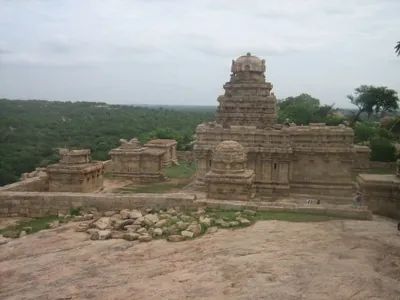
Moovar Koil in Tamil means “three temples” and the complex is named so very aptly. This temple complex consists of three separate shrines, standing in a line facing west, with their front ardha-mandapas connecting to a common maha-mandapa, followed by a Nandi-mandapa, bali-pitha and a dhvaja-stambha. There are also remains of fifteen or sixteen subsidiary shrines, all enclosed within an enclosure wall. There were two entrances into the complex, one through west with a gopura on top and another in north-east opening into a circular stone well. Of the three temples, two have survived fully while only the base of the third remains.
Local traditions and folklores give some interesting interpretations for the term ‘Moovar’. As per one belief, three Shaiva saints (nayanars) Appar, Sundarar and Manikkavachakar built one shrine each. Another belief states that kings of three major dynasties Cheras, Cholas and Pandyas constructed one shrine each. Another tradition states that these three shrines were constructed to house Hindu Trinity of Brahma, Vishnu and Shiva. The foundation inscription clears all doubts, stating that these temples were constructed by the Irukkuvel chief Bhooti Vikramakesari on behalf of himself and his two wives, Karrali and Varaguna.
Both the temples are very similar in architecture, style and approach except their sculptural decoration. The adhishthana is built over an upana and composed of a jagati decorated with lotus petals, vrtta–kumuda, kantha over-imposed with vyalas distributed over its length with makaras on the corners and finally a reduced pattika and prati. Barrett takes this adhisthana decoration as an original early Chola form while Soundara Rajan states that this is the earliest example of padmapushkala adhisthana. A padmapushkala adhisthana contains elements of padmabandha and vaprabandha adhisthana. The lotus decoration over jagati comes from padmabandha and the vrtta-kumuda capped within urdhva-padma and adhah-padma clasps come from vaprabandha. The vimana is tri-ratha in plan, with three niches on each side except in the west. The niches are compartmentalized within two pilasters, the central or bhadra niche is broader than the corner or karna niches. In the central shrine, bhadra niche is decorated with an elaborate makara-torana resting over its side pilasters. In the bhadra niche are found Ardhanarishvara in the east, Shiva-Bhikshatana in the north and niche in the south is empty.
The shikhara is dvi-tala (two tier) and rests above the walls, separated by a cornice moulding. Below the cornice is a regular bhuta or gana frieze shown playing various musical instruments. Above the cornice runs a vyala frieze. The first floor has an arrangement of kuta-sala-kuta, sala in middle with kutas at the corners. Niches on the sala shrine are decorated with an image. In the north is found Shiva (Barrett identifies him with Vishnu), in the east is placed Shiva seated with Uma, in the south is found Dakshinamurti, while the niche in the west is empty.
The second floor (tala) is bereft of the kuta-sala-kuta arrangement. The sala of the first tala is extended to this floor covering the central portion of each side. Apsaras or damsels are adorning the karna niche on this tala. A square griva rises above this tala supporting a square cupola above. Large kudu arches are provided in the middle of all sides. Nandis are placed at the corners. In the griva niches are found, Shiva with Uma in the west, Shiva seated with one his hand resting over a linga in the north, Indra riding over an elephant in the east and Dakshinamurti in the south. Over the square cupola is topped with a kalasa, stupi and other elements.
The iconographic theme of the southern shrine is much elaborate and richer in comparison to the central shrine. Among the icons placed in bhadra niches, in the north is found Shiva as Bhikshatana, in the east is placed Shiva as Gangadhara and in the south is found Shiva holding a vina (Vinadhara Dakshinamurti?). Icons on the first tier are Harihara in the west, standing Shiva with Parvati in the north, Kalari in the east and Natesha in the south. The sculpture of Kalari, Shiva annihilating Yama (Kala), is definitely one of the best art specimen of the Irukkuvel period. Shiva is shown dancing in a destructive posture standing over a lying figure of Yama. Though shown in a fierce attitude, a faint smile over Shiva’s face makes the overall theme very amiable and pleasant.
Niches over griva also have some interesting icons. Niche in the west is empty, in the north is placed Shiva standing with Parvati, in the east is found Tripurantaka and in the south is Shiva as Gajasamharamurti where he shown tearing apart the skin of an elephant. Depicted with four hands he carries a snake in one of hand while another hand is in suchi mudra pointing downwards. The image of Tripurantaka is considered among the best specimens of the Irukkuvel period. Here, Shiva is shown holding a bow and taking a dancing posture, identified as kodukotti by R Nagaswami. He tells that this dance was performed immediately after the destruction of the Tripurasuras.
We have already discussed the dating of Bhuti Vikramakesari and associated controversies. These also apply when we try to date this temple. Barrett appears to be in double thoughts when he dates the temple within a decade either side of 960 CE, asserting that there is nothing in the architecture of the temple which demands a date early in the second half of the tenth century CE. The base, elevation and detail remain firmly rooted in the style of the First Phase, to which, indeed, the temple complex has sometimes been attributed. He says that the temple seems to be the sole representative of the Second Phase on the southern border of the Cholamandalam. Gary J Schwindler disagrees with Barrett in latter’s placement of Moovar Koil to the second phase explaining that the temple fits stylistically more comfortably in the First Phase. Soundara Rajan takes this temple as clearest statement of the Konadu idiom preserved and places it between 878 and 886 CE. He also identifies this temple with the Tiruppudishvara temple mentioned in the foundation inscription of Muchukundeshvara Temple on the basis that the founder of the Moovar Koil was Maravan Pudi giving his name to the temple. M A Dhakytakes that this monument was constructed soon after the famous war of Tirupurambium, around 880 CE. It is now generally believed that king Bhuti Vikramakesari was a contemporary of the Chola king Aditya I (870-907 CE) and he would have constructed these temples during the last decades of the ninth century CE.
We understand the risks associating art and style to a dynasty. Region may offer a better classification rather than dynasties. However, as there are many past studies basing classifications on dynasties, it would not be out of space to have a look into those here. Kodumbalur being situated in the traditional Chola land, its art and temples are considered as part of the larger Chola idiom during its early phase. Early stages of any style are generally evaluated for the influences on it from the nearby regions and its predecessors. Similarly, various theories are proposed for the foreign influence over the temple style and architecture during the early Chola period. The most discussed proposition is that there is a significant and considerable influence coming from the Pallavas and Chalukyas, as many of their temples are pre-dated before the start of the Chola dynasty. Bhoothalingam writes, “Experts declare that they are Chola temples and details confirm this, yet none can fail to be struck by their Pallava grace. The style and the moulding of the sculpture have the same quality of distinguished restraint which gave them the distinctive Pallava air of austere charm. How did the Kodumbalur Chola temples happen to get this touch when it is clear that the chieftains of Kodumbalur were such staunch allies and lieutenants of the Cola sovereigns?”
Another proposal is of Pandyan influence of which Soundara Rajan is the main proponent. His argument is based upon the construction material. While many of the Pallava and Chalukya structural temples are constructed not in granite stone, therefore the Cholas would have got inspiration of using granite from somewhere else, and that is from the Pandyas. Barrett appears to agree with the Pandyan influence however he has different arguments for the same. Rama Sivaram opines that the search for Chola style must begin somewhere within the Mutharaiyar territories as the making of the Chola architecture began with Vijayalaya’s conquest of Thanjavur from the Mutharaiyars.
Inscriptions
Few inscriptions discovered in the temple complex are listed below:
- On the south wall of the central shrine of Moovar koil – Sanskrit language, Pallava-grantha characters – mentions Bhuti alias Vikramakesari built three shrines in his name and in the names of his two wives, Karrali and Varaguna and consecrated Mahadeva. He also donated a matha and eleven villages to Mallikarjuna of Mathura (Madura?) for the offerings to the god and feeding of fifty Asitvatkara (kalamukha) ascetics. Mallikarjuna was born in Atreya-gotra and disciple of Vidyarasi. Genealogy of Bhuti, said to be born in Yadu-vamsa as Minnamala, is provided – Paravirajit, Viratunga, Ativira, Sangakrit, Nripakesari, Paradurgamardhana, Samarabhirama. His grandfather Paradurgamardhana is said to have conquered Vatapi. His father Samarabhirama is told to have killed Chalukki in the battle of Adhirajamangala. Bhuti’s mother, Anupama, was a Chola princess. Bhuti fought against the Pallava armies and conquered Vira-Pandya in the battle and killed Vanchivel. Bhuti, from his wife Karrali, begot Parantaka and Adityavarman.
- On the north wall of the central shrine of the Moovar koil – refers to certain regnal year of the Chola king Rajendra I – mentions various victories conferred upon the king, also mentions the temple at Kodumbalur in Urattur-kurram of Konadu in Keralantaka valanadu.
03 / AIVAR KOIL (AINTALI)
Aivar Koil (Aintali)
Aivar Koil in Tamil means ‘five temples’, named aptly it being a quincunx (panchayatana) complex comprising of five shrines, one placed in the center and one each at corners. Only the base of the structure has survived suggesting that its walls and shikhara was probably constructed in brick and stucco as the opinion of K V Soundara Rajan. The complex faces east. Adhisthana of the central shrine is of padabandha type, resting over an upana and composed on a jagati, tripatta-kumuda, kantha sandwiched between two kampa courses, a pattika and a prati. The central shrine was of sandhara type, provided with a circumambulation path around its sanctum. All the five shrines were found having a Shivalinga inside. The temple was extended with an ardha-mandapa and a maha-mandapa in later periods. Both were provided with a flight of steps for entrances, ardha-mandapa with two entrances, one on north and one in south, and maha-mandapa with an entrance on the west.
A Nandi-mandapa was added to the complex later. An image of Nandi is still there in this mandapa. In the excavations are found an image of four-armed Durga, an image of four-armed Vishnu and six images of dvarapalas. Soundara Rajan dates the temple to the first quarter of ninth-century CE, the period of Cattan (Sattan) Maravan, father of Bhuti Vikramakesari. He suggests that Aivar Koil is perhaps the first important monument of the Irukkuvels at their capital belonging to a time when they had direct matrimonial ties with the Mutharaiyars. He also draws similarities of this temple with that of Sundaravarada temple at Uttiramerur built during the Pallava king Dantivarman (795-846 CE). The Brahma image in the Chicago Art Institute is probably from this temple site.
Inscriptions
Various inscriptions found in the temple complex are provided below:
- On the east tier of the mandapa of Aivar temple – refers to the sixth regnal year of the Chola king Parakesarivarman – records a gift of a perpetual lamp by a certain individual for the welfare of his wife, in the temple of Tiru Aindali-Mahadeva at Kodumbalur in Urattur-kurram.
- At the same place – refers to the fifteenth regnal year of the Chola king Rajakesarivarman – the available portion only provides a name of a lady, Nangayar Anantan Paliyili of Urattur-kurram. Soundara Rajan suggest that this Rajakesarivarman might be identified with the Chola king Aditya I (870-907 CE). He opines that the lady Nangayar Anantan Paliyili would be same as Paliyili Siriyanangai, wife of Mallan Anantan and daughter of Sattan Paliyili of Narthamalai inscription of Paliyilisvaram cave temple.
- On the south tier of the same mandapa – refers to the eighteenth regnal year of the Chola king Rajakesarivarman – registers a gift for a perpetual lamp by a certain individual, in the temple of Tiru Aindali Mahadeva at Kodumbalur.
- On a stone built into the pond in front of the Muchukundesvara temple – Sanskrit language, much damaged, seems to be a genealogy, name of Atri can be recognized
- On the three stones built into the same pond – Kannada language, ancient characters – fragmentary inscription mentions Kodumbalur and kesarisvara
- On the south tier of the mandapa of the Aivar temple – refers to fourteenth regnal year of the Chola king Rajaraja I, corresponding 999 CE – refers to a donation for a perpetual lamp by a certain individual
04 / MUCHKUNDESVARA TEMPLE
Muchkundesvara Temple
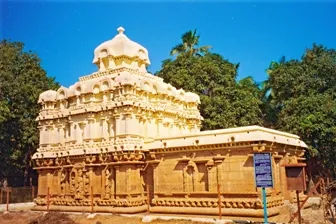
The temple faces east and consists of a garbha-grha, ardha-mandapa, a closed maha-mandapa and an open pillared mandapa, the last two are later additions. The open pillared mandapa was built with materials taken from other ruined temples as its built in a haphazard manner. The temple stands within a complex, on corner of which were constructed four temples, all facing the central temple. One shrine is empty while other three have images, an image of Kartikeya, Chandeshvara and a later image of Bhairava.
| Arrangement of sub-shrines in a parivara type temple |
|---|
The vimana is a tri-tala (three tiers) shrine with its first tala in tri-ratha style. Adhishthana is built over an upana and composed of a jagati, tripatta-kumuda, kantha sandwiched between two kampa courses and pattika. Tri-ratha design results into a central bhadra niche (devakoshtha) and corner karna niches. All the niches are bereft of images. Second tala has arrangement of kuta-sala-kuta on each side. Niches have been provided on the sala, and the images installed in these niches are of Vinadhara-Dakshinamurti in the south, Vishnu in the west and Brahma in the north. Niches are also provided on the griva in the uppermost third tier (tala) of the shikhara. It houses the same icons as of the second tala.
Earlier the temple was assumed constructed during the reign of the Chola king Aditya I taking evidence of an inscription (no 33 of Inscriptions of Pudukkottai State). However a later discovered inscription clearly states that in the fourteenth regnal year of the Chola king Parantaka I, Mahimalaya Irukkuvel alias Parantaka Vira Chola alias Kunjaramallan appointed the priests of the Tiruppudisvaram temple to conduct worship in the new temple of Mudukundamudaiyar. This suggests that the Tiruppudisvaram temple was a separate and distinct temple. Barrett places the temple in around 921 CE, taking Mahimalaya, the builder of the temple, as a contemporary of Parantaka I and Gandharaditya. An inscription at Nirpalani also confirms contemporaneity of the Irukkuvel chief Parantaka Vira Chola alias Mahimalaya with the Chola king Gandharaditya (950-956 CE). Based upon this evidence, the temple may be placed in the first half of the tenth century CE.
05 / LOCATION & MAP
Place the story on the map.
PLACE THIS STORY ON THE MAP
Kodumbalur, Pudukkottai district, Tamil Nadu
Tamil Nadu, India
ABOUT THIS FIELD ENTRY
From the Puratattva archive.
This article was first published on Puratattva (puratattva.in) and appears on Bharat Ke Wow with permission. Photographs are credited in their captions.
Read the original entry ↗