


01 / INTRODUCTION
Ghrishneshwar
The Jyotirlinga of Unshaken Devotion
इलापुरे रम्यविशालकेऽस्मिन्समुल्लसन्तं च जगद्वरेण्यम् ।
वन्दे महोदारतरस्वभावं घृष्णेश्वराख्यं शरणं प्रपद्ये ॥
“I seek refuge in Ghrishneshwar, who shines in the beautiful and spacious land of Ilapura, who is honoured by the world, and whose nature is surpassingly generous.”
There are temples that overwhelm the pilgrim through their monumental scale, and there are temples whose power lies in drawing the mind inward through intimacy. Ghrishneshwar, situated at Verul near the celebrated Ellora caves in Maharashtra, belongs to the latter kind. Traditionally revered as the twelfth and concluding Jyotirlinga, it stands within a sacred landscape shaped by centuries of religious, artistic and cultural activity. The temple is surrounded by the rock-cut monuments of Ellora, including the extraordinary Kailasa temple, ancient routes associated with Devagiri, and a sacred water body remembered in tradition as Shivalaya.
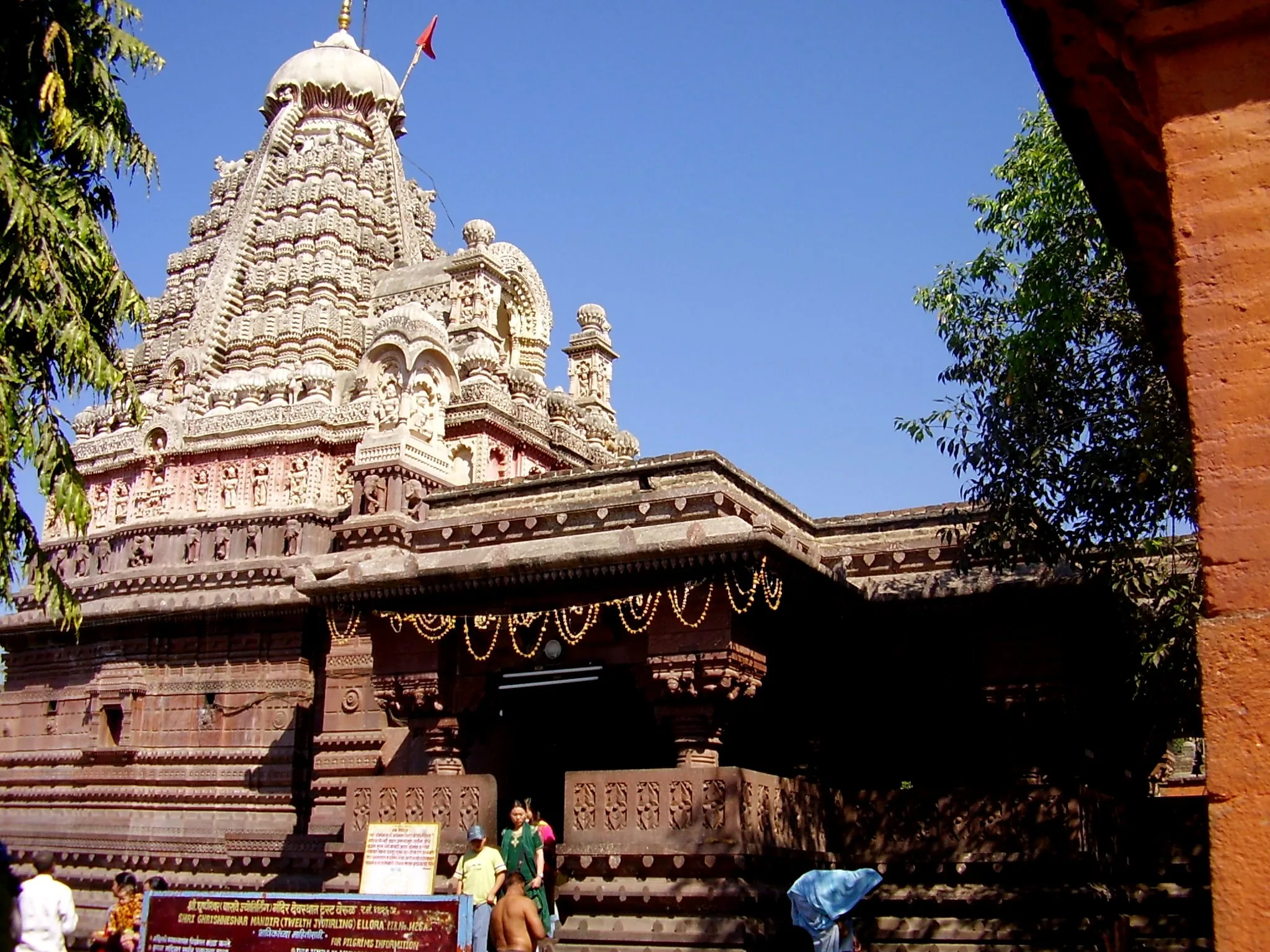
The present shrine is built largely in warm reddish stone. Its sculpted shikhara, pillared sabhamandapa and comparatively compact sanctum create an architectural movement from the openness of the courtyard into the intimacy of the inner shrine. The sounds of pilgrims, bells, prayers and the repeated name of Shiva fill the outer spaces, while within the sanctum the experience becomes more immediate. Ghrishneshwar is a temple in which the devotee approaches the Linga with a sense of personal nearness rather than merely viewing the deity from a distant threshold.
Yet the true importance of Ghrishneshwar does not lie in architectural grandeur. Its spiritual heart is the story of Ghushma, a woman whose devotion remained unbroken even when her family was shattered by jealousy and violence. She fashioned one hundred and one earthen Lingas each day, worshipped them and immersed them in a sacred lake. When her son was murdered, she did not abandon her vrata or turn against Shiva. Her steadfastness brought the dead back to life. When Shiva then appeared and offered to punish the murderer, Ghushma asked instead for forgiveness.
This gives Ghrishneshwar a distinctive spiritual character among the Jyotirlingas. Its central lesson is not merely that Shiva answers devotion with miracles. It asks a more difficult question: after suffering has been endured and divine power has been received, can the devotee remain free from vengeance? Ghushma’s greatness lies in the fact that she could. Her devotion did not culminate in the destruction of her enemy but in compassion.
The shrine is traditionally remembered as the final Jyotirlinga in the customary sequence. Yet “last” does not mean lesser. The completion of a pilgrimage has its own sanctity. After remembering the other Jyotirlingas, the pilgrim arrives at Ghrishneshwar where devotion, surrender and forgiveness come together in a single story.
02 / PURANIC ORIGIN
Puranic Origin
The principal sacred narrative of Ghrishneshwar is associated with the Shiva Purana. The story is placed in the southern region near a splendid mountain called Deva, traditionally associated in later geographical understanding with Devagiri. The landscape around present-day Verul and Daulatabad provides a recognisable setting for this ancient narrative. Yet the Purana does not begin with a miraculous manifestation of light. It begins within an ordinary household—with learning, sacred fires, marriage, longing and the pressures of social expectation.
The household belongs to Sudharma, a Brahmin of the Bharadvaja lineage. Learned in the Vedas and Shastras, he maintains the sacred fires, performs the three daily Sandhyas, teaches disciples, welcomes guests and gives generously. His wife Sudeha is also religiously inclined and devoted to the household. Their marriage is described as affectionate and their home as respected. Yet there is one absence that gradually comes to dominate their lives: they have no child.
Sudharma accepts their childlessness with a degree of philosophical detachment. He reminds Sudeha that worldly relationships cannot ultimately provide security for the self. But Sudeha experiences the matter differently. Her longing is intensified by social judgement when a neighbour mocks her childlessness and warns that without an heir her wealth, status and continuity of the household will disappear. Her private sorrow is thereby transformed into public humiliation.
She repeatedly asks Sudharma to seek a son. At one point he offers two flowers before the sacrificial fire, inwardly assigning one as the sign of childbirth. Sudeha chooses one, but the expected sign does not fall to her. Sudharma urges acceptance and deeper surrender to Shiva. Eventually Sudeha herself proposes that Sudharma marry her younger sister Ghushma.
Sudharma hesitates because he recognises a danger that Sudeha does not yet fully understand. He warns her that if Ghushma bears a son, jealousy may arise. Sudeha assures him that she will never resent her sister and herself brings Ghushma into the household.
Ghushma does not enter the family as a rival. She becomes part of the household under Sudeha’s care. Her defining spiritual practice is the worship of Parthiva Lingas. Every day she fashions one hundred and one Lingas from earth, worships them with mantra, water and flowers, and then carries them to a nearby lake and immerses them. The following day she begins the practice again.
This simple ritual contains an entire philosophy of existence. Earth is gathered and shaped into the form of Shiva. The form is worshipped and then released into water. What has been created is not possessed. It is offered and dissolved. The devotee learns through repetition that sacredness does not depend upon permanent possession of a form.
Ghushma eventually completes the worship of one hundred thousand Parthiva Lingas. Shiva’s grace manifests, and she gives birth to a son of auspicious qualities. The long vrata appears to have reached its desired fulfilment. Yet the birth of the child becomes the very event that exposes Sudeha’s unresolved jealousy.
The blessing becomes a mirror. Relatives praise Ghushma, the child honours Sudeha as an elder mother, and the household continues to show affection towards her. Yet the comparison within Sudeha grows stronger. The younger sister has become a mother; she remains childless. What had once been sorrow turns into resentment, and resentment eventually turns towards violence.
One night, Sudeha enters the young man’s room while he sleeps and kills him. She cuts the body into pieces, carries the remains to the lake where Ghushma immerses her Lingas, and throws them into the water. She then returns to the house. The next morning, the young man’s wife discovers the blood and fragments of his body, and the household is overwhelmed by grief.
Yet Ghushma does not abandon her worship.
She continues the appointed vrata. Her action is not presented as indifference to her son’s death. Rather, her devotion is no longer dependent upon favourable circumstances. She does not approach Shiva only when she wants something. Her relationship with the Lord has become the centre of her life, and even catastrophe cannot displace it.
She takes the one hundred and one earthen Lingas to the lake as she has done every day. She repeats Shiva’s name and follows the same path she has followed countless times before. She immerses the Lingas in the water.
And as she turns back, her son stands alive upon the bank.
The same lake into which Sudeha had cast the broken body now gives back life. What had been used to conceal death becomes the setting for restoration. The miracle is therefore not merely a reversal of tragedy; it transforms the meaning of the sacred water itself.
At that moment Shiva appears before Ghushma as a mass of splendour. He reveals that Sudeha was responsible and offers to destroy her with His trident. Ghushma, however, does not ask for revenge. She asks Shiva to protect Sudeha.
Her forgiveness is not an attempt to deny the crime. Shiva himself identifies the crime, Sudeha experiences shame and later undertakes expiation and seeks forgiveness. What Ghushma refuses is the continuation of violence. Her son has been restored, and she will not demand another death in response to the first.
Pleased by this extraordinary devotion, Shiva offers Ghushma a boon. She does not ask for wealth, power or personal fame. She asks Him to remain at that place in her name for the protection of all beings.
Shiva agrees. He becomes Ghushmesha, the Lord associated with Ghushma. The sacred lake is called Shivalaya, and Shiva promises blessings for her lineage, including learning, prosperity, longevity, noble conduct, worldly well-being and liberation. The family then performs one hundred and one circumambulations, while Sudeha repents and seeks forgiveness.
Thus the Jyotirlinga is born not merely from ritual perfection but from a transformation of the heart.
03 / HISTORICAL BACKGROUND
Historical Background
The sacred identity of Ghrishneshwar is ancient in Puranic and local memory, but the visible temple standing at Verul today belongs largely to later periods of rebuilding. Like many important shrines of the Deccan, the temple experienced changing political circumstances, periods of damage and neglect, followed by restoration under devoted patrons.
Tradition and modern historical accounts associate an important restoration with Maloji Bhosale, the grandfather of Chhatrapati Shivaji Maharaj, around the late sixteenth or early seventeenth century. A remembered inscription connects the Bhosale family with work at the shrine and its sacred tank. Such patronage involved more than repairing walls. Temple restoration sustained priests, festivals, water structures, feeding arrangements, land grants and the wider economy that supported pilgrimage.
The present form of the temple is widely associated with eighteenth-century Holkar patronage, and popular tradition particularly credits Queen Ahilyabai Holkar with its restoration. Some accounts distinguish different phases of rebuilding and also associate Gautamabai Holkar with the work. The exact attribution varies between popular and historical accounts, but the larger picture remains clear: the Holkar household played a major role in restoring the temple and the Shivalaya tirtha.
Ahilyabai Holkar occupies a special place in India’s sacred geography because of her extensive patronage of temples, ghats, wells, dharmashalas and pilgrimage establishments across the country. Her approach was not to gather sacred centres into a single royal complex but to strengthen places where local traditions were already established.
At Ghrishneshwar, the history of rebuilding creates an interesting parallel with the Puranic story. Ghushma repeatedly creates the Linga, immerses it and begins again the following day. Likewise, a sacred structure may suffer damage, yet devotion restores it. Continuity does not always mean that stone survives untouched. Sometimes continuity lies in the determination to rebuild what history has wounded.
The temple’s historical setting is also inseparable from Ellora. The nearby cave complex contains thirty-four major Buddhist, Hindu and Jain monuments extending for more than two kilometres along a basalt escarpment. Created broadly between the sixth and tenth centuries, the caves bear witness to the coexistence of several religious traditions in the Deccan.
The most celebrated monument at Ellora is Kailasa, generally associated with Rashtrakuta patronage. Unlike an ordinary temple constructed by assembling individual blocks of stone, Kailasa was excavated downward from the living rock. The temple, courtyards, halls, elephants, pillars, bridges, sculptures and vimana were released from a single mountain mass.
For the pilgrim visiting Ghrishneshwar, the proximity of Kailasa creates a remarkable contrast. At Ellora, a mountain becomes a temple. At Ghrishneshwar, earth becomes a Linga. One represents extraordinary collective labour; the other preserves the daily work of a devotee’s hands. The vast and the intimate stand together in the same sacred landscape.
04 / TEMPLE ARCHITECTURE
Temple Architecture
The Ghrishneshwar temple rises upon a high moulded base of reddish, russet and brown stone whose appearance changes with the light. The architecture belongs naturally to the Deccan landscape while displaying the disciplined craftsmanship of traditional temple masonry. Its lower portions convey solidity, while the upper sections become progressively more elaborate.
The exterior walls are articulated through bands, projections, niches and sculptural panels. Deities and scenes from sacred traditions inhabit the surfaces, while the shikhara rises in diminishing tiers crowded with miniature architectural forms and divine figures. From a distance the temple appears compact and composed; when approached closely, its stone surfaces reveal a much richer world of sculpture.
The Sabhamandapa leads the devotee towards the sanctum. Accounts commonly describe twenty-four pillars within the hall, decorated with motifs and narrative figures. These pillars are not merely structural supports. They organise the movement of the pilgrim, create rhythm within the hall and frame the view towards Nandi and the Garbhagriha.
A substantial image of Nandi faces Shiva. His still posture carries a familiar meaning in Shaiva temples, but at Ghrishneshwar the symbolism is particularly appropriate. Nandi represents patient attention and unwavering focus. He remains turned towards Shiva without distraction, reflecting the same steadiness that defines Ghushma’s daily worship.
The Garbhagriha itself is comparatively small. The Linga traditionally faces east, and the confined space brings the worshipper into a close relationship with the deity. Water from Abhisheka, flowers, offerings and the repeated touch of devotees give the sanctum the living texture of an active temple rather than the preserved surface of an archaeological monument.
This distinction is important when considering Ghrishneshwar beside Ellora’s Kailasa. The temple does not attempt to compete with the monumental achievement of the rock-cut complex. Its architectural achievement is of another kind. It is a functioning sacred building, shaped by ritual use. Its halls must receive pilgrims, its thresholds organise movement, its sanctum must sustain daily worship and its surfaces must endure water, oil, flowers, cloth and human nearness.
The temple is therefore not simply something to be looked at. It is something to be inhabited through worship.
05 / SACRED LEGENDS
Sacred Legends
The central legend of Ghrishneshwar is the story of Ghushma, Sudeha and Sudharma, but several sacred traditions have grown around the shrine. The Puranic account gives the temple its principal spiritual identity, while local traditions add other layers of meaning without necessarily replacing the central narrative.
In oral retellings, the Puranic Ghushma sometimes becomes Kusuma. In this version, a devout woman worships Shiva daily and immerses the Lingas in a tank. A jealous co-wife kills her son and throws the body into the water. The woman continues her worship, Shiva restores the boy and manifests as the Jyotirlinga known as Ghrishneshwar.
The relationships may be simplified in these popular versions. The murderer may be described as the husband’s first wife rather than Ghushma’s elder sister, and the daily Lingas may be spoken of in a simpler form. Yet the emotional movement remains unchanged: devotion, jealousy, murder, steadfast worship, restoration and forgiveness.
Such oral traditions preserve what communities find most memorable. The name Kusuma means “flower,” and this association has perhaps contributed to the tenderness with which the story is remembered. The devotee who offers herself through worship becomes like a flower placed before Shiva—vulnerable, fragrant and without violence.
Another local tradition connects the shrine with Parvati and a forest called Kamyavana. According to this account, Shiva and Parvati were in the forest when Parvati became thirsty. Shiva opened the earth with His trident, causing water to emerge, and the resulting lake came to be known as Shivalaya.
The story then turns towards the Goddess’s sacred adornment. Parvati prepares kumkuma or saffron paste, rubbing it with water in her palm or beneath her thumb. Through this sacred friction, a radiant Linga appears. The name Ghrishneshwar is therefore associated in this local tradition with the act of rubbing, ghrishana, and with the Linga manifested through the touch of the Goddess.
The two traditions offer different windows into the same sacred presence. In the story of Ghushma, the Linga is repeatedly created from earth by a human devotee. In the story of Parvati, it emerges through the touch of the Goddess. Both place sacred creation in feminine hands. Both connect matter, touch and devotion. Neither begins with monumental architecture.
The sacred landscape of Ghrishneshwar therefore contains several memories at once. The Puranic story reveals devotion and forgiveness. The Parvati tradition reveals the creative power of Shakti. The lake of Shivalaya holds both memories in its waters.
06 / SPIRITUAL SIGNIFICANCE
Spiritual Significance
Ghrishneshwar is fundamentally a temple of steadfast devotion. Ghushma does not worship Shiva only when life is favourable. Her vrata continues through joy, motherhood, tragedy and miraculous restoration. Her devotion is therefore not transactional. She does not abandon Shiva when the reward she expected appears to have disappeared.
This is the deepest teaching of the shrine. Faith is often imagined as a moment of intense emotion, but Ghushma’s faith is expressed through rhythm and repetition. Every day she makes the Lingas. Every day she worships them. Every day she releases them into water. Her spiritual practice becomes so deeply woven into her being that even catastrophe cannot break it.
The second great teaching is forgiveness. When Shiva offers to punish Sudeha, Ghushma refuses revenge. Her forgiveness is not denial of the crime. The crime is recognised; Sudeha experiences shame and performs expiation. What Ghushma refuses is the perpetuation of violence. Her son has been restored, and she will not use divine power to demand another death.
This gives the temple a special significance for those facing family wounds, jealousy, comparison, childlessness, social pressure, conflict between relatives and grief. These are not subjects placed outside the sacred narrative. They are precisely what the Puranic story brings into the temple. The household itself becomes a field of tapas.
The shrine is traditionally approached for well-being, family harmony, children, continuity of lineage, relief from sorrow and the fulfilment of worthy desires. Yet the story prevents these blessings from becoming a simple bargain. Ghushma’s worship existed before the child, continued after his birth and did not cease when she believed him dead. Her vrata was not a method of controlling life; it was a way of placing life in Shiva.
The story also gives a profound understanding of bhukti and mukti. Ghushma receives worldly well-being—her son lives, her family continues and Shiva remains near. Yet she is also inwardly free. She is neither shattered by loss nor consumed by attachment when what she loves is restored. The worldly blessing rests within spiritual maturity.
Her greatness is therefore not that she escapes the household. She becomes spiritually great within the household. Her kitchen, courtyard, water path and family relationships become part of her yoga. Ghrishneshwar thus speaks particularly powerfully to householders, reminding them that liberation is not necessarily found only in remote forests or caves. Sacred life can be created within ordinary responsibilities when those responsibilities are transformed by devotion.
Even Sudeha’s story contains a difficult form of grace. To be spared is not necessarily to be excused. She must face the truth of her action, experience shame, perform repentance and ask forgiveness. Grace becomes an opportunity for transformation rather than a denial of responsibility.
The final teaching of Ghrishneshwar is therefore compassion after justice has been acknowledged. Shiva offers punishment; Ghushma asks for mercy. The Lord restores life; the devotee refuses to create another death. In this sense, Ghushma becomes like Shiva Himself—compassionate, generous and free from the desire to retaliate.
07 / FESTIVALS AND RITUALS
Festivals and Rituals
The daily rhythm of Ghrishneshwar revolves around Abhisheka, Alankara, offerings and Arati. The priests maintain a ritual cycle that continues regardless of the changing stream of pilgrims. A visitor may arrive and depart within a few hours, but the worship of Shiva continues without interruption.
The simplicity of the temple’s daily worship reflects the central practice of Ghushma. Shiva accepts both the simplest offering and the elaborate worship of a major temple. The earthen Linga made by the devotee’s hands and the richly adorned deity of the festival belong to the same devotional world when the offering is made without pride.
Mondays are particularly sacred to Shiva, and the month of Shravana brings large numbers of devotees. Many observe fasts, carry water, offer Bilva leaves and undertake vows during this period. The monsoon also transforms the landscape around Verul, making the surrounding greenery more vivid while deepening the colour of the temple’s stone.
The principal annual festival is Mahashivaratri. Devotees fast, remain awake through the night, chant the Panchakshari Mantra and participate in repeated worship of Shiva. The night vigil is particularly meaningful at Ghrishneshwar because the temple’s central story itself is one of devotion maintained through the darkness of suffering until the dawn of restoration.
The festivals of the temple are also collective occasions involving much more than priests and pilgrims. Local families, flower sellers, musicians, cooks, transport workers, volunteers and others participate in sustaining the celebration. The life of a sacred festival therefore extends into the life of the surrounding community.
The temple’s worship may take different external forms as the deity is adorned with cloth, flowers, silver, lamps and fragrance. Yet beneath this festival abundance remains the same principle that defines Ghushma’s worship: Shiva accepts the offering when it is made with sincerity rather than pride.
08 / PILGRIMAGE INFORMATION
Pilgrimage Information
Ghrishneshwar is situated at Verul, near the Ellora cave complex in Maharashtra. Its location makes it particularly distinctive among the Jyotirlingas because a visit to the temple can naturally be combined with a journey through one of India’s greatest archaeological and sacred landscapes.
The proximity of Ellora gives the pilgrim an unusual opportunity to encounter both living worship and ancient rock-cut architecture within the same landscape. The caves contain Buddhist, Hindu and Jain monuments, demonstrating the coexistence of different religious communities in the Deccan. The Kailasa temple, excavated from a single mass of basalt, is especially significant.
Yet the histories should not be confused. The present Ghrishneshwar temple belongs largely to later rebuilding, while the principal rock-cut phase of Ellora belongs to earlier centuries. Their relationship is therefore primarily geographical and sacred, rather than a single architectural chronology.
For the pilgrim, however, their juxtaposition is deeply meaningful. At Ellora, the mountain itself is transformed into a temple. At Ghrishneshwar, earth is transformed into the Linga through the devotion of Ghushma. The immense achievement of collective craftsmanship and the intimate act of personal worship stand side by side.
The sacred tank associated with Shivalaya is also an important part of the pilgrimage landscape. Local tradition identifies a built tank near the temple with the Puranic lake into which Ghushma immersed her Lingas. Pilgrims understand its waters through the memory of her worship and the restoration of her son.
The lake’s symbolism is particularly powerful. It receives the earthen Lingas, receives the body of the murdered son and then gives him back alive. What had been used as a hiding place for violence becomes the place of divine restoration. In the sacred imagination of Ghrishneshwar, water gathers together creation, dissolution, loss and renewal.
A pilgrim approaching Ghrishneshwar therefore encounters more than a Jyotirlinga. The journey includes the temple, the sacred lake, the wider Ellora landscape and the memory of Devagiri. Together they form a kshetra in which architecture, scripture and living devotion reinforce one another.
09 / UNIQUE FEATURES
Unique Features
Ghrishneshwar’s first great distinction is that it is traditionally regarded as the twelfth and concluding Jyotirlinga. The final position gives the shrine a special symbolic importance. The pilgrim who has travelled through the twelvefold sequence arrives here at a temple whose teaching centres upon the completion of devotion through forgiveness.
The temple’s intimate sanctum is another defining feature. Compared with the immense architectural scale of nearby Kailasa or some of the other major Jyotirlingas, Ghrishneshwar creates its effect through nearness. The devotee approaches the Linga closely, and the compact sanctum retains the atmosphere of a living place of worship.
The reddish Deccan stone gives the temple its distinctive visual character. The shikhara, sculpted exterior, pillared hall and carved surfaces create a rich architectural expression without relying upon overwhelming size.
The association with Shivalaya, the sacred lake, is perhaps even more important than the architecture. It is rare for a Jyotirlinga legend to place a water body so centrally within the spiritual drama. The lake is the place where Ghushma’s Lingas are immersed, where the murdered son’s body is thrown, and where life is restored.
The shrine is also unique because its central sacred story is centred upon a woman devotee rather than a king, warrior or conqueror. Ghushma’s greatness grows through repetitive domestic worship. She shapes the Lingas with her own hands, performs her vrata day after day and ultimately asks Shiva to remain for the welfare of all beings. The deity takes her name, making the shrine itself a permanent remembrance of her devotion.
The proximity to Ellora and Kailasa creates another extraordinary feature. Few Jyotirlinga pilgrimages place the devotee so close to a monument of such monumental rock-cut achievement. Yet the contrast is itself meaningful: Kailasa represents the transformation of an entire mountain into a temple, while Ghrishneshwar preserves the transformation of ordinary earth into sacred Lingas through daily worship.
Finally, Ghrishneshwar is distinguished by the moral depth of its legend. Many sacred stories centre upon the defeat of an external demon. Here the deepest enemy is jealousy within a family. Shiva’s victory is not complete merely because the murdered son is restored. It reaches fulfilment when the cycle of vengeance is broken and the offender is brought back through repentance and forgiveness.
10 / SCRIPTURAL REFERENCES
Scriptural References
The principal scriptural foundation of Ghrishneshwar is the Shiva Purana, which preserves the detailed account of Sudharma, Sudeha and Ghushma. The narrative explains the origin of the Jyotirlinga through Ghushma’s daily Parthiva Linga worship, the birth and murder of her son, his restoration through Shiva’s grace and her refusal to seek vengeance.
The traditional Jyotirlinga verse identifies the sacred landscape as Ilapura, generally associated with Elapura or Ellora, while the present village of Verul carries the same geographical memory into Marathi usage. The verse particularly praises Shiva’s mahodaratara-svabhava, His exceedingly generous nature. This quality is reflected throughout the legend: Shiva restores life, honours devotion, offers protection and accepts the devotee’s request for mercy.
The Shiva Purana also preserves the significance of one hundred and one throughout the story. Ghushma creates one hundred and one Lingas each day, the family performs one hundred and one circumambulations after Shiva’s manifestation, and blessings are associated with one hundred and one generations. The number suggests fullness extending beyond a completed hundred—a sense of abundance and continuity.
The sacred lake is identified in the Puranic story as Shivalaya. It is not merely the setting for the legend but an active participant in it. The lake receives the Lingas, receives the murdered body, witnesses Shiva’s grace and gives back the restored son. The practice of immersing the Parthiva Lingas expresses the deeper teaching that sacred form is created, worshipped and released rather than possessed.
The tradition of Kusuma represents the continuing oral life of the Puranic story. Although details differ in popular retellings, the essential movement remains the same: a woman’s devotion survives jealousy, murder and grief, Shiva restores the child and the Jyotirlinga manifests as Ghrishneshwar. The distinction between the detailed Puranic account and local retelling is important and should be preserved rather than artificially merged.
The local tradition connecting the name with Parvati’s kumkuma provides another sacred explanation. In this account, the Goddess’s rubbing of saffron or kumkuma produces a radiant Linga, connecting the name Ghrishneshwar with ghrishana, the act of rubbing. This tradition differs from the Shiva Purana’s Ghushma narrative, but both place sacred creation in feminine hands and connect the manifestation of Shiva with devotion and touch.
The sacred geography surrounding Ghrishneshwar also includes Ellora, whose Buddhist, Hindu and Jain monuments testify to the religious plurality of the Deccan. The Kailasa temple, excavated from living rock and associated with Rashtrakuta patronage, provides an extraordinary architectural counterpart to the living worship of Ghrishneshwar.
Yet the scriptural heart of Ghrishneshwar remains remarkably simple.
A woman makes a Linga from earth.
She worships it.
She releases it into water.
She does this again the next day.
And again.
When everything she loves seems to have been taken from her, she continues.
Shiva restores what was lost.
Then He offers her the power to punish.
She chooses forgiveness.
That is why Shiva remains in her name.
Ghrishneshwar is therefore not merely the concluding Jyotirlinga in a sacred sequence. It is a temple of continuity—the continuity of worship when life becomes unbearable, the continuity of compassion after suffering, and the continuity of sacred memory through generations.
The material may be only earth.
The offering may be known to no one.
The day may be filled with sorrow.
Still, the Linga can be shaped.
Still, Shiva’s name can be spoken.
Still, what has been offered can be released.
And in that surrender, the heart becomes spacious enough to hold grief, truth, justice and mercy without breaking.
11 / PHOTOGRAPHS
From the whole to the detail.
Select a photograph to explore it at a larger scale.
12 / LOCATION & MAP
Place the story on the map.
PLACE THIS STORY ON THE MAP
Verul, near Ellora, Maharashtra
Maharashtra, India
ABOUT THIS FIELD ENTRY
Rooted in the Bharat Ke Wow archive.
This page is part of the Bharat Ke Wow series on the Dvādaśa Jyotirlingas. Sacred narratives are presented as temple tradition.
Read the original entry ↗