


01 / INTRODUCTION
Ramanathaswamy Temple
The Lord of Rama’s Devotion
Rameshwaram is not merely a temple town; it is a sacred meeting place of Rama and Shiva, where devotion itself becomes the bridge between the two great traditions of Hindu worship.
On the southeastern coast of Tamil Nadu, upon the island of Rameswaram, stands the magnificent Sri Ramanathaswamy Temple, one of the most sacred shrines of Lord Shiva and one of the twelve revered Jyotirlingas of India. The temple occupies a vast sacred precinct on the shores of the Bay of Bengal and has, for centuries, drawn pilgrims seeking purification, devotion and liberation. Its sanctity is inseparably connected with Lord Rama, who, according to tradition, worshipped Shiva here after the great battle of Lanka. The very name Ramanathaswamy, meaning “the Lord of Rama,” preserves the memory of that act of devotion.
Rameswaram is also one of the four Char Dham pilgrimage centres of India, together with Badrinath, Dwarka and Puri. In the sacred geography of Bharat, it therefore occupies a position of exceptional importance. The ancient texts associated the region with the name Gandhamadana Kshetra, while later traditions came to centre upon the great Ramanathaswamy Temple and its extraordinary network of sacred waters.
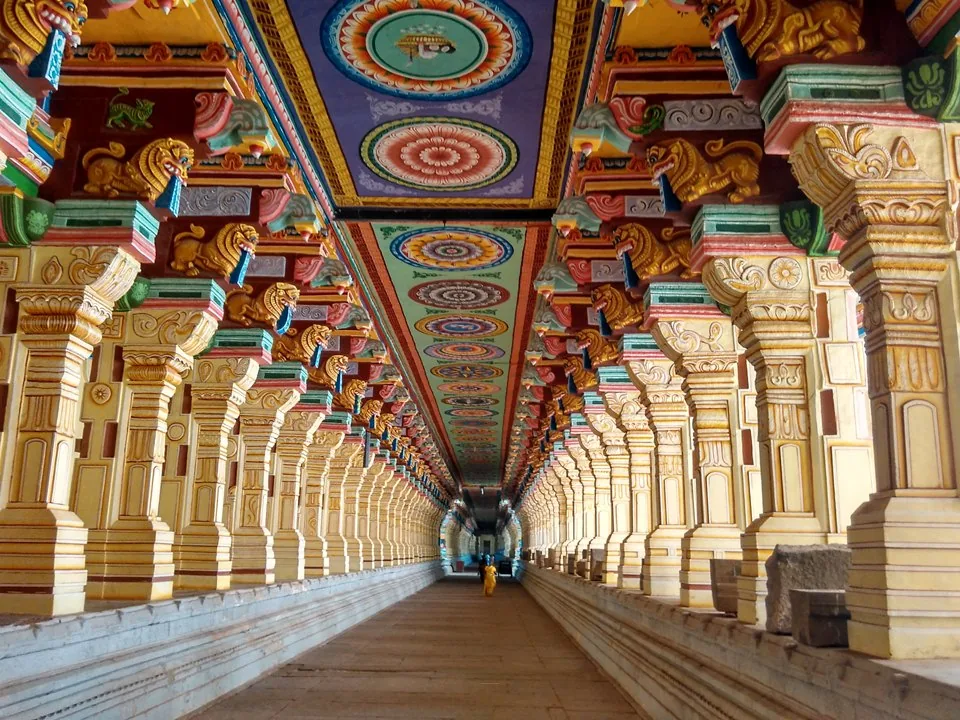
The temple is renowned not only for its theological importance but also for its architecture. Its towering Dravidian gopurams, enormous Nandi, richly carved pillars and seemingly endless corridors make it one of the great architectural achievements of South India. The celebrated third corridor, extending for hundreds of metres and supported by more than a thousand pillars, has become one of the defining images of Indian temple architecture.
Yet the true character of Rameswaram is found not simply in the scale of its architecture. Pilgrims walk barefoot through its vast colonnades, bathe in its sacred waters, chant the names of Shiva and Rama, and approach the sanctum with the belief that the pilgrimage itself is an act of purification. The temple is therefore both monument and living tirtha.
Its sacred identity rests upon a profound theological idea: Rama, the incarnation of Vishnu, worshipped Shiva before and after his great battle with Ravana. Rameswaram consequently stands as one of the most powerful places in India where the traditions of Rama and Shiva meet in an atmosphere of mutual reverence.
02 / PURANIC ORIGIN
Puranic Origin
The sacred origin of Rameswaram is inseparable from the Ramayana. According to the traditional account, after the destruction of Ravana and the conclusion of the battle in Lanka, Rama desired to worship Shiva. Ravana, despite being Rama’s adversary, was also a Brahmin and a great devotee of Shiva. Rama therefore wished to perform worship and atonement for the act of killing him.
The story begins with Rama’s desire to install a Shiva Linga. He asked Hanuman to travel to Mount Kailash, the sacred abode of Shiva, and bring back a Linga suitable for worship. Hanuman departed upon his mission, but the auspicious moment for the worship approached before he could return.
Seeing the need to complete the ritual at the appointed time, Sita fashioned a Linga from the sand. This sacred form became the principal Linga of the temple and came to be known as Ramalingam. The simple act of Sita moulding the sand into the form of Shiva became one of the central sacred memories of Rameswaram. The Linga was not created by a king or sculptor but by the hands of the Divine Mother herself, in the presence of Rama and in the spirit of devotion.
When Hanuman finally returned from Kailash carrying the Linga known as the Vishvalingam, he was distressed to discover that worship had already begun. Rama, however, reassured him and ordained that the Linga brought by Hanuman should be worshipped first, as an expression of gratitude towards his devoted servant. This tradition continues in the temple, where the Vishvalingam is worshipped before the Ramalingam.
The episode carries a profound message about devotion. Rama does not dismiss Hanuman’s offering simply because the ritual has already been completed. Instead, he gives the Linga brought by Hanuman a place of honour. The tradition thus preserves both Sita’s spontaneous devotion and Hanuman’s unwavering service.
Puranic traditions further describe Shiva appearing before Rama and granting him victory over Ravana. Rama then requested Shiva to remain at this sacred place for the sanctification and spiritual benefit of the world. Shiva accepted, and thus the place became known as Ramanathaswamy, the Lord of Rama.
The sacred waters of Rameswaram are also woven into this legendary landscape. The twenty-two teerthams within the temple are traditionally associated with Rama’s twenty-two arrows. These waters are regarded as spiritually purifying, and pilgrims have for generations approached them before entering the sanctum.
Another tradition connects the region with Agni, the fire god, and the sage Agastya. According to the legend preserved in the source, Rama’s powerful austerities affected Agni, and Rama cast five Lingas into the sea for Agni to recover. Agni was relieved of his distress after bathing at the sacred waters, which subsequently became known as Agni Teertham.
Thus the sacred origin of Rameswaram combines Rama’s devotion, Sita’s worship, Hanuman’s service, Shiva’s grace and the purifying power of sacred waters. The entire island becomes, in this tradition, a landscape shaped by the events of the Ramayana.
03 / HISTORICAL BACKGROUND
Historical Background
Although the sacred history of Rameswaram reaches into the mythic past, the physical history of the Ramanathaswamy Temple has unfolded over many centuries. The island has been associated with successive South Indian dynasties, including the Pandyas and Cholas, while rulers from Sri Lanka also played an important role in the development and renovation of the shrine. Inscriptions and literary references provide evidence of a temple whose importance grew steadily through the medieval period.
Some of the surviving smaller shrines within the complex are associated with the early Chola or even pre-Chola period. The source connects these early developments with rulers such as Parantaka I and Rajaraja Chola I, who are said to have erected smaller Lingas at the site during the tenth and eleventh centuries. These early shrines form part of the deeper architectural layers beneath the later monumental complex.
The temple received important patronage from Parakramabahu I, the ruler of Polonnaruwa in Sri Lanka, during the twelfth century. Tradition and inscriptions associate him with the construction of several inner shrines and an early corridor. The main sanctum is associated with the Pandya ruler Maravarman Kulasekara Pandya, under whose reign the temple had developed into a substantial complex.
The religious importance of Rameswaram is further confirmed by the Tamil Shaiva tradition. The great Nayanmar saints Appar, Sundarar and Sambandar praised the shrine in their hymns. Its inclusion among the Paadal Petra Sthalams establishes Rameswaram as one of the sacred temples celebrated in the Tamil Shaiva canon. This is particularly significant because it demonstrates that the shrine’s importance was already deeply established within Tamil devotional culture centuries before its later architectural expansion.
The history of Rameswaram was not, however, uninterrupted. In the early fourteenth century, the invasion of the Pandya kingdom by Malik Kafur, the general of Alauddin Khalji, brought destruction to several sacred centres of the region. The source records traditions and historical accounts describing damage to the temple at Rameswaram during this period, including the destruction of structures and the establishment of a mosque associated with the raid.
The temple subsequently experienced a remarkable revival. Medieval Tamil rulers and Nayak governors contributed to its restoration, but the greatest architectural transformation came under the Sethupati rulers of Ramanathapuramduring the seventeenth and eighteenth centuries. Dalavai Sethupati rebuilt portions of the eastern gopuram, while his successor Vijayaraghunatha Sethupati expanded the inner corridors.
The most celebrated patron was Muthu Raghunatha Sethupati, under whose patronage the magnificent third corridor, known as the Chokkattan Mandapam, was constructed. Its enormous dimensions and more than 1,212 pillars transformed Rameswaram into one of the greatest architectural expressions of the Tamil temple tradition.
The rulers of Jaffna in Sri Lanka also contributed to the temple’s reconstruction and preservation. King Jeyaveera Cinkaiariyan is traditionally associated with bringing stone from Koneswaram at Trincomalee for the rebuilding of the inner sanctum, while his successor Gunaveera Cinkaiariyan continued the patronage.
Later, the Maratha rulers of Tanjore supported the pilgrimage infrastructure of Rameswaram by constructing numerous choultries, or pilgrim rest houses, between the eighteenth and nineteenth centuries. These developments helped sustain the temple as a major pilgrimage centre and ensured that the sacred journey remained accessible to devotees travelling from distant parts of India.
By the nineteenth century, the temple had acquired much of the form recognised today, with its massive compound walls, gopurams and vast corridor system. The temple’s history is therefore a story of repeated destruction, rebuilding and renewal. Through all these changes, however, the sacred identity of Rameswaram remained intact. It continued to be revered as a moksha-tirtha, a sacred pilgrimage destination associated with liberation.
04 / TEMPLE ARCHITECTURE
Temple Architecture
The Ramanathaswamy Temple is one of the supreme achievements of Dravidian temple architecture. Its enormous compound is enclosed by high walls and entered through monumental gopurams whose tiered pyramidal forms rise dramatically above the island landscape. The towers are covered with stucco representations of gods and goddesses, transforming the gateways into vast sculptural compositions.
The western gopuram is particularly imposing, rising to approximately sixty-five metres. Its sculptural forms can be seen from considerable distances across the surrounding landscape. Yet the true architectural glory of Rameswaram lies not in its vertical towers but in its extraordinary horizontal corridors.
The temple contains three great concentric rectangular corridors surrounding the central sanctum. The third and outermost corridor is the most celebrated. Measuring approximately 197 metres from east to west and 133 metres from north to south, it is one of the longest temple corridors in the world. Its 1,212 granite pillars, many of them around thirty feet in height, create an almost endless procession of stone forms.
Each pillar is individually carved, carrying images of deities, dancers, floral motifs and other traditional forms. The repetition does not produce monotony. Instead, it creates rhythm. As the pilgrim walks through the corridor, the pillars seem to advance and recede endlessly, transforming the act of walking into an architectural meditation.
The open nature of the corridors allows light and air to enter between the different sections. Sunlight falls upon the stone surfaces and brings out the details of the carvings. The result is an architectural experience that changes throughout the day according to the movement of light.
At the centre lies the Garbhagriha, the sanctum of Ramanathaswamy. Here the temple tradition preserves the presence of two principal Lingas: the Ramalingam, associated with Sita’s sand Linga, and the Vishvalingam, brought by Hanuman from Kailash. In accordance with Rama’s instruction, the Vishvalingam receives worship first, followed by the Ramalingam.
The sanctum itself is more restrained than the enormous corridors surrounding it. The square stone chamber is crowned by a copper-covered roof and a gilded vimana, culminating in a golden kalasha. The contrast between the vast outer architecture and the quiet central sanctum draws the pilgrim gradually from grandeur towards intimacy.
The temple contains many other important shrines. Parvathavardhini, the consort of Ramanathaswamy, has her own shrine, while Ganesha and Murugan occupy prominent positions within the complex. The Setu Madhava shrine recalls the sacred bridge associated with Rama, while the shrine of Kashi Vishwanath symbolically connects Rameswaram with the great northern pilgrimage centre of Kashi.
The immense Nandi, approximately seventeen feet tall and carved from a single block of granite, faces the sanctum. It is one of the largest Nandi images in India and serves as the monumental intermediary between the devotee and Shiva.
The temple’s inscriptions in Tamil and Sanskrit record donations and renovations by generations of rulers. Many of the pillars carry scenes from the Ramayana and Shaiva traditions, allowing mythology and architecture to exist together. Unlike temples whose visual appeal depends primarily upon elaborate vertical ornamentation, Rameswaram’s greatest aesthetic power lies in its immense geometric colonnades extending towards the sea.
05 / SACRED LEGENDS
Sacred Legends
The central legend of Rameswaram is the meeting of Rama and Shiva. Rama, after defeating Ravana, seeks to worship Shiva and perform the necessary act of atonement. The story is extraordinary because Rama himself, though regarded as an incarnation of Vishnu, bows before Shiva. Rameswaram therefore becomes a place where devotion transcends sectarian distinctions.
The creation of the Ramalingam by Sita is one of the most beloved elements of the tradition. While Hanuman journeys to Kailash, Sita creates the Linga from the sand of the sacred island. The form made from earth becomes the central object of worship, demonstrating that the Divine can be invoked through sincerity rather than material grandeur.
Hanuman’s return with the Vishvalingam introduces another beautiful dimension. Rama does not allow Hanuman’s effort to be overlooked. Instead, he ordains that the Linga brought from Kailash be worshipped first. The practice continues to this day and preserves the relationship between Rama and Hanuman in the ritual life of the temple.
The sacred geography of Rameswaram is similarly shaped by the Ramayana. The twenty-two teerthams within the temple are traditionally associated with Rama’s twenty-two arrows. Their waters are believed to possess purifying power, and pilgrims undergo ritual bathing in them before approaching the main deity.
The tradition of Agni Teertham connects the sacred waters with Agni and Rama. The sea itself becomes part of the pilgrimage, and devotees traditionally bathe at the shore before proceeding into the temple complex.
The temple’s eleven particularly sacred Shivalingams also extend the Ramayana narrative throughout the complex. These are traditionally associated with Rama and other figures including Hanuman, Sita, Lakshmana, Sugriva, Nala, Angada, Nila, Jambavan, Vibhishana and Indra. The temple thus becomes not simply the home of one Linga but a sacred landscape containing the memory of the entire Ramayana tradition.
Another beautiful tradition concerns Parvathavardhini. Every Friday, the Goddess is taken in a golden palanquin from her shrine to symbolically meet Ramanatha. The ritual expresses the eternal union of Shiva and Shakti and brings the divine couple together within the sacred rhythm of the temple.
The Kashi Vishwanath shrine within Rameswaram provides another layer of sacred symbolism. The Linga here is traditionally believed to have been brought by Hanuman from Varanasi, while Goddess Vishalakshi is also worshipped nearby. Thus Rameswaram and Kashi, the two great Shiva pilgrimage centres at opposite ends of India, are symbolically joined within the same temple complex.
06 / SPIRITUAL SIGNIFICANCE
Spiritual Significance
The spiritual significance of Rameswaram is rooted above all in devotion, purification and liberation. The image of Rama worshipping Shiva is itself a spiritual teaching. The Divine, even in the form of an avatar, bows before the Divine. Rama’s worship demonstrates humility and reminds the pilgrim that spiritual greatness is not measured by power but by the willingness to surrender before the sacred.
The temple’s identity as a Jyotirlinga gives it a universal Shaiva significance, while its connection with Rama makes it central to the Ramayana tradition. These two identities do not compete. They reinforce one another. Rama’s devotion sanctifies Shiva worship, while Shiva’s presence sanctifies the landscape through which Rama passed.
The sacred waters are central to this spiritual experience. The twenty-two teerthams are traditionally regarded as waters capable of cleansing sins and granting spiritual and worldly benefits. The pilgrim does not simply enter the temple and stand before the Linga. The journey begins with purification through water.
Among these sacred waters, Koti Teertham holds particular importance. Tradition says that Rama created it by striking the earth with an arrow. Its water is considered so sacred that it is used in temple rituals and has traditionally been carried to other pilgrimage centres, including Kashi.
The pilgrimage therefore follows an inward movement. The pilgrim begins with the sea and the sacred waters, proceeds through the teerthams, walks through the enormous corridors and eventually reaches the sanctum. The physical movement from water to stone, from openness to enclosure and from the outer corridor to the inner Linga mirrors the movement from external purification towards inner surrender.
Rameswaram is also deeply associated with moksha. The source describes the temple as a moksha-tirtha, a pilgrimage destination associated with liberation. For generations, devotees have believed that bathing in its sacred waters and receiving darshan of Ramanathaswamy can remove accumulated sins and prepare the soul for spiritual release.
The temple’s position within the Char Dham tradition adds another dimension. Pilgrims travelling across India may encounter Shiva in Rameswaram after visiting other great sacred centres. Rameswaram thus becomes part of a larger pilgrimage map in which India’s sacred geography itself becomes a spiritual journey.
Perhaps the deepest message of Rameswaram is found in the simple act that gave the place its name: Rama worshipping Shiva. In that moment, the distinctions between different forms of the Divine dissolve into devotion. The Lord of Ayodhya bows before the Lord of Kailash, and the sacred island preserves that humility for generations to come.
07 / FESTIVALS AND RITUALS
Festivals and Rituals
The daily life of Ramanathaswamy Temple is marked by a continuous cycle of Shaiva worship. Hereditary temple priests conduct the rituals from the early morning until night, beginning with the opening ceremonies and continuing through the various forms of Abhishekam, Alankaram and Aarti.
The Abhishekam is central to the worship of Ramanathaswamy. Water, milk, honey and Bilva leaves are offered upon the sacred Linga, accompanied by mantras and ritual prayers. The deity is then adorned through Alankaram, while lamps are offered in the Aarti ceremonies. For the pilgrim, these rituals transform the ancient story into a living experience.
The nightly Aarti is particularly atmospheric. Lamps illuminate the sanctum, flowers surround the deity and Vedic hymns resound through the temple. Outside, pilgrims continue to circumambulate the great corridors, carrying offerings of Bilva leaves, flowers and incense.
Maha Shivaratri is one of the principal celebrations of the temple. The festival is observed over several days, with special Abhishekams, extensive decoration and large gatherings of devotees. The night-time worship and chanting reach their climax around midnight, when the temple becomes filled with the sound of prayers and devotional singing.
Panguni Uthiram, celebrated during March–April, marks the divine marriage of Shiva and Parvati. The utsava deities are taken in procession through the temple streets, while devotees themselves invoke the blessings of divine marriage and fulfil their own vows. This festival brings the relationship between Ramanatha and Parvathavardhini into the centre of the temple’s public religious life.
The Tamil calendar brings further celebrations. Tamil New Year, the Mondays of Shravan, and Aadi Krithigai, associated particularly with Murugan, are observed with special worship. The temple also holds its own Ramanathaswamy Brahmotsavam, a ten-day celebration culminating in a major procession.
Yet the most important ritual experience for many pilgrims is not a festival at all. It is the traditional bathing in the sacred teerthams. Pilgrims move from one sacred water source to another, undergoing ritual purification before approaching Ramanathaswamy. The waters therefore form an integral part of the temple’s daily pilgrimage rather than merely an occasional ritual.
08 / PILGRIMAGE INFORMATION
Pilgrimage Information
Rameswaram lies on Pamban Island in Ramanathapuram district, at the southeastern edge of Tamil Nadu. The island is connected to the mainland by the historic Pamban Bridge, giving the pilgrimage journey a distinctive geographical character. The town lies approximately 170 kilometres from Madurai and can be reached by road and rail.
The journey to Rameswaram itself carries symbolic significance. The pilgrim crosses from mainland Tamil Nadu onto an island surrounded by the sea, entering a landscape associated with Rama’s journey towards Lanka. The sea is therefore not simply geographical scenery; it forms part of the sacred memory of the place.
For traditional pilgrims, the visit begins with Agni Teertham, the sacred seashore associated with the temple. From there, pilgrims proceed into the temple complex for the ritual bathing in the twenty-two teerthams. Each well or tank has its own name and sacred association. The sequence of bathing is therefore part of the pilgrimage experience rather than a simple act of physical cleansing.
After the sacred baths, devotees proceed towards the Ramanathaswamy shrine. The enormous corridors become part of the pilgrimage itself. Walking barefoot beneath thousands of carved pillars allows the pilgrim to experience the temple not merely as a building but as a sacred path.
Rameswaram also provides accommodation for large numbers of pilgrims because of its importance as a Char Dham. The town’s pilgrimage infrastructure has developed over centuries, with traditional rest houses and other facilities serving visitors from across India.
The temple can naturally be incorporated into a larger sacred journey. Many pilgrims visit Rameswaram as part of the Char Dham tradition or combine it with other important temples and sacred places in Tamil Nadu. Its association with Kashi is particularly strong, and the presence of the Kashi Vishwanath shrine within the complex symbolically links the northern and southern ends of the great Shiva pilgrimage tradition.
A pilgrimage to Rameswaram is therefore best understood not simply as a temple visit but as a ritual journey through water, architecture, legend and devotion. The pilgrim begins at the sea, passes through sacred waters, walks through monumental corridors and finally stands before the Linga worshipped by Rama.
09 / UNIQUE FEATURES
Unique Features
Rameswaram possesses several features that distinguish it even among the great Jyotirlinga temples of India.
The most extraordinary is its corridor system. The third corridor, extending approximately 197 metres by 133 metres and supported by 1,212 granite pillars, is one of the greatest architectural achievements of the Indian temple tradition. The immense scale creates an experience unlike that of almost any other shrine.
The temple’s twenty-two teerthams constitute another defining feature. These sacred wells and tanks are woven directly into the pilgrimage ritual, making purification through water an essential part of the experience. Their names preserve associations with deities, sages and sacred places throughout Hindu tradition.
The existence of two principal Shiva Lingas, the Ramalingam and Vishvalingam, is another distinctive feature. One is associated with Sita and the other with Hanuman, and the tradition that the Vishvalingam should be worshipped first preserves Rama’s honouring of Hanuman’s devotion.
The temple also contains an extraordinary network of shrines associated with the Ramayana. Lingas connected with Rama, Sita, Lakshmana, Hanuman, Sugriva, Nala, Nila, Angada, Jambavan, Vibhishana and Indra allow the epic narrative to be encountered throughout the temple rather than being confined to a single legend.
Its association with Kashi Vishwanath is equally remarkable. The presence of a Linga believed to have been brought by Hanuman from Varanasi creates a sacred bridge between Kashi and Rameswaram. The pilgrim who comes to the southern ocean therefore encounters a symbolic presence of the northern Ganga city within the same temple.
The temple’s Nandi, carved from a single block of granite and standing approximately seventeen feet high, is another striking feature. It dominates the space before the sanctum and provides a monumental visual focus as the pilgrim approaches Ramanathaswamy.
Perhaps the most profound unique feature, however, is theological rather than architectural. Rameswaram is the shrine where Rama worshipped Shiva. It therefore embodies a message of harmony between Vaishnava and Shaiva traditions. The temple’s very name preserves this relationship: Ramanathaswamy is Shiva as worshipped and revered by Rama.
10 / SCRIPTURAL REFERENCES
Scriptural References
The sacred identity of Rameswaram is rooted primarily in the Ramayana and the Shaiva Puranic tradition. The source associates the legend with the Yuddha Kanda of Valmiki’s Ramayana and with later Puranic elaborations. Rama’s worship of Shiva before proceeding towards Lanka and his subsequent desire to sanctify the place form the foundation of the temple’s sacred identity.
The tradition of the Ramalingam and Vishvalingam is central to this scriptural memory. Sita creates the Ramalingam from sand when Hanuman is delayed in returning from Kailash, while Hanuman brings the Vishvalingam. Rama’s command that the Vishvalingam be worshipped first preserves the spirit of gratitude and devotion between Rama and Hanuman.
The Shaiva tradition further records that Shiva appeared before Rama and granted him victory over Ravana. Rama’s request that Shiva remain at Rameswaram transformed the site into a sacred centre whose purpose extended beyond the events of the Ramayana itself. Shiva remained so that the world could receive the sanctifying power of the tirtha.
The temple’s importance within Tamil Shaivism is also established by the hymns of the great Nayanmars Appar, Sambandar and Sundarar. Their praise of Rameswaram places the temple among the Paadal Petra Sthalams, linking the pan-Indian Jyotirlinga tradition with the deeply rooted Tamil devotional movement.
The sacred teerthams provide another scriptural and traditional dimension. Their names—Mahalakshmi, Savitri, Gayatri, Saraswati, Setu Madhava, Gandhamadana, Ganga, Yamuna, Shiva, Koti and others—bring a multitude of sacred associations into the temple. The tradition that these waters cleanse sins and grant spiritual benefits has made ritual bathing one of the defining elements of Rameswaram pilgrimage.
The Koti Teertham, in particular, is associated with Rama striking the earth with his arrow. Its water is regarded as especially sacred and is used within temple worship as well as being carried to other pilgrimage centres. The tradition thereby connects Rameswaram’s sacred waters with the wider network of Hindu tirthas.
The inscriptions within the temple add a historical dimension to these sacred traditions. Tamil and Sanskrit inscriptions record donations, renovations and royal patronage, allowing the temple’s physical history to be read alongside its scriptural memory.
Ultimately, the sacred identity of Rameswaram rests upon a profound act of devotion: Rama, having accomplished the great task of restoring dharma, turns towards Shiva in humility and worship.
The sand Linga made by Sita, the Linga carried by Hanuman, the sacred waters created by Rama, the endless corridors built by generations of kings, and the prayers of countless pilgrims all converge upon that one memory.
Rameswaram is therefore not merely the place where Shiva is worshipped as a Jyotirlinga. It is the place where Rama’s devotion to Shiva became sacred geography.
The sea remembers Rama’s journey.
The teerthams remember his purification.
The Lingas remember his worship.
The corridors preserve the devotion of generations.
And at the heart of it all, Ramanathaswamy remains—the Lord whom Rama himself came to worship.
11 / PHOTOGRAPHS
From the whole to the detail.
Select a photograph to explore it at a larger scale.
12 / LOCATION & MAP
Place the story on the map.
PLACE THIS STORY ON THE MAP
Rameswaram, Pamban Island, Tamil Nadu
Tamil Nadu, India
ABOUT THIS FIELD ENTRY
Rooted in the Bharat Ke Wow archive.
This page is part of the Bharat Ke Wow series on the Dvādaśa Jyotirlingas. Sacred narratives are presented as temple tradition.
Read the original entry ↗