
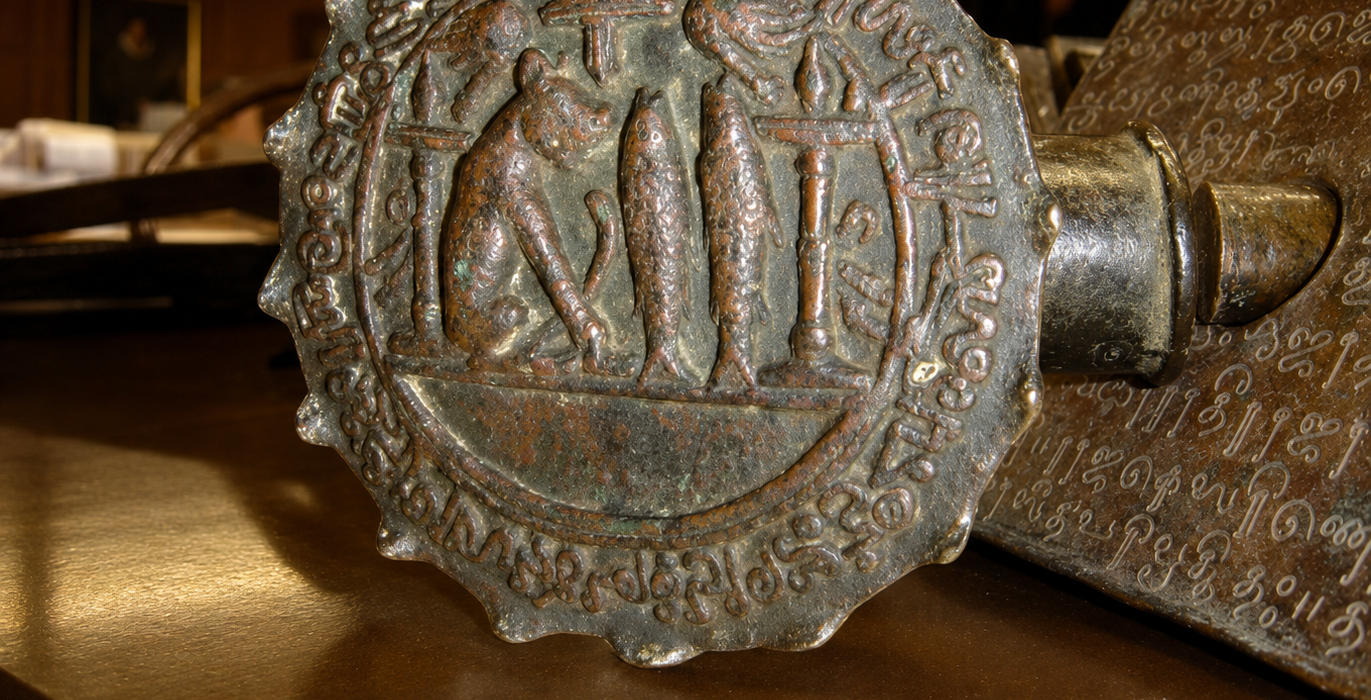
Anaimangalam Copper Plates: The Chola Charter That Connected India to the Maritime World
- May 18, 2026
- 0 Comment
There are moments when history does not merely survive — it returns.Not as a legend.
Not as folklore.
But as a memory engraved in metal.
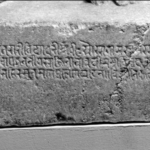
The Anaimangalam Copper Plates, widely known today as the Leiden Copper Plates, are among the most extraordinary surviving records of the Chola age. They are not merely inscriptions from medieval India. They are a civilizational archive, carrying within them the pulse of empire, maritime diplomacy, temple culture, administrative precision, and the cosmopolitan imagination of the Indian Ocean world.
For centuries, these copper plates remained far away from the land that created them, preserved in the collections of Leiden University Library. Yet their story never truly left India. It survived in epigraphy, in Tamil historical memory, in scholarship, and even in literature, quietly echoing through the pages of Ponniyin Selvan.
And now, with their restitution to India, the Anaimangalam Copper Plates have become more than an archaeological artefact.
They have become a symbol of historical return.
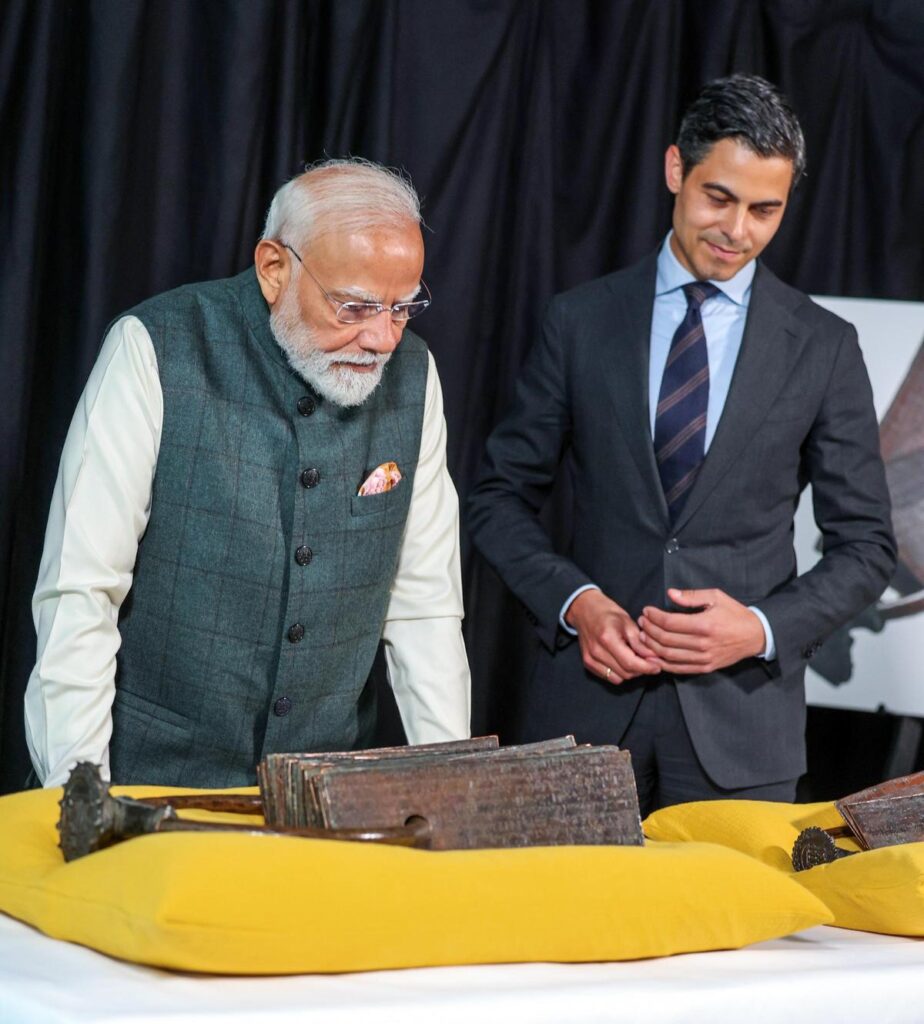
Quick Facts: Anaimangalam Copper Plates
| Aspect | Details |
| Also Known As | Leiden Copper Plates |
| Dynasty | Chola Empire |
| Period | 11th Century CE |
| Issued By | Rajendra Chola I |
| Original Grant | Associated with Chudamani Vihara |
| Languages Used | Sanskrit and Tamil |
| Scripts | Grantha and Tamil |
| Material | Copper plates bound with bronze seal |
| Historical Importance | Maritime diplomacy, Buddhist patronage, Chola administration |
| Preservation History | Held for centuries in Leiden, Netherlands |
| Repatriation | Officially restituted to India in 2026 |
The Anaimangalam Copper Plates and the Oceanic Imagination of the Cholas
Modern maps often make us imagine ancient kingdoms as land-bound powers.
But the Cholas looked outward, toward the sea.
The Anaimangalam Copper Plates reveal this maritime imagination with astonishing clarity.
At the heart of the inscription lies a royal grant connected to the village of Anaimangalam and the famous Buddhist institution known as the Chudamani Vihara at Nagapattinam. The plates record that in the 21st regnal year of Rajaraja Chola I, lands and revenues were granted for the maintenance of a Buddhist monastery established by a ruler from Srivijaya in Southeast Asia.
That single detail transforms our understanding of medieval India.
This was not an isolated kingdom.
This was a connected civilization.
The Bay of Bengal was not a boundary. It was a corridor.
Ships moved across it carrying:
- monks,
- merchants,
- diplomats,
- inscriptions,
- luxury goods,
- and ideas.
Nagapattinam itself emerged as one of the great cosmopolitan ports of the Indian Ocean world — where Tamil merchants, Buddhist pilgrims, Southeast Asian envoys, and sacred institutions coexisted within a thriving maritime network.
The copper plates preserve the administrative memory of that world.
Why the Anaimangalam Copper Plates Matter Today
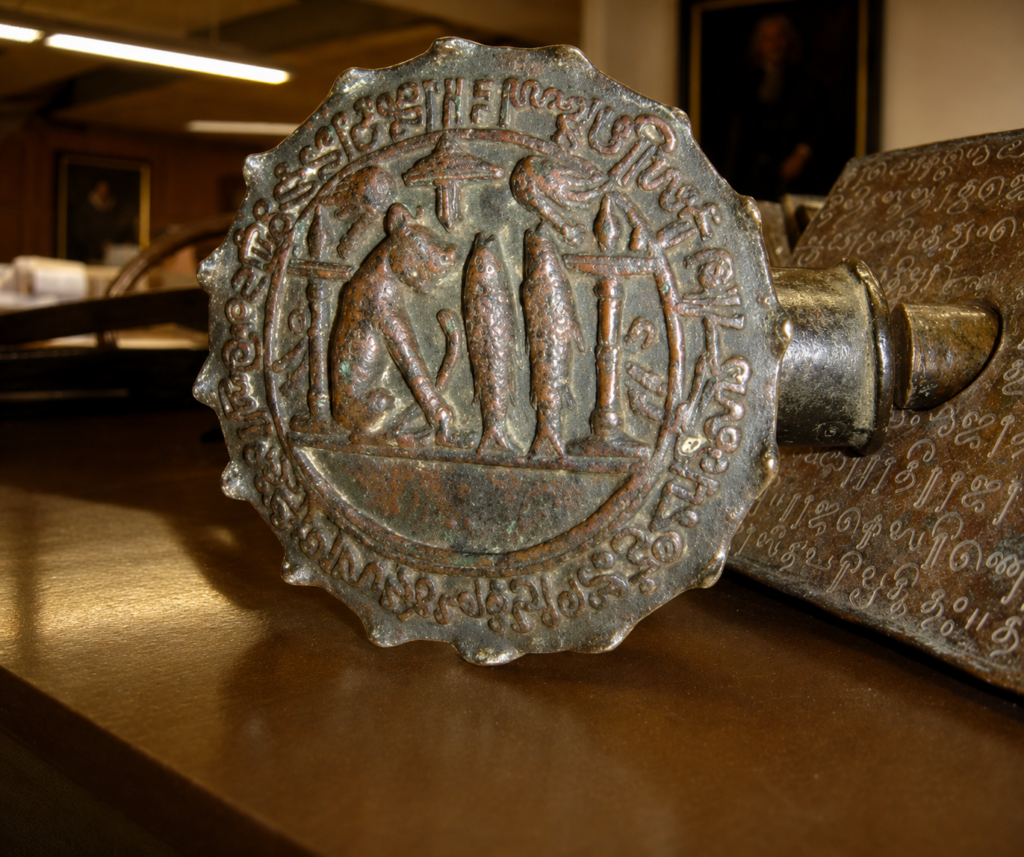
The importance of the Anaimangalam Copper Plates goes far beyond epigraphy.
They challenge several modern misconceptions about premodern India.
For decades, colonial narratives portrayed medieval India as fragmented, chaotic, and poorly documented. But the Chola inscriptions reveal something entirely different:
- highly structured administration,
- multilingual statecraft,
- maritime diplomacy,
- revenue systems,
- archival continuity,
- and institutional patronage.
The plates demonstrate how governance operated through carefully recorded legal and fiscal mechanisms.
The process itself was sophisticated:
- Royal commands were issued verbally.
- Recorded on palm-leaf manuscripts.
- Permanently engraved on copper.
That transition — from speech to inscription — reflects a civilizational understanding of memory and legitimacy.
The state understood that dharma had to be documented.
Rajaraja Chola and the Sacred Cosmopolitanism of the Cholas
Perhaps the most extraordinary aspect of the Anaimangalam Copper Plates is what they reveal about Chola cultural confidence.
Rajaraja Chola I was among the greatest Shaiva rulers in Indian history — the builder of the monumental Brihadisvara Temple.
Yet the same ruler supported a Buddhist vihara associated with Southeast Asian patrons.
This was not a contradiction.
It was civilizational maturity.
The Chola world was deeply rooted in temple culture, yet expansive enough to support intellectual and religious networks beyond sectarian boundaries. Buddhism, Shaivism, trade guilds, Sanskrit learning, Tamil literary traditions, and maritime diplomacy all existed within the same political universe.
The Anaimangalam Copper Plates preserve that layered reality.
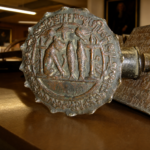
The Chola Seal: Sovereignty Engraved in Copper
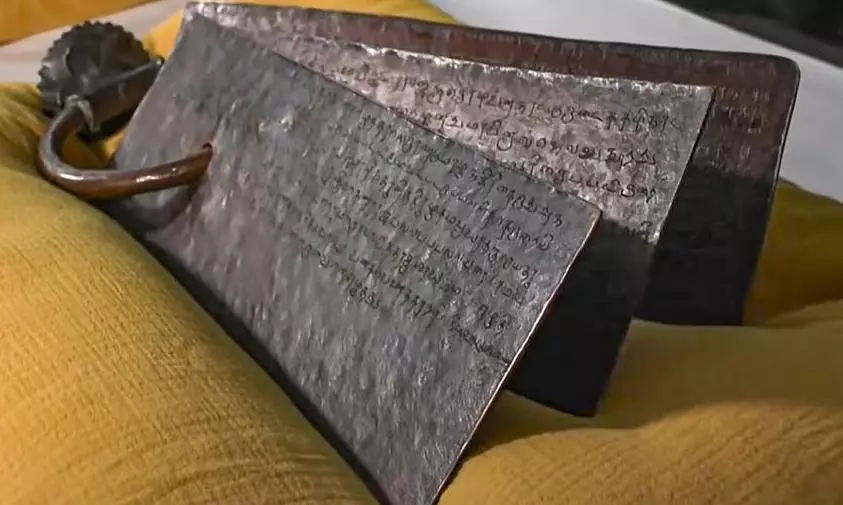
The physical structure of the Leiden Plates is itself magnificent.
The larger charter consists of:
- 21 copper plates,
- bound by a massive bronze ring,
- bearing the royal seal of Rajendra Chola I.
The seal includes iconic Chola symbols, including the tiger emblem.
These were not temporary records.
They were designed to survive centuries.
Even today, one can almost imagine the royal scribes engraving each line carefully into copper — aware that they were not merely recording administration, but preserving sovereignty itself.
The plates remind us that the Cholas were not only temple builders or conquerors. They were archivists of civilization.
Sanskrit, Tamil, and the Intellectual Ecology of the Chola World
One of the most fascinating dimensions of the Anaimangalam Copper Plates is their bilingual structure.
The Sanskrit section establishes cosmic legitimacy through genealogy and sacred lineage. It connects the Cholas to legendary rulers and solar dynasties.
The Tamil section becomes practical and grounded:
- land grants,
- tax structures,
- village boundaries,
- administrative officers,
- and revenue details.
Together, they reveal the multilingual intellectual ecology of medieval South India.
Sanskrit articulated universal kingship.
Tamil articulated local governance.
Neither displaced the other.
Both operated together.
This coexistence is one of the defining characteristics of Bharatiya civilization.
The Cholas and Southeast Asia: A Shared Maritime Civilization
The Anaimangalam Copper Plates also illuminate the deep relationship between South India and Southeast Asia.
The Srivijayan connection is especially important.
Before later military conflicts under Rajendra Chola, the Cholas and Srivijaya were connected through:
- diplomacy,
- trade,
- pilgrimage,
- Buddhist patronage,
- and maritime exchange.
The same ocean that later carried naval expeditions once carried monks and manuscripts.
History becomes richer when we resist reducing civilizations to warfare alone.
The Cholas were conquerors, yes — but they were also diplomats, patrons, navigators, administrators, and builders of transregional networks.
The Long Journey of the Leiden Plates
The journey of the copper plates themselves is almost cinematic.
The inscriptions eventually reached the Netherlands during the colonial period and remained in the collections of Leiden University for generations.
For scholars, the Leiden Plates became foundational to reconstructing Chola chronology and political history. Historians such as K.V. Subrahmanya Aiyer emphasized their immense value in correcting misconceptions about the Chola dynasty.
Yet beyond scholarship lies a deeper question:
Where does civilizational memory belong?
The repatriation debate surrounding the Anaimangalam Copper Plates is part of a larger global conversation about cultural heritage, colonial acquisition, and historical belonging.
In 2026, Leiden University formally restituted the plates to India.
It was not merely a transfer of objects.
It was the return of memory.
Why Repatriation Is About More Than Artefacts
A copper plate is not merely copper.
An inscription is not merely text.
Objects like the Anaimangalam Copper Plates carry:
- political memory,
- sacred geography,
- language traditions,
- artistic continuity,
- and civilizational identity.
Their return represents something larger than nationalism.
It represents restoration.
At the same time, the story of Leiden University also reminds us that preservation and scholarship matter. The ideal future is not isolation, but collaboration — where artefacts return home while digital archives, academic access, and international research continue to flourish.
The future of heritage lies not in possession alone, but in shared stewardship.
Explore Books on Chola History and Temple Civilization
Readers interested in exploring the intellectual and civilizational legacy of the Cholas in greater depth can explore our curated collection covering temple architecture, sacred geography, epigraphy, sculpture, mural traditions, and the living continuity of South Indian civilization.
The Three Great Living Temples
A richly curated journey into the monumental world of the Chola Dynasty, this premium hardcover volume explores the architectural and spiritual grandeur of:
- Brihadisvara Temple
- Gangaikonda Cholapuram
- Airavatesvara Temple
Blending sacred architecture, sculpture, murals, inscriptions, ritual traditions, and historical storytelling, the book reveals how these temples continue to embody the artistic brilliance and spiritual continuity of Bharatiya civilization.
Rather than treating these temples as frozen monuments of the past, the volume approaches them as living sacred spaces — where devotion, art, kingship, and memory still converge.
Focus Areas
- Chola temple architecture
- Sacred geometry and iconography
- Tamil inscriptions and epigraphy
- Shaiva traditions of South India
- Chola art and sculpture
- Ritual continuity in living temples
- UNESCO heritage temples of Tamil Nadu
- Civilizational history of the Cholas
For readers moved by the story of the Anaimangalam Copper Plates, this work becomes a natural continuation of that journey — from copper inscriptions and maritime diplomacy to the stone temples that still define the Chola imagination.
Step into a legacy that still breathes.
Bring home The Three Great Living Temples — and witness history that continues to live.
Browse the Collection:
The Three Great Living Temples
FAQ: Anaimangalam Copper Plates
The Anaimangalam Copper Plates are a set of 11th-century Chola inscriptions recording royal grants connected to the Chudamani Vihara at Nagapattinam. They are among the most important epigraphic sources for Chola history.
They are called the Leiden Plates because they were preserved for centuries at Leiden University in the Netherlands.
The inscriptions are associated primarily with Rajaraja Chola I and Rajendra Chola I.
They provide evidence for:
- Chola administration,
- maritime diplomacy,
- Buddhist patronage,
- multilingual governance,
- and India’s connection with Southeast Asia.
The plates demonstrate that medieval India possessed advanced systems of administration, archival preservation, taxation, legal grants, and international diplomacy.
Their restitution represents the return of an important civilizational artefact to India and contributes to broader global conversations about heritage repatriation.
A Civilization Remembered in Copper
The Anaimangalam Copper Plates endure because they are more than inscriptions.
They are evidence that memory can survive oceans.
They remind us that the Cholas were not only builders of temples, but builders of systems — of governance, exchange, diplomacy, and sacred continuity.
And perhaps that is why their return feels so deeply symbolic.
Because somewhere between copper and inscription, between Tamil and Sanskrit, between Nagapattinam and Leiden, between literature and archaeology — a civilization waited patiently to be remembered again.
For some, the story may begin in an archive.
For others, in a history book.
For many, perhaps, in the pages of Ponniyin Selvan.
But eventually, the journey leads here: