


01 / INTRODUCTION
Dhauli,
Thus Spoke Ashoka
Dhauli Hill or Dhauligiri is located on the left banks of river Daya, a tributary of Mahanadi, and situated about 10 km from Bhubaneswar. It is believed to be the location of the famous Kalinga war, where the banks of Daya would have provided a natural boundary line between the two armies. In Ashoka’s own words, as mentioned in his Rock Edict XIII, “One hundred and fifty thousand persons were thence carried away captive, one hundred thousand were there slain, and many times that number died.” Kalinga war holds a very important position in the Indian history, as after witnessing the bloodshed and massacre Ashoka laid down his arms to follow the path of dharma-vijaya (religious victory).
Markham Kittoee discovered the famous Ashokan edicts at Dhauli in 1833. Rock Edicts numbering I-X and XIV are found here. Edicts XI-XIII are replaced by two special edicts, known as Kaling Edict I and Kalinga Edict II. Edict XIII mentions about the Kalinga war and death toll in the same. It can be understood that Ashoka might not want this edict to be included in his newly conquered territory as refreshing memories about that deadly war would go against his political wishes. However, there is no specific reasons to believe why Edicts XI-XII were missed out at Dhauli as both are very secular in nature. In his pillar edicts, Ashoka mentions that his set of edicts were engraved as per the local requirements, sometimes in full and sometimes in brief, omitted in parts or full, and space available on the medium. This might be the case at Dhauli where few edicts were omitted to include extra and special two separate edicts.
The two separate Kalinga edicts are about specific instructions from Ashoka to his local officers and princes on maintaining their conduct in the newly conquered territory. In order to earn trust among his conquered subjects, Ashoka instructed his officers to avoid any harassment, unjust punishment, or forceful subjection. He announced that “All men are my children”, and like he wishes welfare and happiness for his own children, he wishes the same for all men, in this life and afterlife.
Ashoka was very conscious in his efforts to win trust over new territory. He ensured that his ministers (Mahamatras) carry out tours at regular intervals to keep check on how his instructions were followed by the local officers. He also asked his Prince Viceroys of Ujjaiyini and Takshshila to send inspectors every year ensuring that his instructions were being followed strictly by the local officers of Toshali and Samapa.
Toshali was earlier identified with Dhauli however after discovery of the fortified city of Sisupalgarh, the identification got changed. Antiquity of Sisupalgarh is established till 500 BCE and Dhauli being situated in vicinity might have enjoyed the status of a famous Buddhist center. This would have made Ashoka to engrave his edicts on Dhauli hill as large congregations would have been witnessed during various Buddhist festivals, specially during the days of Tishya constellation. Thus, Ashoka instructed his officers to read out this edicts during that period propagating the message to large mass.
Translation of Ashoka’s edicts can be read on below page links:
- Rock Edict I
- Rock Edict II
- Rock Edict III
- Rock Edict IV
- Rock Edict V
- Rock Edict VI
- Rock Edict VII
- Rock Edict VIII
- Rock Edict IX
- Rock Edict X
- Rock Edict XIV
- Kalinga Edict I
- Kalinga Edict II
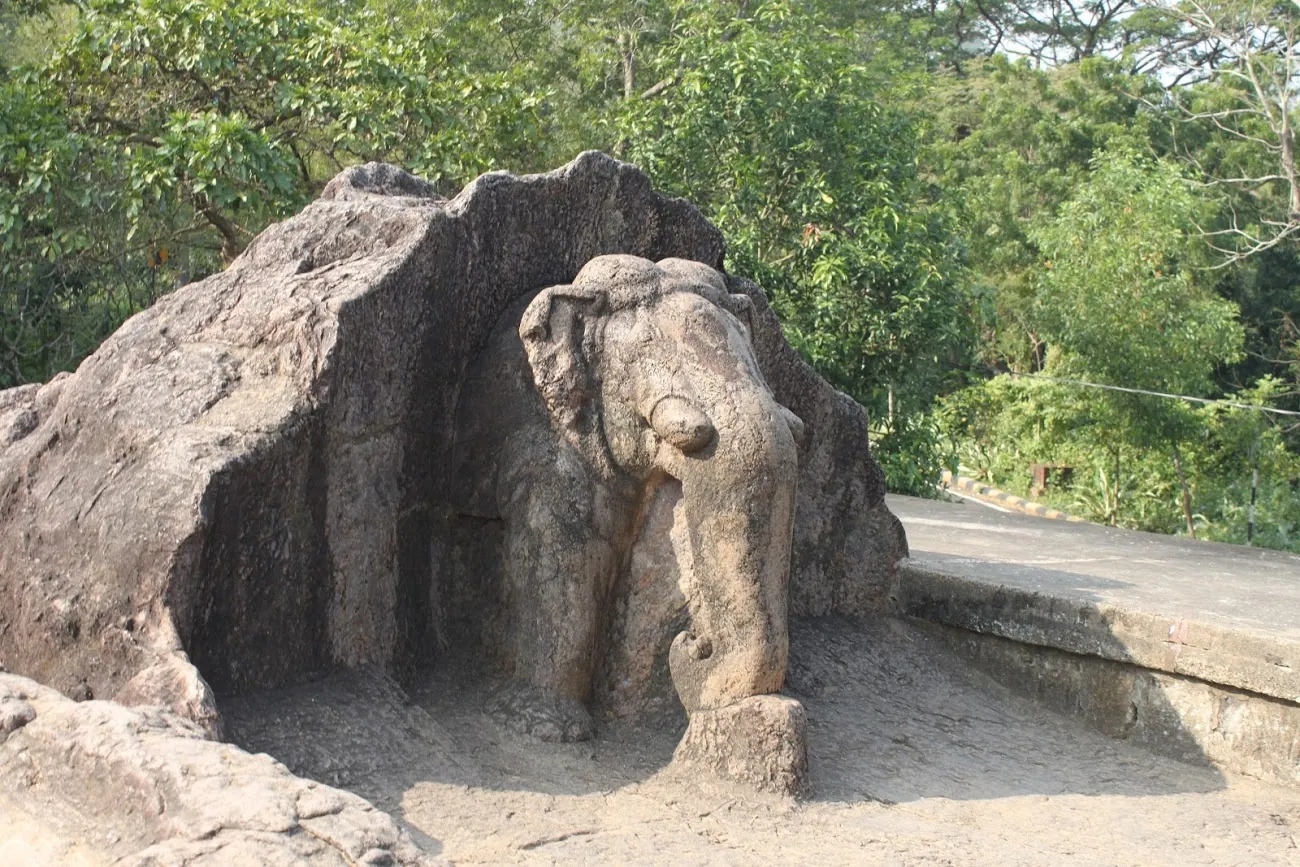
Next to these edicts, an elephant is carved out on a hill face, with only his foreparts, shown emerging out of the hill face. Elephant is one of the most sacred animal in the Buddhist pantheon. As per a legend, queen Maya, the mother of child Siddhartha (later known as Buddha), had a dream where she saw a white elephant entering into her womb. This was the sign that she conceived Siddhartha and thus the importance of elephant in Buddhist religion. This stone elephant is one among the oldest surviving specimen of Indian art, dating to the Maurya period. The posture of the animal, emerging out of a hill face, may be taken as the establishment and expansion of the Buddhist faith into this newly conquered territory.
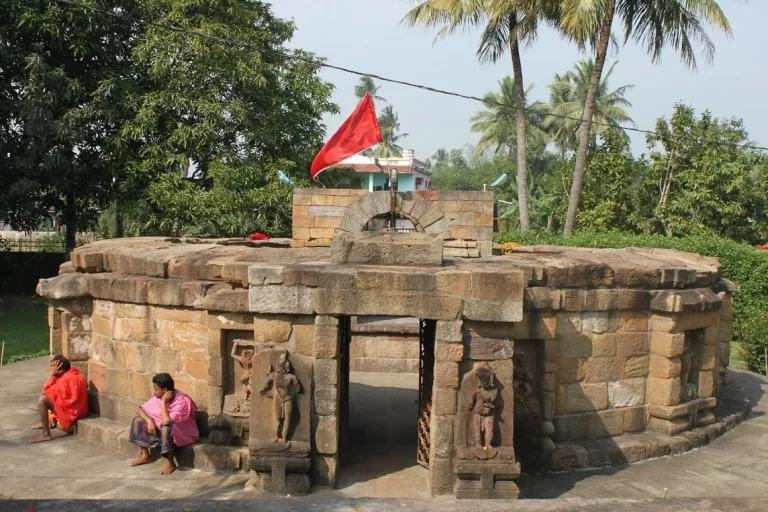
Dhauli hill consists of three short rocky ranges. The southern range is known as Ashvathama on which the famous Ashokan edicts are found. J D Beglar, who visited the place in 1875-76, mentions remains of a stupa on the flat terrace of this hill. R L Mitra in 1880 also mentioned the same and it appears that those remains were present till later 19th century CE.
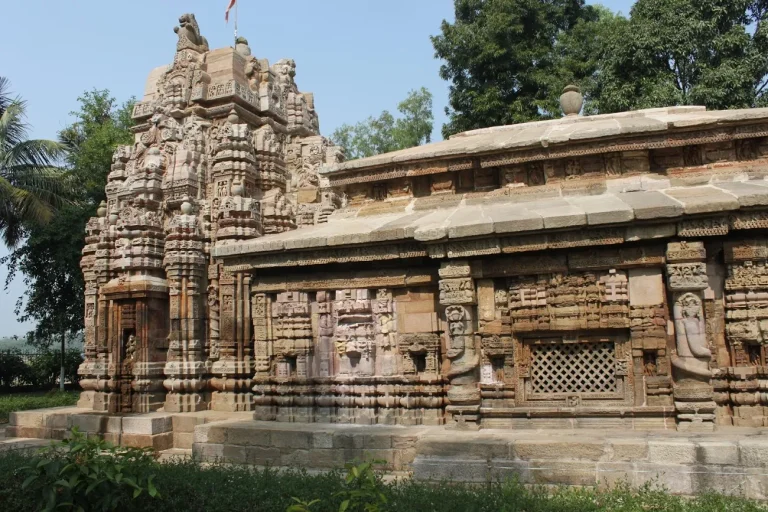
On the most prominent hill range of Dhauli stands the present Dhavalesvar Temple. It was built on the remains of an ancient temple dating to Bhaumakara period. Beglar assigned the temple of 5th century CE. Panigrahi is of opinion that the temple was contemporary with Lingaraja belonging to eleventh century CE.
A white Shanti Stupa, which stands majestically commanding a magnificent view of the Daya river below. This stupa was built in 1971-72 in collaboration between the Japan Buddha Sangha and the Kalinga Nippon Buddha Sangha. Various panels, around the periphery of the stupa, depict Buddha’s life episodes. On the way to the stupa stands a replica of Ashokan pillar.
Apart from the Ashokan edict, another important inscription is found at Dhauli. This inscription is found in one of the caves opposite to the Ashokan edict. The inscription belongs of the Bhauma-kara king Santideva and records construction of a temple named Arghyaka-Varati by Loyomaka of Viraja (modern Jajpur). The inscription is dated in the year 93 of an unknown era which most probably be corresponding to the Ganga era. R D Banerji assigns this inscription to 865 CE.
Translation of the inscription of Santikaradeva
(In) the year 93, (during) the reign of the illustrious Santikara-deva, this temple of Aghyaka-Varatiwas caused to be made as a gift by Bhatta Loyomaka, son of he physician Nannata (and) grandson of Bhimata, who was born of the womb of Ijya (and was) an inhabitant of Virajo.
02 / LOCATION & MAP
Place the story on the map.
PLACE THIS STORY ON THE MAP
Dhauli, Khordha district, Odisha
Odisha, India
ABOUT THIS FIELD ENTRY
From the Puratattva archive.
This article was first published on Puratattva (puratattva.in) and appears on Bharat Ke Wow with permission. Photographs are credited in their captions.
Read the original entry ↗